How Arbitrage Betting Works When Bookmakers Disagree
2026-09-18 · 21 min · 4,154 words
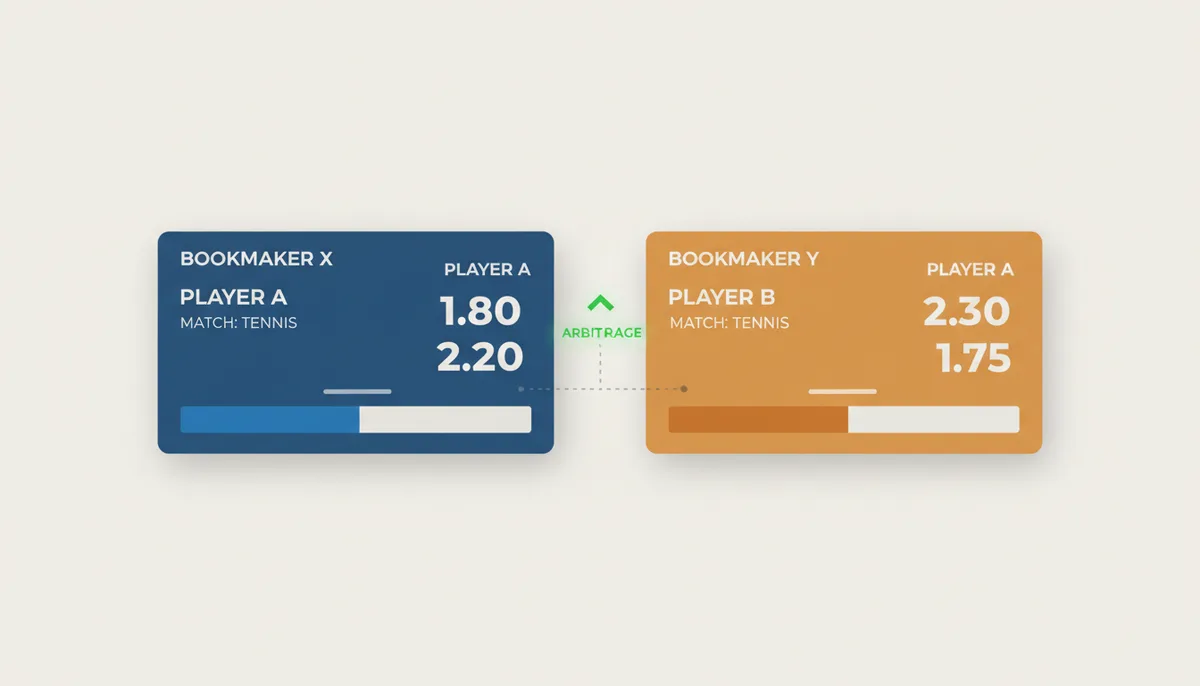
Two bookmakers, same tennis match, opposite mistakes. One site has Player A at 2.10 to win; another has Player B at 2.05. If you back both in the right proportions, you return roughly £103.70 for every £100 staked — before a ball is struck. That gap, small and boring and mathematically locked, is the entire premise of arbitrage betting.
Most people who hear about it react in one of two ways: either it's a scam, or it's free money. It's neither. Arbing is a trading method that exploits pricing disagreements between competing bookmakers, and like any trading method it comes with execution risk, capital requirements, and opponents who actively try to stop you. This guide walks through the actual math, the step-by-step execution, where opportunities come from, and the risks that the "risk-free" marketing always skips.
Why is 'guaranteed profit' possible in a world built on chance?
A normal punter wins by predicting the future. An arbitrage bettor wins by finding two merchants who disagree about the present. That's the fundamental difference: you are not gambling on an outcome, you are buying all outcomes of an event at a combined price below their fair value. Whether the event itself is random is irrelevant — you've removed the event from the equation.
Think of it like currency exchange. If one bureau sells euros at £0.84 and another buys them at £0.86, you can sell to one and buy from the other until the gap closes. You haven't predicted anything about the euro. You've just noticed two shops with different prices and moved faster than they did.
Sports betting creates these gaps constantly because bookmakers are independent competitors, not departments of one company. More than a hundred licensed operators price the same football match on a Saturday afternoon. They use different models, hold different liabilities, and update at different speeds. Most of the time their odds are close cousins. Occasionally — for a few minutes — they're far enough apart that backing every outcome across multiple books returns more than 100% of your stake.
Set your expectations correctly, though. Typical arbs return 1–5% on turnover. That sounds tiny until you multiply it by dozens of opportunities a week and account for the fact that returns compound on a rolling bankroll. But the margins also mean sloppy execution — a misplaced decimal, a bet placed at the wrong stake, an odds shift you didn't notice — wipes out a dozen successful arbs in one mistake. This is a methodical, spreadsheet-driven activity. Treat it like a part-time job with a brokerage account, not a lottery, and you have a chance of doing well.
How bookmakers' odds create an arbitrage opportunity
Start with how a single bookmaker makes money, because arbitrage is simply that mechanism inverted.
Decimal odds convert directly into implied probability: divide 1 by the odds. Odds of 2.00 imply a 50% chance; odds of 1.50 imply 66.7%. (I'll use decimal odds throughout — they make the math visible. American +150/-200 and fractional 3/1 notation are just different clothes on the same numbers.)
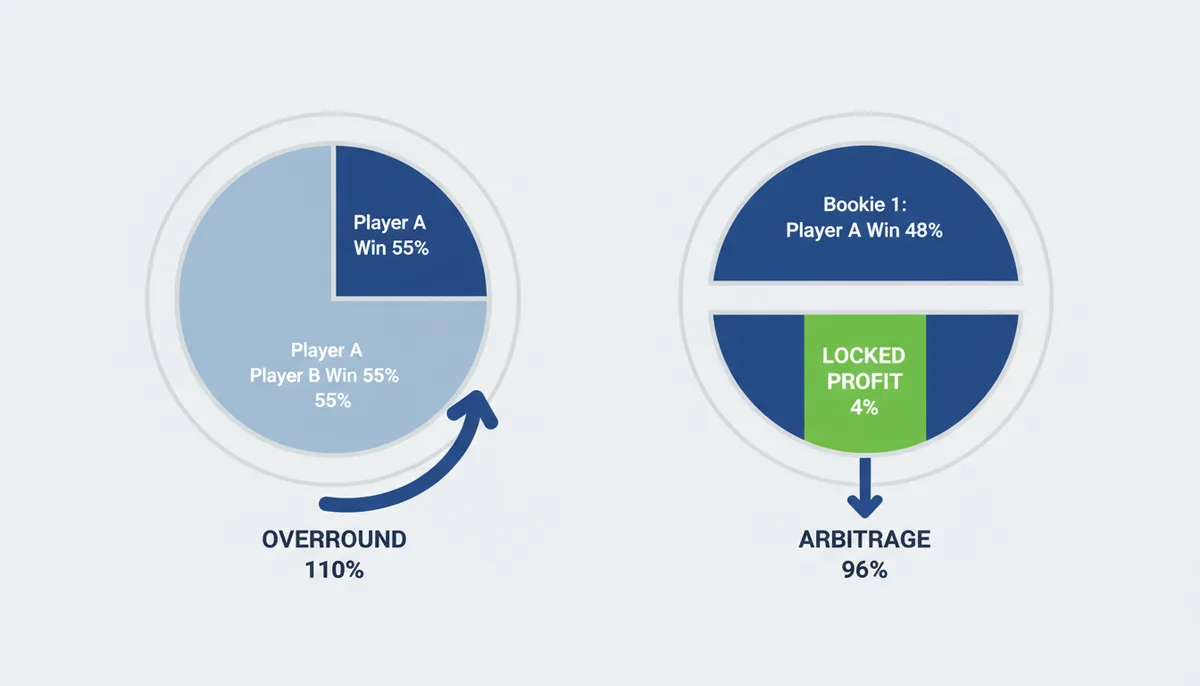
A bookmaker sets odds on every outcome of an event. If those odds reflected pure probability, the implied probabilities would sum to exactly 100%. They don't. A book might price two tennis players at 1.85 and 1.90. That's 54.05% + 52.63% = 106.68%. The extra 6.68% is the overround — also called the vigorish, the vig, or simply the margin. It's the built-in edge that lets the book profit over time regardless of who wins, as long as bets arrive in roughly the right proportions.
Arbitrage is the overround running in reverse. No single book will quote a book below 100% — that would be handing out free money. But if you combine the best price on each outcome from different books, the combined implied probability can drop below 100%. Back Player A at Bookmaker 1 (48% implied) and Player B at Bookmaker 2 (48% implied), and you've bought a 100% event for 96% of its fair price. The missing 4% is your locked profit, split proportionally across both outcomes.
One nuance worth understanding: an individual bookmaker's book being over 100% doesn't guarantee them profit on any single event — it guarantees them an edge. If their customers bet lopsidedly, the book can still lose on that match. That's exactly why bookmakers move their odds: to balance incoming money, not just to reflect probability. And those movements, made independently by dozens of firms, are what create and destroy arbs all day long.
The formula for finding and calculating an arb
The test for an arbitrage opportunity is one line of arithmetic:
Arbitrage % = (1 / Odds A) + (1 / Odds B) + (1 / Odds C) + ...
Sum the reciprocals of the best available odds for every outcome. If the total is below 1, an arb exists. Your guaranteed profit margin is (1 / Arbitrage %) − 1, expressed as a fraction of total stake.
Two-way example. Bookmaker A offers Over 2.5 goals at 2.10. Bookmaker B offers Under 2.5 at 2.05.
- Over: 1 / 2.10 = 0.4762
- Under: 1 / 2.05 = 0.4878
- Total: 0.9640 — below 1, so this is an arb
- Margin: (1 / 0.9640) − 1 = 0.0373, or about 3.7%
Now distribute a £100 total stake so each outcome returns the same payout. The formula for each leg:
Stake = (Total Stake × (1 / Odds)) / Arbitrage %
- Over stake: (100 × 0.4762) / 0.9640 = £49.40
- Under stake: (100 × 0.4878) / 0.9640 = £50.60
If Over wins: 49.40 × 2.10 = £103.74. If Under wins: 50.60 × 2.05 = £103.71. Either way you collect roughly £103.70 on £100 staked — £3.70 profit, no opinion required. (The penny difference is rounding; calculators handle it, or you tilt a few pence toward the outcome you'd rather win.)
Three-way example. Football's 1X2 market — home win, draw, away win — is where most real arbs live, because three outcomes across three different books diverge more often than two. Say the best prices you can find are Home at 2.60, Draw at 3.50, Away at 3.30, each at a different bookmaker:
| Outcome | Bookmaker | Decimal Odds | Implied Probability (1/odds) | Stake (£100 total) | Payout | Profit |
|---|---|---|---|---|---|---|
| Team A wins (Home) | Bookmaker A | 2.60 | 38.46% | £39.51 | £102.73 | £2.73 |
| Draw | Bookmaker B | 3.50 | 28.57% | £29.35 | £102.73 | £2.73 |
| Team B wins (Away) | Bookmaker C | 3.30 | 30.30% | £31.13 | £102.73 | £2.73 |
| Total | — | — | 97.33% | £100.00 | — | £2.73 (2.73%) |
The combined book is 97.33% — you're buying a 100% event for 97.33% of its value, and the 2.73% difference lands in your pocket regardless of the result.
Two practical notes. First, nobody does this arithmetic by hand in modern practice; an arbitrage calculator ingests the odds and spits out stakes instantly — SorteCalc's arbitrage calculator does exactly this, and its dutching logic (dutching is the same stake-splitting technique, just the general name for equalizing returns across selections) handles 2-way, 3-way, and larger books. Second, the exact stakes a calculator produces — £39.51, £29.35 — look nothing like how a normal punter bets. That has consequences we'll get to in the risks section.
How to place an arbitrage bet step-by-step
The math is the easy part. Execution is where arbs live and die, because every number you just calculated assumes you get the odds you saw. Here is the sequence, in the order that minimizes damage:
- Find the arb. From a scanner alert or manual comparison, note the odds, the bookmakers, and the exact market (e.g., "Full Time Result" — not "To Win," not "90 Minutes Plus Extra Time").
- Verify the odds manually. Open both bookmakers directly and confirm the prices on their sites. Scanners lag; a displayed 2.10 may now be 2.00, which kills the arb.
- Open bet slips for every leg in separate tabs. Logged in, accounts funded, selections added to slips but not placed. You want zero navigation left between you and the confirm button.
- Calculate exact stakes. Feed the verified odds into your calculator. If a leg has a stake limit — more common than you'd think — recalculate for the actual stake you can place, or walk away.
- Place the soft bookmaker's leg first. The soft book is the one with the outlier price — the mistake. It's the price most likely to change or be pulled, so you capture it first. Always.
- Wait for confirmation. Not "submit." Confirmation. The bet slip must return a success message or appear in your open bets. A flash of the odds changing mid-submission means you need to see what price you actually got.
- Only then place the hedge leg(s). The sharp book or exchange side — the "correct" price — moves less and suspends less. Get it placed, get it confirmed.
- If leg one fails, reassess before doing anything. Either re-run the calculator at the new odds (accepting a smaller arb or a small locked loss) or hedge at the current market to exit. Never place leg two "at whatever" and hope.
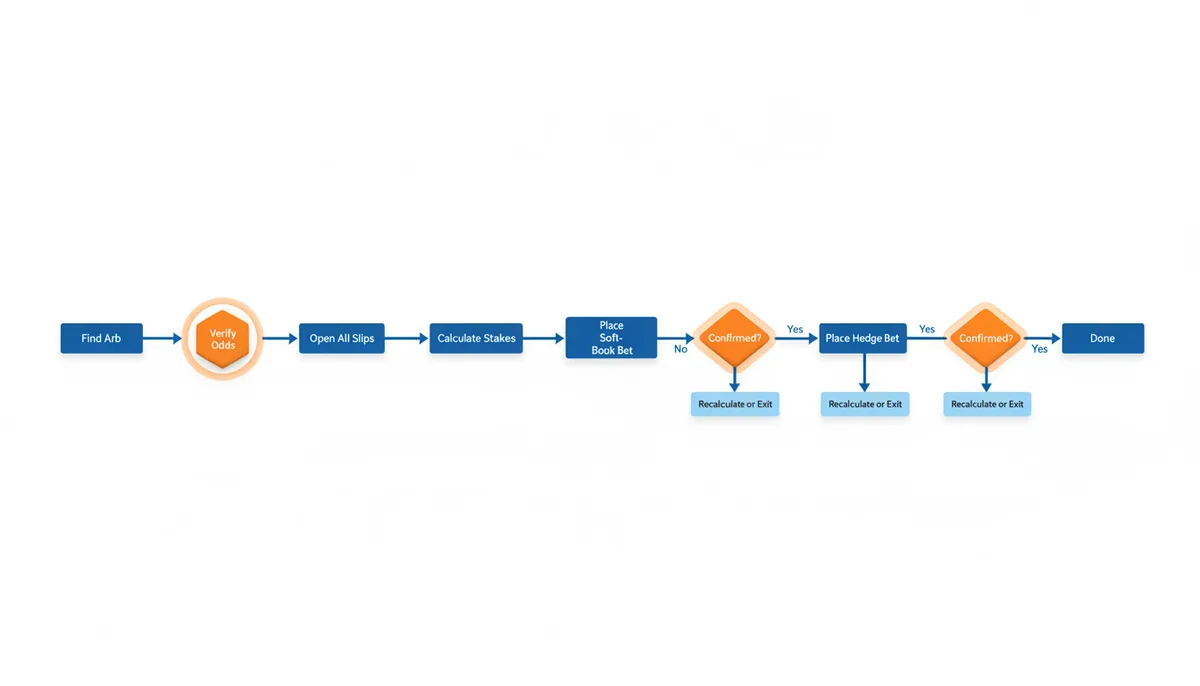
Why soft-side-first is non-negotiable: the soft book's price is the anomaly, and anomalies get corrected — by the book's own traders or by the weight of arbers hitting it. The sharp side (a low-margin book or an exchange) is broadly where the market agrees the price should be; it may drift, but it rarely snaps. If you place the hedge first and the soft price vanishes, you're holding a naked bet you never wanted, sized for an arb that no longer exists. I've watched people learn this exactly once.
One more operational point: your money has to already be there. An arb that lasts four minutes cannot wait for a card deposit to clear. Professionals keep bankroll pre-distributed across a dozen-plus accounts, with e-wallets like Skrill or Neteller as the transfer pipe between book and bank, because those move in hours rather than days. Capital sitting in your bank account earns nothing and captures nothing.
Where arbitrage opportunities actually come from
Bookmakers split into two broad tribes, and arbing lives in the gap between them.
Sharp bookmakers — Pinnacle is the textbook example — run thin margins (a couple of percent on major markets), accept winners, and update prices aggressively. Their odds are the market's best estimate of true probability. Betting exchanges like Betfair play a similar role: peer-to-peer matching with a commission, prices set by crowds, usually tight to fair.
Soft bookmakers — the big recreational brands, Bet365 and its peers — run fatter margins, cater to casual punters, and move slower. Their odds are management decisions as much as market prices: they shade prices toward popular teams, pad margins on favourites, and react to news on their own schedule. The soft book is nearly always the source of the arb's outlier price; the sharp book or exchange is nearly always the hedge.
The specific causes, in rough order of frequency:
- Slow reaction to information. A starting-eleven leak, a goalkeeper injury in warm-ups. Sharps re-price in seconds; a soft book might take ten minutes. Ten minutes of arb.
- Weight of money. A book shortens a popular side because customers keep backing it, not because the probability changed. The other side of its market drifts out of line with the market.
- Genuine model disagreement. Two pricing teams, two different numbers for the same event. On obscure leagues — third-tier Scandinavian football, challenger tennis — this happens constantly, which is why obscure leagues are arb country.
- Promotions and odds boosts. A book pushes one price above fair value as marketing. Occasionally the boost alone creates the arb against the sharp price.
- Pricing errors. A trader maps the wrong line, fat-fingers a digit, quotes 5.0 where the market is 2.2. These are the juiciest arbs and — as the next section explains — the most dangerous ones.
How long do arbs last? Pre-match, usually minutes, not hours. In-play, frequently seconds. And the arbers themselves are the correction mechanism: every £500 that hits the outlier price nudges it toward the market, until the gap closes and the scanner stops showing it. You're not just racing the bookmaker. You're racing every other arber who got the same alert.
The real risks that make arbing not 'risk-free'
"Risk-free" is the single most expensive phrase in this hobby. The arbitrage profit is mathematically locked only if all your bets stand at the agreed odds and all bookmakers honour them. Three things routinely break that assumption.
Palpable errors ("palps"). Bookmakers' terms allow them to void bets priced at obviously incorrect odds — the classic case is a misplaced decimal, like 26.0 instead of 2.60. If the soft leg of your arb gets voided after the event goes in-play or settles, you're left holding the hedge as an ordinary bet, often at a loss. Regulators generally side with books on genuinely obvious errors; in the UK you can escalate disputes to IBAS, but "the price was clearly a typo" is a defence books win more often than you'd like. Treat any arb larger than about 8–10% with suspicion — abnormal size is itself the tell. I stick to the 1–5% herd.
Execution risk. Odds move between leg one and leg two; bet limits reject your stake ("maximum £37 accepted"); the exchange side has insufficient liquidity at your price. Each of these converts your setup into an open position you didn't plan. The mitigation is assembly-line preparation: both slips open, stakes pre-calculated, limits checked in advance, hedge sized with a buffer for partial fills.
Account restrictions ("gubbing"). This is the strategic risk, and it ends most arbers' careers at each book in months, not years. Bookmakers profile customers: stakes like £39.51 and £29.35, on outlier prices only, with instant withdrawals — that's an arber's signature, and the response is a stake cap of pennies or a closed account. Defenses are behavioral: round your stakes (£40, £30), throw in the occasional normal accumulator, avoid betting exclusively when the price is the market's biggest outlier, and spread action across many books so no single account looks pure. Accept the trade-off — every one of those defenses slightly dilutes your edge, but they extend account lifespan, and account lifespan is the true limiting factor on your long-run profit.
| Risk | How to identify it | What can go wrong | Mitigation strategy |
|---|---|---|---|
| Palpable error | One book's price beats the second-best market price by an absurd margin (e.g., 5.0 vs a 2.2 market) | Book voids the soft leg after placement or settlement; your hedge becomes a straight gamble and you can incur a loss | Skip arbs with suspiciously large percentage returns; favour the 1–5% range and avoid obvious misprices |
| Odds change mid-placement | Price shortens between the scanner alert and your bet slip; the on-site price no longer matches the scanner | Arb shrinks or vanishes after leg one is placed; you may be left with an under-hedged position or a locked loss | Place the soft leg first, pre-fill all slips, re-verify odds on-site, and decide your maximum acceptable loss exit in advance |
| Stake limitation | Book rejects the bet or shows "max stake £X" at slip stage or on the market page | You cannot cover the required hedge size; the position is left open or under-hedged, increasing exposure | Check limits before placing leg one; recalculate stakes to fit available limits; use exchanges for big hedge legs |
| Account restriction (gubbing) | Stakes suddenly capped to pennies, repeated low limits, or a closure email after a run of precise-amount bets | Fewer soft books to shop; reduced capacity to place arbs and diminished long-term profitability at that bookmaker | Round stakes to whole numbers, mix in occasional standard bets, spread volume across many books, and accept slightly diluted edge for longer account lifespan |
The tools professional arbitrage bettors use
Four categories make up the toolkit: comparison sites for manual hunting, scanning software for automation, exchanges for the hedge leg, and a calculator for stake splitting.
Odds comparison sites aggregate prices across books on one page. You can find arbs manually — line up Home, Draw, Away best prices and run the formula — but the coverage is limited to major books and by the time you spot the discrepancy, it's often gone. It's how you learn; it's not how you scale.
Arb scanners poll dozens of bookmakers continuously and alert you when combined books fall below 100%. Free scanners exist and are fine for practice, but they typically run delayed feeds (minutes behind live) and cover a handful of books — in a business where opportunities die in minutes, a delayed feed is a museum of dead arbs. Paid scanners run near-live feeds, cover dozens of operators, filter by margin and market, and unlock in-play arbing. That subscription is the cost of being first instead of tenth.
Betting exchanges (Betfair and its rivals) serve three roles: a sharp hedge leg, a liquidity source when book limits block you, and a "lay" mechanism — betting against an outcome — that turns any two-outcome arb into a back-vs-lay pair. Factor commission into your arb math; a 2–5% commission on winnings eats thin margins if you ignore it.
E-wallets keep the machine oiled. Skrill and Neteller move money between book and wallet far faster than bank transfers, which matters when a soft account needs reloading mid-session. One caution: many books exclude e-wallet deposits from sign-up bonuses, so decide per account whether you're farming the bonus or the arbs. Rarely both.
And the calculator — whatever you use, SorteCalc's arbitrage calculator or a spreadsheet you've built — should be second-nature before real money moves. Stake math done in your head under time pressure is how £39.51 becomes £39.15 and the arb becomes a silent loser.
| Tool type | Cost | Data speed | Bookmakers covered | Pre-match arbs | In-play arbs | Typical user |
|---|---|---|---|---|---|---|
| Manual search (odds comparison site) | Free | Slow — you verify every book yourself | 10–20 major books | Yes | No | Beginner learning the math |
| Free arb scanner | Free | Delayed feeds, often several minutes behind | A handful of books | Yes | Rarely | Casual arber testing the water |
| Paid (subscription) scanner | Monthly subscription | Live or near-live odds feeds | Dozens of books, plus exchanges | Yes | Yes | Serious part-timer or professional |
Advanced arbs: middles, sharbing, and in-play
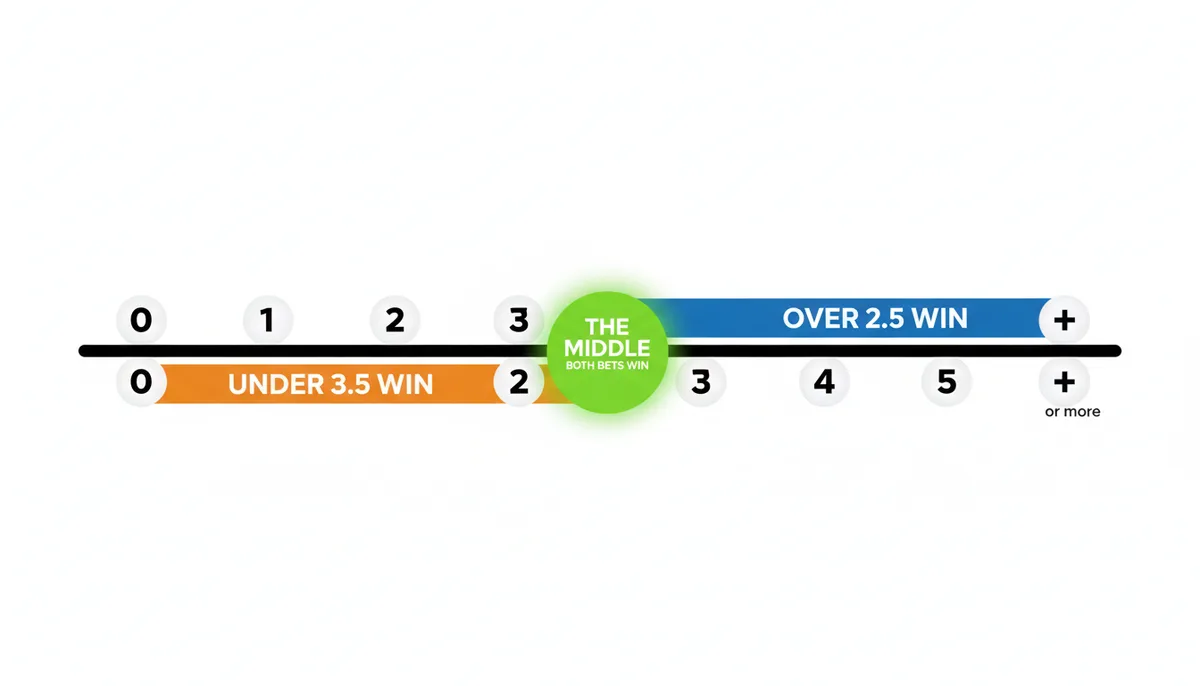
Middles invert the arb logic in a way worth understanding. Take totals: Over 2.5 goals priced at 2.10 at one book and Under 3.5 goals at 1.95 at another. The combined book is 47.6% + 51.3% = 98.9% — a 1.1% loss if you split stakes evenly. But notice the overlap: if the match finishes with exactly 3 goals, Over 2.5 wins and Under 3.5 wins. You've paid 1.1% for a lottery ticket that pays roughly 100% when it lands. Middles are not guaranteed profit — they're a cheap premium on a specific scoreline, and the mismatch between the tiny certain cost and the large conditional payoff is what draws experienced traders. The middle window (here, exactly 3 goals) gets wider when the lines differ more, and narrower-but-cheaper when they're closer.
Sharbing — shop arbing — is the offline cousin. Physical betting shops print coupon odds once, often in the morning, and can't re-tailor them until the next print run. An arber backs the stale coupon price in-store and lays it off online at the true market price. It works because paper moves slower than servers. The catch is equally physical: shops enforce low stake ceilings, regulars get recognized, and a betting slip with three-figure precision looks very different from a shop punter's tenner.
In-play arbing is where the volume is. Live prices swing on every shot and booking, margin disagreements between books spike constantly, and scanners show multiples of the pre-match arb count. It's also where every risk in this article intensifies: odds suspend mid-click, acceptance delays of several seconds get built in, palp-voiding happens more often, and the soft leg can be obsolete before your slip even loads. My position: run pre-match only until your execution is automatic — months, not weeks — then add in-play on liquid markets with small stakes while you learn the latency.
Frequently asked questions
How much money do I need to start arbitrage betting?
You can run your first arbs on a few hundred pounds spread across two or three bookmakers, and that's a sensible paid education. But to operate properly — absorbing voided legs, holding hedges on exchanges, catching several arbs a session — a working bankroll of £1,000–£2,000 is more realistic. The deeper point isn't the total, it's the distribution: money you can't deploy at the right book in the right minute earns nothing. Plan on splitting your roll across at least five to ten accounts from the start, and accept that some of it will sit idle waiting for its book's prices to drift out of line.
Is arbitrage betting legal in the UK/US/EU?
Placing bets with licensed bookmakers at their own posted odds is legal wherever betting itself is legal — the UK and most of the EU included, and in the US wherever state law permits sports betting (which varies state by state). What arbing is not is welcome. Virtually every bookmaker's terms and conditions let them restrict or close your account for it, void obvious misprices, and cap your stakes — all legally. So the honest answer: you'll never get in legal trouble for arbing, but the bookmaker doesn't have to keep doing business with you, and mostly they won't.
How much profit can I realistically make?
Individual arbs return roughly 1–5% of total staked, with the bulk of healthy volume clustering at the low end. What that compounds into depends on bankroll, volume, and speed: someone running sessions most evenings, recycling a bankroll of a couple of thousand through dozens of weekly arbs, might aim for a 5–10% monthly return on their active roll in good stretches. That is an aim, not a wage — voided bets, slippage, gubbed accounts, and dead weeks all take their cut. Anyone advertising a guaranteed monthly figure is selling you something.
Why don't all bookmakers just use the same odds to prevent this?
Because they're competitors with different incentives, not a cartel with a shared spreadsheet. Each book sets prices from its own models, its own liabilities (a book drowning in Home money shortens the Home price), and its own margins: sharps run thin and move fast, soft books run wide and move slow. Even if they wanted to align — which they don't, since pricing is a competitive weapon — they'd have to match in real time across thousands of markets, and the arbs you see are precisely the moments where the market's correction lag is longest. Prices converge; arbitrageurs simply collect the toll while convergence is in progress.
What happens if a bookmaker cancels one of my bets?
Then you no longer have an arb — you have an ordinary bet, probably the hedge side, at a price that no longer makes sense. Two options. Let it run as a gamble, which occasionally wins but has negative expected value on average. Or trade out: find the best available opposite price (usually a shade worse than your voided leg) and lock in a small loss, typically a few percent of stake. Most experienced arbers take the small locked loss every time; the whole point of the discipline is refusing variance you didn't price in. Log every void — if one book voids repeatedly, it goes to the back of your rotation.
Can I do arbitrage betting on my phone?
Practically, no, and the failures are expensive when they come. Arbing demands simultaneous verified odds on two or more sites, a stake calculator, and two bet confirmations inside a window that may last a couple of minutes — that's juggling three apps with session timeouts and odds refreshes fighting you the whole way. A desktop with multiple windows, kept logged-in accounts, and the calculator open is the minimum viable setup. Your phone is fine for monitoring alerts; treat it as the pager, not the trading desk.
Sources
- UK Gambling Commission — Claims regarding the legality of betting practices in the UK and the right of operators to manage business risk (e.g., closing accounts).
- International Betting Integrity Association (IBIA) — Information on market integrity, how bookmakers manage odds, and the industry perspective on suspicious betting patterns.
- Pinnacle - Betting Resources — Expert articles explaining concepts like vigorish, how odds are made, and why Pinnacle has a 'winners welcome' policy, which is relevant to the sharp vs. soft bookmaker discussion.