Blackjack House Edge: The Rule Changes That Move the Number
2026-11-07 · 15 min · 2,801 words
Why Don't All Blackjack Tables Have the Same Odds?
Imagine walking into a casino and seeing two blackjack tables side by side. Both have the same minimum bet, the same dealer, and the same number of players. Yet one table has a house edge of 0.4%, while the other sits at 2.2%. That 1.8% difference isn’t a fluke—it’s the result of rule variations that casinos use to shape the game. The house edge in blackjack isn’t a fixed number; it’s a moving target determined by a specific mix of rules. Understanding these differences is how you turn a game of chance into a game of strategy.
For example, a table paying 3:2 for a natural blackjack (like a $10 bet winning $15) versus one that pays 6:5 (a $10 bet winning $12) changes the math dramatically. Similarly, whether the dealer hits or stands on a soft 17, or if you’re allowed to double down after splitting, can shift the edge in the casino’s favor—or yours. These aren’t just trivia points; they’re the tools you need to pick the best game in the house.
What Does the House Edge Mean for Your Bankroll?
The house edge is the casino’s average profit from your bets, expressed as a percentage. If a table has a 0.5% edge, for every $100 you wager, the casino expects to keep $0.50 over time. That might seem trivial, but over hours of play, it adds up. Let’s say you bet $10 per hand and play 60 hands an hour. At a 0.5% edge, your theoretical loss is $3 per hour. At a 2.0% edge, that jumps to $12. The difference isn’t just numbers—it’s the difference between walking out with your bankroll intact and watching it shrink.
But the house edge is a long-term average. In the short term, you might win big or lose fast. Variance is the wild card here. A 0.5% edge doesn’t mean you’ll win 99.5% of your bets—it means that, over thousands of hands, the casino’s profit will trend toward 0.5%. The key is to choose games where that trend works in your favor.
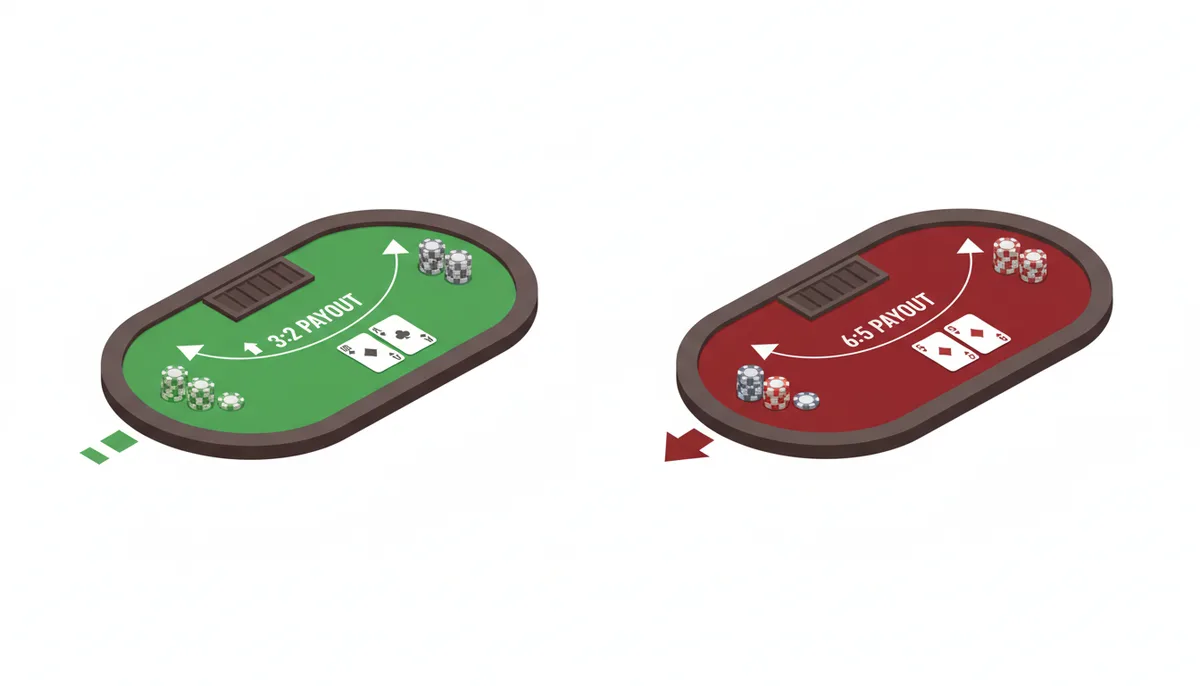
The Payout Rule: Why Is '6:5' the Worst Sign in a Casino?
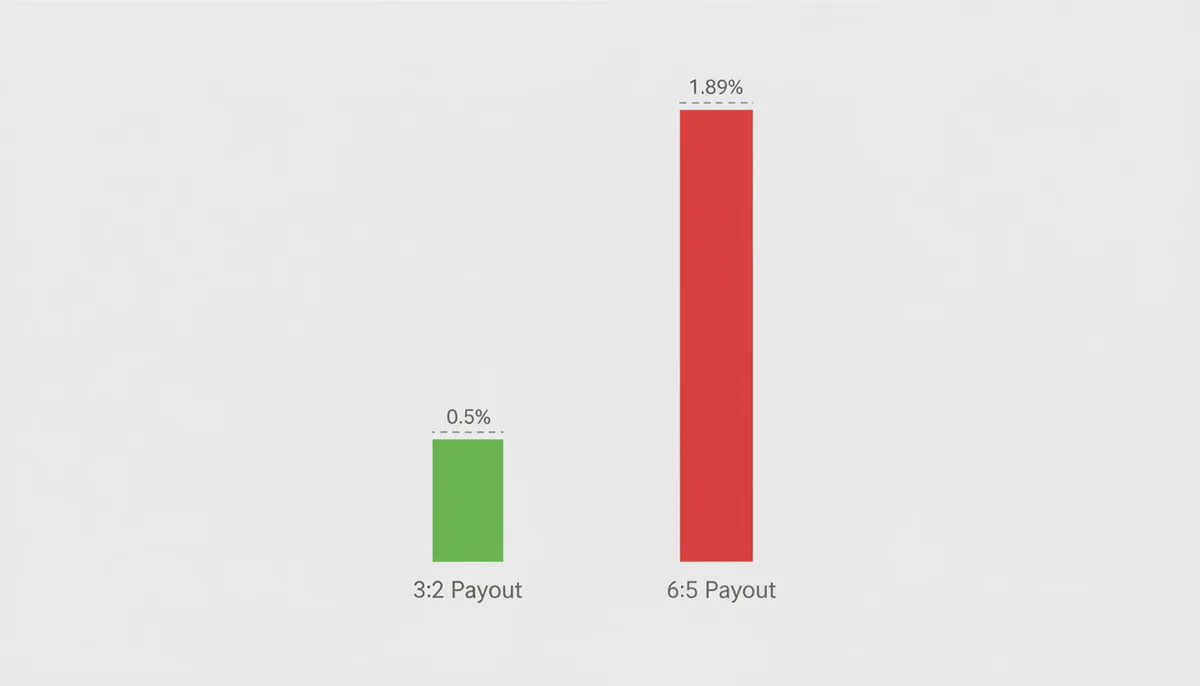
Blackjack’s most infamous rule change is the shift from 3:2 to 6:5 payouts for a natural. A standard 3:2 payout means a $10 bet wins $15. A 6:5 payout means the same bet wins only $12. This doesn’t sound like much, but a 1.39% increase in the house edge—often more than the entire baseline edge of a well-structured game. If a table has a 0.5% edge with 3:2, switching to 6:5 turns it into a 1.89% edge. That’s not just bad; it’s disastrous.
Why do casinos do this? Because 6:5 tables are profitable. They attract players who don’t understand the math and keep them coming back. If you see a 6:5 sign, walk away. No other rules can compensate for that hit. Even if the dealer stands on soft 17 and you can double after splitting, the 6:5 payout still leaves you with a house edge over 1%. It’s the single worst rule in the game.
The Dealer's Hand: How Does 'Dealer Hits Soft 17' Change the Game?
Soft 17 is a hand that includes an Ace counted as 11 (e.g., Ace-6). When the dealer hits soft 17 (H17), they take an extra card on this total. This rule increases the house edge by 0.22% compared to when the dealer stands on soft 17 (S17). Here’s why: the dealer busts more often, but they also improve their hand to 18-21 more frequently. The net effect is a small but meaningful shift in favor of the casino.
For example, a table with H17 and all other favorable rules (like 3:2 payouts) still adds 0.22% to the edge. If the baseline was 0.5%, it becomes 0.72%. That might seem minor, but over time, it compounds. Always look for tables where the dealer stands on soft 17. It’s a simple rule that makes a big difference.
What Player Options Give You an Edge Back?
Casinos balance bad rules with player-friendly options. The most valuable are:
- Double After Split (DAS): Allows doubling down after splitting pairs. This reduces the house edge by ~0.14%. It’s most useful when you split small cards (like 2s or 3s) and double on strong hands.
- Late Surrender (LS): Lets you forfeit half your bet after seeing the dealer’s upcard. This cuts the house edge by ~0.07-0.10%, especially when the dealer has a strong hand like a 10 or Ace.
- Re-Split Aces (RSA): Permits splitting Aces more than once. This is rare but valuable, reducing the edge by ~0.08%.
| Rule Name | Effect on House Edge (%) | Brief Description | Basic Strategy Adjustment |
|---|---|---|---|
| Double After Split (DAS) | -0.14 | Allows doubling after splitting pairs | Split more often and double on strong hands |
| Late Surrender (LS) | -0.07 to -0.10 | Surrender half your bet after seeing dealer's upcard | Surrender against dealer's 10 or Ace |
| Re-Split Aces (RSA) | -0.08 | Allows splitting Aces more than once | Split Aces and hit or stand based on dealer's upcard |
How Do Deck Count and Shuffling Affect the Odds?
Deck count matters. Fewer decks mean a higher chance of drawing a natural blackjack. For example:
- Single deck: Baseline house edge ~0.17% (with S17, 3:2, DAS, and LS)
- Double deck: ~0.46% (with S17, 3:2, DAS, and LS)
- 6-deck shoe: ~0.64% (with S17, 3:2, DAS, and LS)
Continuous Shuffling Machines (CSMs) negate this advantage by randomizing the deck after every hand. They’re like an infinite deck—no card counting, no penetration, and a guaranteed house edge. If you’re playing for edge, avoid CSMs. Stick to traditional shoes with deep penetration (at least 75% of the deck played before reshuffling).
| Rule | Effect on House Edge (%) | Description |
|---|---|---|
| No-hole-card (European) | +0.11 | Dealer doesn’t check for blackjack before you act |
| Double on 9-11 only | +0.14 | Restricts doubling to specific hands |
| Double on 10-11 only | +0.20 | Further restricts doubling options |
| No re-splitting aces | +0.08 | Prevents splitting aces beyond the first split |
| Early surrender | -0.24 | Allows surrendering before dealer checks for blackjack |
| No blackjack after split | +0.13 | Prevents drawing a natural after splitting |
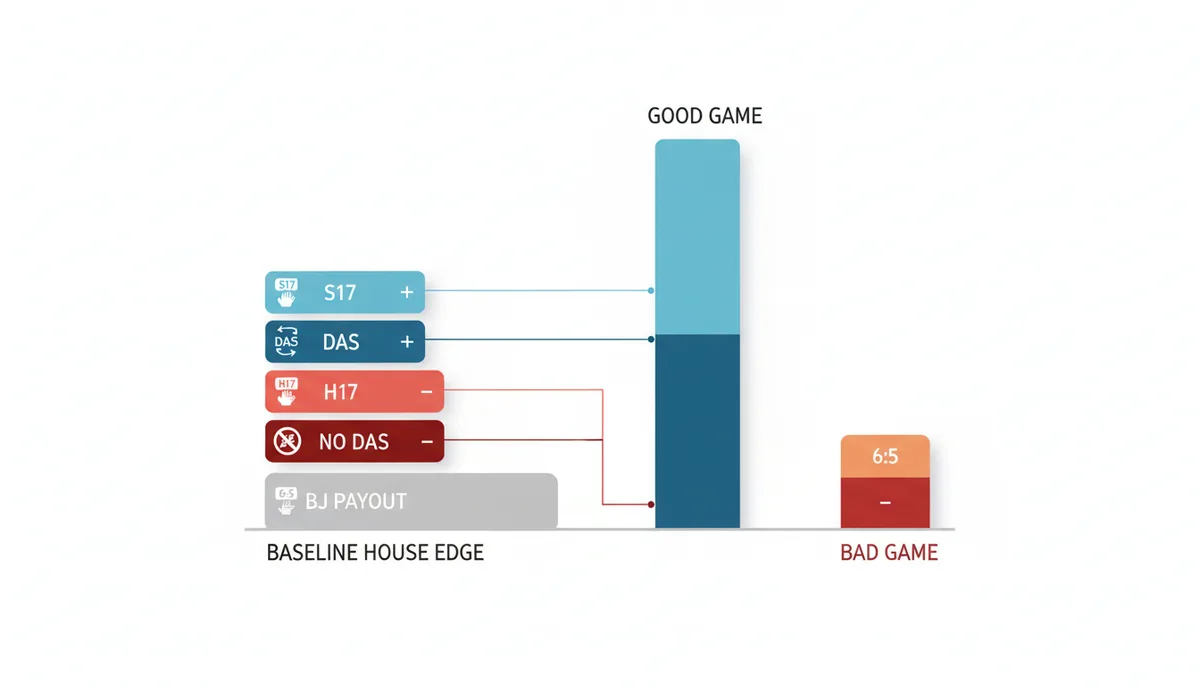
Putting It All Together: How Do Multiple Rules Combine?
Let’s build two tables:
- Good Las Vegas Strip game: 6 decks, S17, DAS, LS, 3:2 payout.
- Bad game: 8 decks, H17, no DAS, 6:5 payout.
Good Game Calculation: Start with a 6-deck baseline of ~0.64%. Subtract 0.22% for S17, 0.14% for DAS, and 0.07% for LS. Total: ~0.21%.
Bad Game Calculation: Start with 8-deck baseline (~0.70%). Add 1.39% for 6:5, 0.22% for H17. Total: ~2.31%.
Are Side Bets and 'Gimmick' Rules Worth the Risk?
Side bets like Insurance, Perfect Pairs, and 21+3 are separate wagers with their own house edges. Here’s the math:
| Side Bet | House Edge (%) | How You Win |
|---|---|---|
| Insurance | ~7.4% | Dealer has a blackjack |
| Perfect Pairs | ~5-10% | Both your cards match (e.g., two Kings) |
| 21+3 | ~4.3% | Your three cards form a poker hand |
Insurance is especially tempting when the dealer shows an Ace, but it’s a 7.4% edge. Basic strategy players should never take it. Side bets are designed to be flashy, not favorable. Avoid them unless you’re playing for fun, not profit.
How Can You Quickly Evaluate a Blackjack Table?
Follow this checklist:
- Payout: Must be 3:2. If it’s 6:5, walk away.
- Dealer Rules: Look for "Stand on Soft 17" (S17).
- Player Options: Check for DAS and LS. These reduce the edge.
- Deck Count: Fewer is better. Single or double deck is ideal.
Rules are printed on the table felt or a placard. If you’re unsure, ask the dealer. A good dealer will explain the rules clearly. Don’t assume; verify.
How to Adjust Basic Strategy for Rule Variations
Basic strategy is your foundation, but it’s not a one-size-fits-all map. When rules shift—like the dealer hitting soft 17 or the payout changing—your strategy needs to adapt. Let’s break it down with two common scenarios:
- Dealer Hits Soft 17 (H17): In standard basic strategy charts, you double down on 11 against a dealer’s 10 when the dealer stands on soft 17 (S17). Under H17, the dealer’s likelihood of improving their hand to 18-21 increases, which changes the optimal play. For example, hitting 11 against a 10 becomes slightly more favorable than doubling. Similarly, surrendering 16 against a 10 becomes more attractive under H17, as the dealer’s bust rate drops. These adjustments are minor but reflect the rule’s impact on hand outcomes.
- 6:5 Payout Tables: Even if a 6:5 table offers other favorable rules (like DAS or S17), the payout distortion overrides them. Basic strategy doesn’t change for this rule, but it should change your decision to play at all. For example, if you’re dealt a blackjack and the payout is 6:5, your average return drops by 1.39% compared to 3:2. That’s a bigger hit than doubling on every hand. The fix? Walk away. No amount of strategy tweaks can make a 6:5 game profitable in the long run.
Tools like the SorteCalc Blackjack Strategy Calculator let you generate rule-specific charts instantly. Input the dealer’s rules, deck count, and payouts, and it adjusts the strategy for you. This is especially handy for complex variations like European Blackjack, where the dealer peeks for blackjack, or games with re-splitting aces. The key takeaway: basic strategy is a starting point, not a final answer. A 1% difference in edge might seem small, but it compounds over time. If you’re playing 100 hands an hour at $10 per hand, a 1% edge shift costs you $10 an hour. That’s not a strategy—it’s a leak.
The Hidden Cost of Shallow Penetration in Multi-Deck Games
Penetration—the percentage of the shoe dealt before reshuffling—matters more than you think. In a 6-deck game, if the dealer cuts off 1.5 decks, only 50% of the cards are played before reshuffling. This isn’t just bad for card counters; it also affects basic strategy players. Here’s why:
- Increased Variance: Shallow penetration means more frequent reshuffles, which disrupts natural card distribution. In a deep game (75% penetration), you’re more likely to see clusters of high or low cards, allowing basic strategy to perform closer to its theoretical edge. Shallow games force you to play more hands in a randomized state, increasing short-term variance. You’ll win and lose faster, which can be misleading if you’re tracking results.
- Lost Opportunities for Doubling/Splitting: Basic strategy tells you to double down on 10 against a 6. But if the shoe is low on 10s due to shallow penetration, that decision becomes riskier. The probability of drawing a 10 drops, and the dealer’s chance of busting decreases. In deep games, you can rely on the shoe to balance out over time. In shallow ones, you’re gambling with incomplete data.
For example, consider a 6-deck game with 50% penetration. The house edge for a basic strategy player remains ~0.64% in theory, but the game’s volatility increases, making it harder to predict outcomes over short sessions. Casinos often pair shallow penetration with 6:5 payouts to maximize their take. Always check the penetration depth by watching how many decks are cut off. If it’s less than 50%, walk. If it’s over 75%, you’re in a player-friendly game.
A Real-World Case: The Bellagio’s 6-Deck Game
Let’s dissect a real-world example: the Bellagio’s 6-deck Blackjack game. Here are the rules:
- 6 decks
- Dealer stands on soft 17 (S17)
- 3:2 payout for blackjack
- Double down on any two cards
- Split pairs up to three times
- No double after split (no DAS)
- No surrender
- Shoes cut at 1.5 decks (50% penetration)
Start with the 6-deck baseline: ~0.64%. Adjust for S17 (-0.22%), 3:2 payout (no change), no DAS (+0.14%), and no surrender (+0.07%). Total: 0.64 - 0.22 + 0.14 + 0.07 = 0.63%. On paper, this is a great game. But the 50% penetration adds an effective 0.15% edge due to variance, pushing the total to ~0.78%. That’s still better than a 6:5 game but worse than a 6-deck shoe with DAS and LS. The lesson? Even a “good” game can be derailed by poor penetration. Always factor in how deep the shoe goes when evaluating a table.
Why Table Minimums Matter More Than You Think
A 0.5% house edge sounds harmless until you factor in table minimums. Let’s compare two scenarios:
- Game A: 0.5% edge, $10 minimum, 60 hands/hour
- Game B: 1.5% edge, $50 minimum, 60 hands/hour
In Game A, your theoretical hourly loss is $3. In Game B, it’s $45. Even though Game B’s edge is three times higher, the minimum bet amplifies the cost. This is why high-rollers often target games with low edges and high limits—they can afford the risk, and the casino profits from their larger bets. For recreational players, the math is clear: a $10 table with a 1.5% edge is worse for your bankroll than a $5 table with 0.5%. Always prioritize lower edges over higher limits unless you have the bankroll to absorb the swings.
Common Mistakes When Choosing a Blackjack Table
Even experienced players make costly errors when selecting a table. Here are three to avoid:
- Ignoring the Payout Sign: A 6:5 table might look tempting with a “$5 minimum” sign, but the 1.39% hit to your edge makes it a trap. Always check the payout first. If it’s not 3:2, move on.
- Assuming “Atlantic City Rules” Are Standard: Atlantic City games are famous for 3:2 payouts and S17, but many casinos mimic the name without the rules. Double-check the actual table rules instead of relying on the name.
- Overlooking Player Options: A table might have a 3:2 payout and S17 but lack DAS or LS. These options can reduce the edge by 0.14-0.10%, which is the difference between a 0.5% game and a 0.65% one. Over 100 hours, that’s a $15 loss on a $10/hand game. Small details matter.
The fix? Use a checklist. Scan the table for the payout, dealer rules, and player options before sitting down. If you’re unsure, ask the dealer. A good dealer will explain the rules clearly. Don’t assume; verify. The casino’s goal is to make you play a game with a high edge. Your goal is to avoid that at all costs.
FAQ
Does my basic strategy change when the rules change?
Yes, slightly. For example, if the dealer hits soft 17, you’ll surrender more often and avoid doubling on certain hands. A universal basic strategy is a strong starting point, but adjustments matter. Use a rule-specific chart if available.
What is the best possible blackjack game I can find?
An ideal game is single-deck, 3:2 payout, S17, DAS, and LS. These games are rare and often have high minimum bets. But when you find one, it’s a goldmine for players. The house edge can drop below 0.5%.
If I play perfect basic strategy, can I have an edge over the house?
No. Basic strategy minimizes the house edge but doesn’t eliminate it. The casino always has a slight edge. Card counting can shift the odds in your favor, but it’s a skill, not a guarantee.
Why would a casino offer a game with a lower house edge?
Lower edges attract skilled players who play longer and spend more. Casinos in competitive markets (like Las Vegas) use favorable rules as a lure. It’s a trade-off: a lower edge for higher volume.
Is card counting affected by these rule changes?
Yes. Fewer decks, S17, and deep penetration make card counting more profitable. 6:5 payouts and CSMs make it impossible. Casinos know this and use rules to counteract it.
What is the house edge on popular variants like 'Blackjack Switch' or 'Free Bet Blackjack'?
Blackjack Switch, played optimally, has a ~0.58% edge. Free Bet Blackjack’s edge is over 1% because the "free" bets are paid for by making a dealer 22 a push. Variants trade convenience for higher house edges.
Sources
- The Wizard of Odds — Primary source for the specific numerical values cited in this article: the 6:5 payout effect, dealer H17 effect, impacts of DAS, late surrender, re‑splitting Aces, deck‑count baselines, side‑bet house edges, and variant house edges.
- Nevada Gaming Control Board — Official regulations and statistics for the Las Vegas and Nevada gaming market; useful for citing standard rule sets and casino revenue context (not used for the numerical deltas above).
- UK Gambling Commission — Information on rules, regulations, and RTP requirements in a major international jurisdiction; useful for comparing rule sets beyond the United States.
- Cornell University School of Hotel Administration — Research papers and industry reports on casino operations and the business decisions behind setting game rules and odds.