Why Roulette Progression Systems Change Risk but Not the House Edge
2026-10-30 · 22 min · 4,271 words
You are sitting at a roulette table. The croupier has just spun the wheel. The ball lands on black. You bet on red, so you lose. The next spin comes up black again. You feel that familiar itch in your chest. You know you are due to win. So you double your bet. You tell yourself that when the ball eventually lands on red, you will win back everything you lost plus a little extra. It feels logical. It feels controlled. But the table has limits, and your bankroll is not infinite. By the time you run out of space to bet, the math has already decided your fate.
Most people who play roulette do not just spin the wheel randomly. They follow a plan. They have a system. This is not unique to online casinos or specific sites; it is a human reaction to a game of chance. You want structure in chaos. You want a method that guarantees you leave with more than you brought in. The promise of a roulette system is seductive. It suggests that skill, or at least discipline, can overcome luck. But skill cannot change the physics of the wheel. Discipline cannot change the probability of the next spin.
This article explains why those systems fail. It does not tell you to avoid the game entirely. It explains what the games actually do to your money. We will look at the math behind the house edge. We will break down how negative progressions work and why they collapse under their own weight. We will look at positive progressions and see why they are just as mathematically doomed, even if they feel safer. We will discuss how these systems change the shape of your session without changing the final destination. If you play, you should know exactly what you are buying. You are buying entertainment. You are not buying an investment strategy.
Why Do So Many Players Swear by Roulette Systems?
The first thing to understand is that betting systems feel like they work. In the short term, they do. You might use a progression method for an hour. You win more often than you lose. You walk away from the table ahead. Your brain remembers the win. It forgets the math. This is how the trap is set. The system gives you a sense of agency. When you lose, it feels like you just need to follow the plan longer. When you win, it feels like the system is working.
Humans are pattern recognition machines. We look for signals in noise. If you see red come up three times, you might bet on black, thinking it is due. If you lose, you might double up, thinking the next one will surely be black. This is the Gambler's Fallacy. It is the belief that past independent events influence future independent events. The wheel has no memory. It does not know it landed on red three times in a row. The probability of red on the next spin is exactly the same as it was on the first spin.
Systems provide a structure that masks this reality. They turn a game of pure chance into a series of steps. Step one: bet one unit. Step two: if you lose, bet two units. Step three: if you win, reset. This structure mimics a recipe. If you follow the recipe, you expect a result. In cooking, following the recipe works because the laws of chemistry are consistent. In roulette, the laws of probability are consistent, but they work against you. The structure makes the loss feel like a mistake in execution rather than a certainty of math. You blame yourself for running out of money, not the house edge.
There is also the element of social proof. You talk to other players. You see them win. You see a win. If you win, you talk to other players. Everyone shares the wins. No one shares the stories of the sessions where they lost their entire bankroll in ten spins. This survivorship bias reinforces the belief that the system is valid. You see the person walking away with a stack of chips. You do not see the person who had to go to the ATM.
Finally, these systems offer a way to rationalize loss. If you win, it is because you played well. If you lose, it is because you did not have enough bankroll, or the table limit stopped you, or the streak was too long. The system is never wrong. The circumstances are. This makes it incredibly difficult to convince a player that the system is fundamentally flawed. To admit the system does not work requires admitting that the loss was inevitable from the start.
What Is the House Edge in Roulette?
To understand why systems fail, you must understand what they are fighting against. That opponent is the house edge. The house edge is not a fee you pay to enter the game. It is built into the payouts. It is the difference between the true odds of an event happening and the amount the casino pays you when it happens. If you bet on a number that has a 1 in 37 chance of winning, the casino should pay you 36 to 1 for the bet to be fair. In European roulette, they pay 35 to 1. That missing unit is the edge.
This edge applies to every single spin. It does not matter what you bet on in the previous spin. It does not matter how much you bet. The expected value of every bet is negative. Let's say you bet on red in European roulette. There are 37 pockets. 18 are red, 18 are black, and 1 is green. Your chance of winning is 18 in 37. Your chance of losing is 19 in 37. If you bet $10, your expected value is calculated like this: (18/37 * $10) - (19/37 * $10) = -$0.27. On average, you lose 27 cents for every $10 you bet.
Most people do not think in expected value. They think in wins and losses. But over time, the math smooths out. If you play 1,000 spins, you will not win every single time, but your total losses will converge toward that average. The house edge guarantees that the more you play, the closer you get to the mathematical expectation. This is the Law of Large Numbers. Systems try to bypass this by altering the size of your bets. They try to win big when you are lucky and lose small when you are unlucky. But they cannot change the probability of winning on any given spin.
There are different versions of the wheel. The house edge changes based on the pockets available. American roulette has 38 pockets because it includes a double zero (00). European roulette has 37 pockets with a single zero (0). French roulette also has 37 pockets but often offers special rules like La Partage or En Prison that reduce the edge on even-money bets. This distinction matters. A system that loses money on an American wheel might lose money more slowly on a French wheel, but it still loses money. No system turns a negative expectation game into a positive one.
Consider the payout for a straight-up bet. You bet on a specific number. In American roulette, there are 38 numbers. You win 1 in 38 times. The payout is 35 to 1. If you bet $100 on number 17, you expect to lose $100 * (1/38) * 35 - $100 * (37/38) = -$5.26. That is the house edge of 5.26%. This is a fixed cost of doing business. The casino does not need to rig the wheel. They just need to make sure you play enough hands. The edge ensures their profit regardless of whether you are on a lucky streak or a losing streak.
| Game Variant | Numbers on Wheel | Payout for Straight-Up Bet | House Edge (Even-Money Bets) | Key Feature |
|---|---|---|---|---|
| American | 38 (1-36, 0, 00) | 35 to 1 | 5.26% | Extra 00 pocket doubles the disadvantage |
| European | 37 (1-36, 0) | 35 to 1 | 2.70% | Single 0 reduces the edge significantly |
| French (La Partage) | 37 (1-36, 0) | 35 to 1 | 1.35% | Half stake returned on 0 for even bets |
How Do Negative Progression Systems Work?
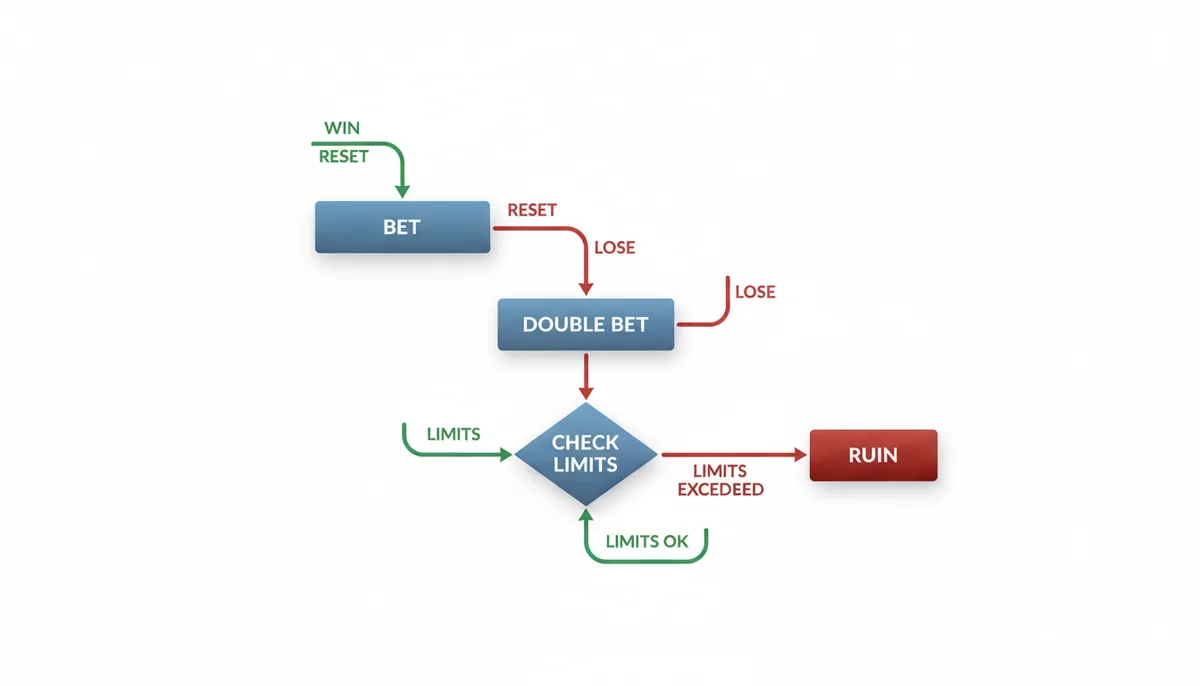
Negative progression systems are the most famous. They are designed for you to increase your bet after a loss. The logic is simple: losses accumulate, so you must bet more to recover them. The most common example is the Martingale. The rule is to double your bet every time you lose. If you start with $10 and lose, you bet $20. If you lose again, you bet $40. When you finally win, the payout covers all your previous losses and leaves you with a profit equal to your original base bet.
Other systems follow the same principle but scale differently. The D'Alembert system is less aggressive. You add one unit to your bet after a loss and remove one unit after a win. If your unit is $10, you bet $10. Lose. You bet $20. Lose. You bet $30. Win. You bet $20. The goal is still to recoup losses over a cycle, but the growth is linear instead of exponential. This feels safer, but the underlying math remains the same. You are betting more money to fix previous mistakes.
The Labouchère system adds a layer of structure. You write down a sequence of numbers, say 1-2-3-4-5. You bet the sum of the first and last numbers ($1 + $5 = $6). If you win, you cross those numbers out. If you lose, you add the bet amount to the end of the sequence. You want to cross out all numbers to finish the cycle with a profit. The system forces you to increase your bets when the sequence gets longer due to losses. Like the Martingale, it requires a win eventually to clear the table.
Why do players like these systems? Because in short sessions, they work. Imagine you lose a few times, but then you win. With the Martingale, you get your money back immediately. You walk away with $10 profit. You feel smart. You feel like you beat the house. But this only works if you can afford to keep doubling. If you lose ten times in a row, you have to bet $10,240 to recover your initial $10 bet. Most players do not check what that number is before they start. They just see the win. They do not see the looming cost.
These systems also create a feedback loop. When you lose, the system tells you to bet more. It makes you feel like you are solving the problem. You are not. You are just delaying the loss of your bankroll. The more you play, the more likely you are to encounter a streak of losses that exceeds your funds. The system does not increase your odds of winning a spin. It only changes how much you win or lose when the outcome is decided.
What Is the Inevitable Flaw in Negative Progressions?
The flaw is twofold. First, bets grow exponentially. Second, casinos impose table limits. The exponential growth is dangerous because it outpaces the human ability to judge risk. In a Martingale system, the bet sizes follow a powers of two sequence. $10, $20, $40, $80, $160, $320, $640, $1,280, $2,560, $5,120, $10,240. If you lose nine times in a row, you have already lost $5,110 to reach the tenth bet. To recover just your original $10 unit, you need to risk $5,120. The ratio of risk to reward is terrible.
Most players assume losing nine times in a row is impossible. But the probability of losing ten even-money bets in a row on a European wheel is (19/37)^10, which is roughly 0.13%. This sounds small. But if you play 1,000 spins, you are playing dozens of such cycles. The probability of hitting a losing streak of that length at least once in a session is much higher than it feels. The math does not care what you feel. It only cares about the odds.
The table limit kills the system. Casinos know this. They set a maximum bet for every table. If the minimum is $10 and the maximum is $1,000, you can place bets of $10, $20, $40, $80, $160, $320, and $640. But the eighth bet requires $1,280. The table stops you. You cannot make the bet. After those seven losses, you have already spent $1,270. You are left with your massive accumulated losses and no way to recover them in a single spin.
This creates a specific risk profile. You win often. You win small amounts. You look successful. But when you lose, you lose everything. The system trades a high frequency of small wins for a low frequency of catastrophic losses. Since the casino has unlimited time and money, and you have a bankroll, the casino wins in the long run. You are simply waiting for the big loss. Every time you win, you are not earning profit. You are deferring the inevitable loss.
How Do Positive Progression Systems Work?
Positive progression systems do the opposite. You increase your bet after a win. The logic is to capitalize on hot streaks. The most popular version is the Paroli, also known as the Anti-Martingale. The rule is usually to double your bet after a win for a set number of steps, then reset. For example, bet $10. Win. Bet $20. Win. Bet $40. Win. Then go back to $10. The goal is to ride a wave of luck and multiply it.
Why do players choose this? Because it feels less aggressive. You are betting with the house's money. If you lose on the second bet, you only lose your initial stake. You do not lose your previous winnings. It protects your bankroll from the rapid depletion seen in negative progressions. You might feel like a disciplined investor. You take profits, then you stop. This appeals to players who do not want to chase losses aggressively.
Another variation is the Reverse Martingale without a fixed stop. You keep doubling until you lose. This is riskier. If you get a run of ten wins, your bet size explodes. You might start with $10 and end up betting $10,240 on the tenth spin. If that loses, you give back all the profits from the previous nine spins. The temptation to "go just one more time" is strong. The system relies on you stopping at the right moment, which is often the hardest part of gambling.
Positive progressions are psychologically distinct from negative ones. Negative progressions try to fix pain. Positive progressions try to maximize pleasure. Both rely on the same false premise: that winning or losing streaks are predictable or controllable. You cannot know when a streak will end. You can only hope to catch it. The system does not predict the streak. It just assumes it exists. If no streak occurs, you win nothing. You just sit there making standard bets that lose money due to the house edge.
Why Don't Positive Progressions Beat the House Either?
The flaw here is the independence of events. Each spin of the roulette wheel is a separate event. The result of the previous spin does not influence the next. There is no "momentum." If you win on red, the probability of winning on the next spin is still 18 in 37 (on European). You might think you are on a hot streak, but you are just observing the past. The future is a new coin toss. When you increase your bet on a win, you are not increasing your odds of winning that next spin. You are only increasing the amount you win or lose.
Consider a simple Paroli cycle. Start with a larger bankroll. Bet $10 and win. You are up $10. You bet $20 and win. You are up $30 total. You bet $40 and lose. You lose $40. You end the sequence down $10 overall. If you had played three flat bets of $10, you would have wagered $30 total. In the Paroli scenario, you wagered $70 total ($10 + $20 + $40). The house edge applies equally to every spin. But your total expected loss scales with the amount you put at risk. By pressing your wins, you expose more money to the edge.
Positive progressions shift the risk to the wins. You win big when you hit a streak. You lose small when you miss. But since streaks are random, you are often losing money on every single spin. The edge is always working against you. The fact that you bet more when winning does not cancel out the edge on the losing spins. The total amount you wagered over a session is what the house takes a percentage of. If your system makes you wager more, it makes you lose more.
There is also the issue of stop limits. Players often decide to "take the money and run" after a certain number of wins. But when you win, you feel confident. You might skip the limit. You might say, "I am on a roll." Then you lose. The system cannot tell you when to stop. Only you can. And the system does not fix your decision-making. It just adds a rule to your betting. The rule cannot fix the odds.
How Do Systems Change Your Gambling Experience?
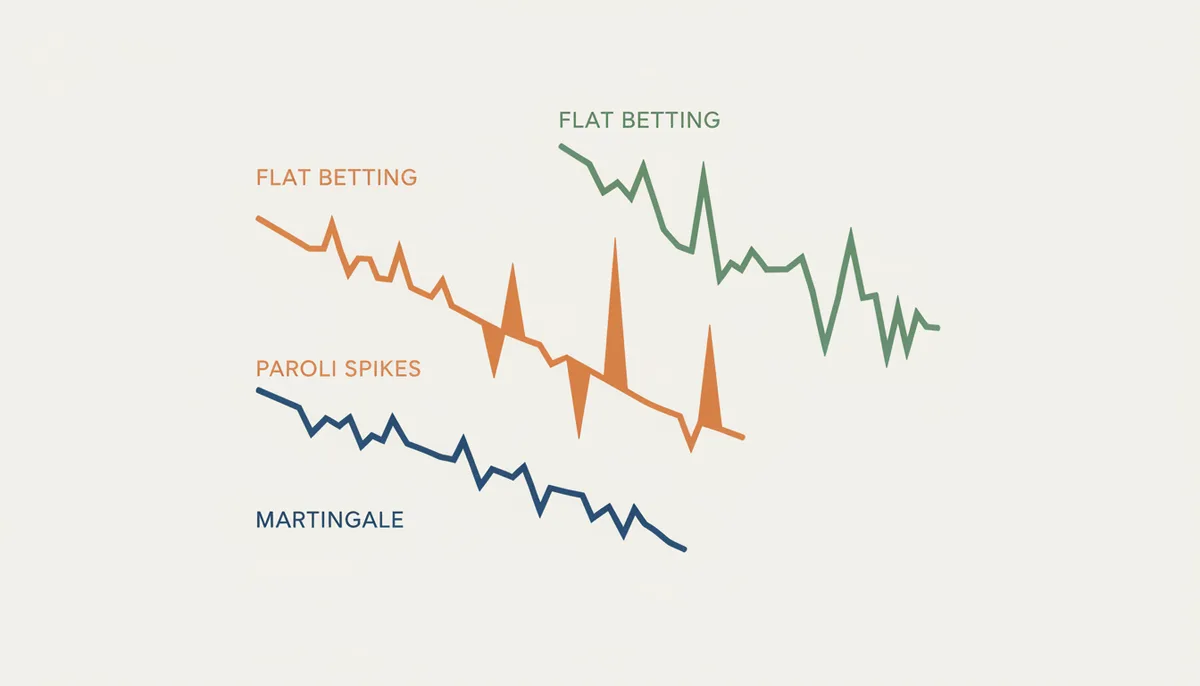
Systems do not change the Expected Value. They do not change the Return to Player. They only rearrange the volatility. Volatility is how much your bankroll swings up and down. Negative progressions like Martingale make you win small amounts often. Your bankroll ticks up slowly. But then it drops to zero in one go. It looks like a slow climb up a hill followed by a cliff. Positive progressions like Paroli make you lose small amounts often. Your bankroll drifts down slowly. But if you hit a streak, it spikes up. It looks like a slow decline with occasional fireworks.
Flat betting is the baseline. You bet the same amount every time. Your bankroll drifts down slowly, roughly following the line of the house edge. It is jagged, but it is steady. You know how long your money will last. With a system, you lose that predictability. You do not know if you will end the session with a small win, a small loss, or a total bust. The system introduces variance. This variance is why the system feels like a strategy. It hides the long-term loss in short-term noise.
Think of it as buying a lottery ticket with a twist. In a lottery, you buy one ticket and hope to win. In a betting system, you are essentially buying a ticket with the promise that if you lose a few times, you buy a bigger ticket. But the bigger ticket costs more than you can afford. You are just changing the price of the ticket you are willing to buy on your worst days. The house always collects the fees regardless of which ticket you buy.
The real choice is about entertainment. If you want small wins and the risk of total loss, a negative progression might feel like a good thrill. If you want to play with house money and accept slow erosion, a positive progression might suit you. But you are not choosing a way to win. You are choosing a way to spend money. The system changes the emotional experience of the game. It changes how you feel when you win or lose. It does not change the final bill.
Is There Any 'Correct' Way to Size Bets in Roulette?
Since no system can beat the house edge, the only effective way to manage your bets is through bankroll management. The goal is to maximize your playing time and minimize the chance of losing everything. The best method for this is flat betting. You decide on a percentage of your total bankroll to bet on each spin. A common rule is 1% to 2%. If you have $1,000, you bet $10 to $20. This ensures that you have a hundred spins of breathing room even if you lose.
Flat betting aligns your experience with the reality of the game. You know you will lose slowly. You are not gambling on a miracle streak. You are paying for time at the table. This is the only way to turn the game into a predictable cost. If you plan to spend $50 on entertainment, you know exactly how much money you need to bring. You do not risk your rent money because you were trying to recoup losses with a Martingale.
Game selection is even more important than betting size. You want to play the version of the game with the lowest house edge. This means choosing French Roulette with La Partage over European, and European over American. On French Roulette, the edge on even-money bets is 1.35%. On American, it is 5.26%. Playing American roulette costs you almost four times as much to play as playing French, regardless of the system you use. There is no system that turns American roulette into a profitable game.
Some players rely on external tools to calculate their odds. Sites like SorteCalc offer calculators for different scenarios. Using a tool can help you understand what you are getting into before you bet. But even the most advanced calculator will tell you that the EV is negative. It might show you your risk of ruin for a specific bankroll size. This helps you decide how much money you can afford to lose. It does not show you a way to win.
| Approach | Goal | Volatility | Risk of Ruin | Session Experience |
|---|---|---|---|---|
| Flat Betting | Maximize play time | Low | Low | Slow, predictable decline |
| Negative Progression | Recoup losses | High | High | Small wins, sudden catastrophic loss |
| Positive Progression | Capitalize on streaks | Medium-High | Medium | Small losses, occasional sharp gains |
FAQ
What if I had an infinite bankroll and there were no table limits?
In that purely theoretical scenario, the Martingale system would guarantee you eventually win. If you have infinite money and no limit on bet sizes, you can keep doubling until you hit a win. The math says you will eventually land on red. But in the real world, neither condition exists. Casinos set limits to protect themselves. And you do not have infinite money. Once you run out of cash or hit the limit, the system fails. The theoretical guarantee disappears.
Is it illegal to use a betting system in a casino?
No, it is not illegal. Casinos are happy for you to use them. The reason they are fine with it is that the systems do not change the house edge. A system might change when you win or lose, but the casino still wins in the long run. They do not need to ban you. They do not need to do anything. You are just playing a negative expectation game slightly differently.
Why do casinos have table limits?
Table limits serve two main purposes. First, they protect the casino from a single massive bet that could bankrupt them. Second, they render betting systems like the Martingale ineffective. If a casino allowed unlimited betting, a wealthy player could eventually break the bank. The limit ensures that the player runs out of money first. It forces the progression to stop exactly when the player cannot recover their losses.
So what is the best strategy for playing roulette?
The best strategy is to play on a French or European wheel. Stick to outside bets to keep the edge as low as possible. Decide on a loss limit before you sit down. Do not try to win. Treat the game as entertainment. If you want to win, play a different game like poker where you play against other players, not the house.
Can a computer program using a system beat online RNG roulette?
No. An RNG (Random Number Generator) is designed to produce statistically independent and unpredictable results. It is just like a perfect physical wheel. The math is identical. The house edge remains unbeatable. A computer program can automate your bets, but it cannot make them win more often than the math allows.
Does the 'La Partage' rule make progression systems profitable?
No. The La Partage rule cuts the house edge on even-money bets to 1.35%, which is the best you can get in roulette. However, it is still a house edge. Systems will still lose money. They might lose money more slowly, but they will still lose. A negative edge is a negative edge, regardless of whether it is 2.7% or 1.35%.
In the end, a betting system does not make you a winner. It makes you a participant in a game that has already decided who will win. It changes the shape of your journey, not the destination. If you play, play with that knowledge.
Sources
- The Wizard of Odds (Michael Shackleford) — Detailed mathematical analysis of roulette odds, house edge for different game variants, and explanations of why various betting systems fail.
- Nevada Gaming Control Board — Official regulations, including rules on game conduct and approved payout structures, which form the basis of house edge calculations.