How to Calculate Fold Equity for a Bluff Before You Put Chips In
2026-10-09 · 24 min · 4,683 words
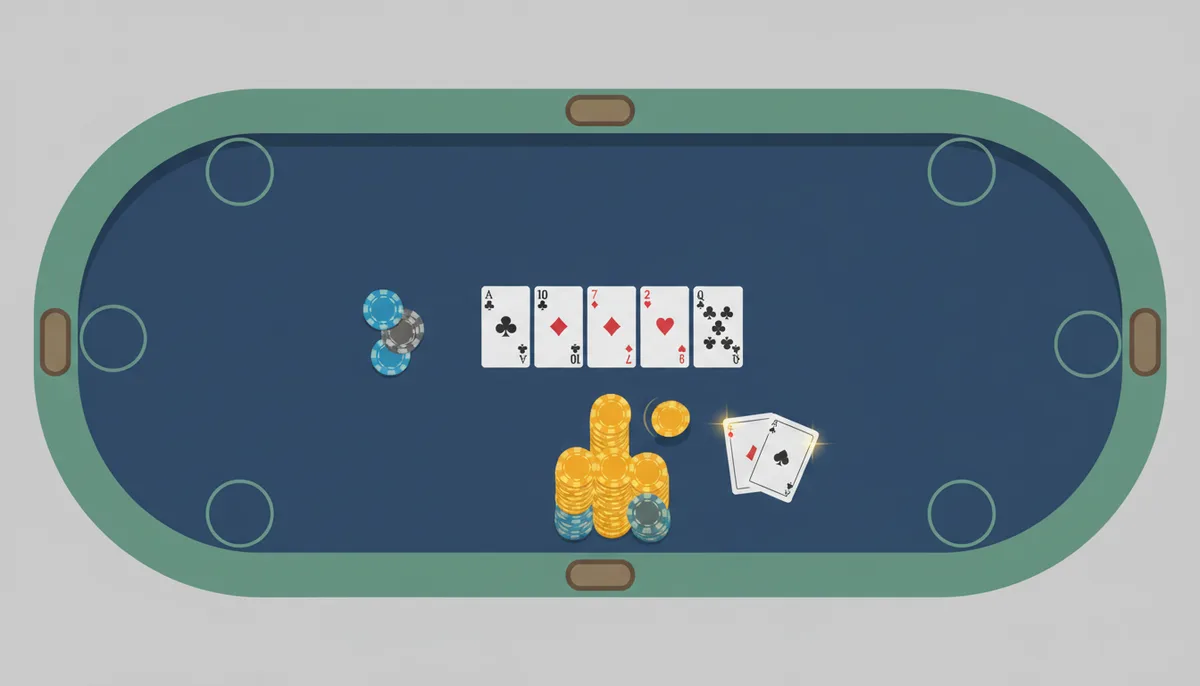
The river is the A♣, your opponent checks, and you have $130 behind in a $69 pot. You do not have a hand you want to show down. The question is not whether you feel brave. It is whether a $45 bet makes your opponent fold often enough to justify the risk. That number — the folding frequency you need — is what fold equity gives you.
When Does a Bluff Make Sense Mathematically?
A river check gives you two ways to take the pot. One is to have the best hand when the cards are turned over. The other is to bet and have your opponent fold. Most players feel the first option. They ask, “Is my hand good enough?” The second option asks a different question: “Will my bet be folded often enough?”
Fold equity is the share of the pot you expect to win because your opponent folds. It is not the same as showdown equity, sometimes called pot equity in casual speech. Showdown equity is your chance to win if the hand goes to cards. Fold equity is your chance to win immediately, without seeing a showdown.
Suppose you have complete air. Your showdown equity is 0%. If your opponent calls, you lose. The only path to profit is a fold. That does not make the bluff hopeless. It makes the bluff a pure race between your bet size and your opponent’s folding frequency.
A bluff is +EV when the money you expect to win from folds exceeds the money you expect to lose when called. Expected value, or EV, is just the average result if you repeated the same decision many times with the same variables. Fold equity is the variable that turns a bet with no showdown value into a profitable play.
Pot odds answer whether a call is profitable. Fold equity answers whether a bet is profitable. They are related, but they point in opposite directions. Pot odds ask what you need from your hand when facing a bet. Fold equity asks what you need from your opponent when making a bet.
The practical rule is simple: do not bluff because the board looks scary. Bluff when your bet size creates a required fold percentage that is lower than the folding frequency you expect. Everything after this point is about finding those two numbers.
The Breakeven Formula: Your Starting Point for Any Pure Bluff
Start with the ugliest version of the problem: you have air. No draw. No backdoor. No chance to win at showdown unless your opponent folds. This is a pure bluff.
The breakeven percentage is:
Breakeven % = Risk / (Risk + Reward)
Risk is your bet size. Reward is the pot before you bet. If the pot is $100 and you bet $50, your risk is $50 and your reward is $100. The formula is:
$50 / ($50 + $100) = 33.3%
That means the bluff makes money if your opponent folds more than one-third of the time. If they fold exactly 33.3%, the bluff breaks even. If they fold 40%, it profits. If they fold 25%, it loses.
This number is often called alpha, written α. In poker bluffing math, alpha is the minimum fold frequency your bluff needs. It is the price of your bet expressed as a percentage.
Here are a few common pure-bluff thresholds:
- A 25% pot bet needs about 20% folds.
- A 50% pot bet needs about 33.3% folds.
- A 75% pot bet needs about 42.9% folds.
- A 100% pot bet needs 50% folds.
You can calculate these by hand in seconds. When reviewing hands, you can also put the pot size and bet size into the SorteCalc Fold Equity Calculator and get the required percentage immediately. The calculator removes arithmetic friction, but it does not solve the harder problem: knowing whether your opponent will actually fold enough.
Take a position on bet size before you fall in love with a bluff. A half-pot bet is a reasonable default when you need a single number to beat. It risks enough to pressure marginal hands but does not demand an extreme folding frequency. The trade-off is that a half-pot bet may not fold off enough weak pairs on a river. If your read says the opponent folds 25% to half-pot but 45% to pot-sized, the larger bet may be correct despite the higher alpha.
How Your Hand’s Equity Changes the Math (Semi-Bluffs)
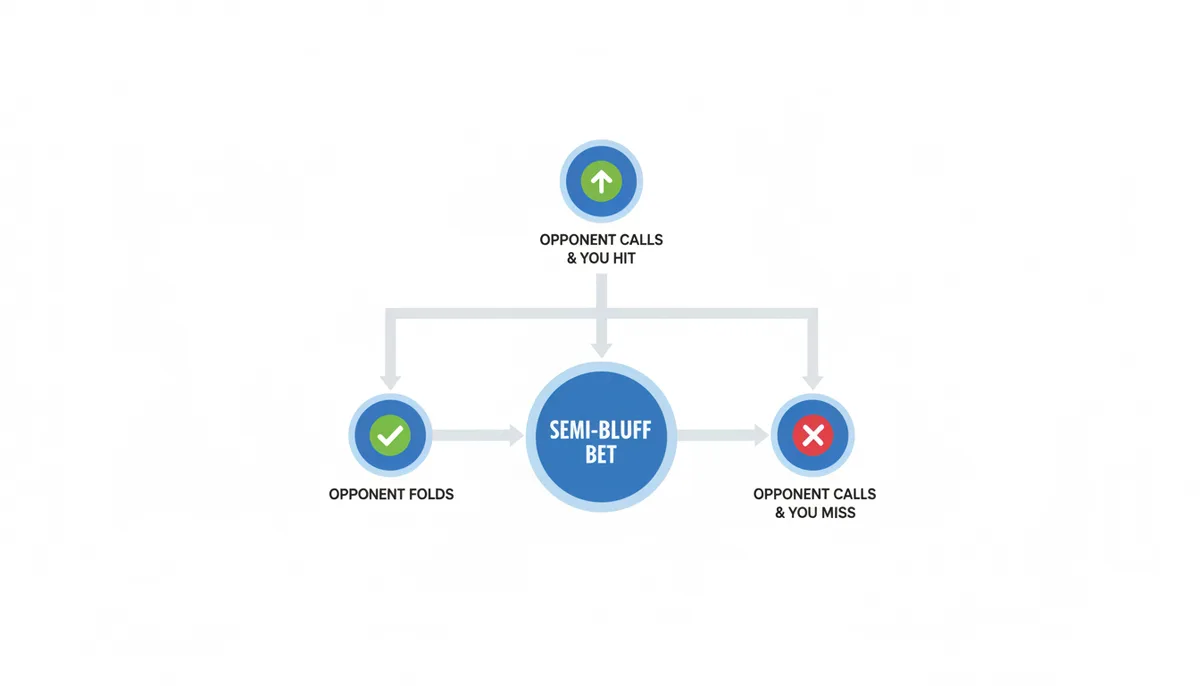
Most real bluffs are not pure air. They are semi-bluffs: bets made with hands that can improve. A flush draw, a combination draw, or even a weak hand with backdoor potential can win at showdown if called. That changes the math because you no longer lose the whole bet every time your opponent calls.
The full EV formula for a bluff is:
EV = (Fold% × Pot) + (Call% × (HandEquity × FinalPot − BetSize))
Break it into parts.
Fold% × Pot is the money you win immediately when your opponent folds. You do not win your own bet back as profit; you win the pot that already exists.
Call% is 1 minus Fold%. If your opponent calls, the final pot becomes the original pot plus your bet plus their call. If the pot is $100 and you bet $50, the final pot after a call is $200.
HandEquity × FinalPot is your share of that final pot. If you have 20% equity, you expect to win $40 of a $200 pot.
Subtract BetSize because you invested $50. In that example, the called branch is worth $40 − $50 = −$10.
So if the pot is $100, you bet $50, you have 20% equity, and your opponent folds f of the time:
EV = 100f + (1 − f)(−10)
EV = 110f − 10
The breakeven fold percentage is 10 / 110 = 9.1%.
That is the key takeaway: showdown equity reduces the fold equity you need. Your draw acts as a backup plan. A pure half-pot bluff needs 33.3% folds. The same half-pot bluff with 20% equity needs only 9.1% folds.
This is why semi-bluffs are often better than pure bluffs. You get two ways to win. You win now if they fold, and you win later if you hit. The cost is that you must estimate your equity honestly. A typical nine-out flush draw has about 19–20% chance to hit by the river with one card to come. The roughly 35% figure applies on the flop, when both turn and river remain, assuming the outs are live.
In Pot-Limit Omaha, the same formula applies, but equities run closer. Draws are more common, redraws are frequent, and a hand that looks like a bluff often has real equity when called. That usually lowers the required fold percentage, but it also means your opponent’s calling range may contain more hands that can improve against you.
Calculating Fold Equity Step-by-Step: A Full Hand Example
Here is a No-Limit Texas Hold’em river spot with real numbers.
You are in the button seat in a $1/$2 game with $200 effective stacks. You open T♠9♠ to $6. The big blind calls. The pot is $13.
The flop comes K♦10♣4♠. The big blind checks. You bet $8. The big blind calls. The pot is $29.
The turn is 3♥. The big blind checks. You bet $20. The big blind calls. The pot is $69.
The river is A♣. The big blind checks.
You have a pair of tens with a weak kicker. The ace likely helped the big blind’s calling range, and any king beats you. You estimate your showdown equity at 10%. You are considering a $45 river bet.
First, treat the hand as a pure bluff. Risk = $45. Reward = $69.
Breakeven % = 45 / (45 + 69) = 45 / 114 = 39.5%.
If you had no chance at showdown, you would need the big blind to fold more than 39.5% of the time.
Now include your 10% equity. If called, the final pot is:
$69 + $45 + $45 = $159.
Your expected share when called is:
10% × $159 = $15.90.
Your net result when called is:
$15.90 − $45 = −$29.10.
The EV formula becomes:
EV = 69f + (1 − f)(−29.10)
EV = 98.1f − 29.10
Set EV to zero:
f = 29.10 / 98.1 = 29.7%.
Your 10% equity lowers the required fold percentage from 39.5% to 29.7%. That is a large change. If you estimate the big blind will fold 35% of the time, the bet is +EV:
EV = 98.1 × 0.35 − 29.10 = $5.24.
If you estimate they fold only 25%, the bet loses:
EV = 98.1 × 0.25 − 29.10 = −$4.58.
The math is clean. The decision is not. On this river, the big blind’s calling range probably contains many kings, many aces, and some stronger tens. If they call with all those hands and fold only air, your 35% fold estimate may be fantasy. In that case, checking is better. You still have some equity, and you avoid turning a marginal hand into a bluff that only gets called by better.
Use the calculation to frame the question, not to replace the question. The number tells you what must be true. Your read tells you whether it is true.
How to Estimate Your Opponent’s Folding Frequency
The formula is easy. The estimate is the job. A required fold percentage means nothing if you plug in a hopeful number.
Tracking software can help. A heads-up display, or HUD, shows statistics collected from previous hands. Programs such as PokerTracker 4 and Hold’em Manager 3 can track how often players fold to continuation bets, how often they go to showdown, and how loosely they enter pots.
When reviewing hands, you can also put the pot size and bet size into the SorteCalc Fold Equity Calculator and get the required percentage immediately.
Three stats matter most for bluff selection.
Fold to Flop C-Bet shows how often a player folds to a continuation bet on the flop. A high number suggests they miss boards often and give up. A low number suggests they float, call with weak pairs, or have a wide defending range.
Fold to Turn C-Bet is more useful for multi-street bluffs. Some players fold flop but refuse to fold turn. Others fold flop often but become sticky when they hit a piece. The turn stat tells you whether their initial weakness persists.
WTSD, or Went To Showdown, measures how often a player sees showdown after flopping. A high WTSD means they call down. Bluffing them is usually a mistake unless the board and your line are extremely credible. A low WTSD means they fold a lot before showdown, but you still need to know what they do on later streets.
Sample size matters. A 30-hand sample can be meaningless. Several hundred hands gives you a direction. Thousands of hands give you a more stable profile. Even then, stats describe past behavior, not a law of nature. A player’s range, position, stack depth, and the specific board can override their general tendency.
Qualitative reads fill the gaps. A nit folds too much to aggression, especially when the board does not obviously help them. A TAG defends strong parts of their range but may fold marginal top pair on a scary river. A LAG calls and raises wide, making pure bluffs expensive. A passive fish may have a high VPIP but still fold too little with weak pairs because they hate laying down second pair.
Your own table image changes the equation. If you have been tight for an hour, your river bet carries more weight. If you have been bluffing every other hand, opponents will call you down lighter. The same bet size can have different fold equity depending on who made it.
| Player Type | Example VPIP/PFR | Example Fold to Flop C-Bet | General Tendency | Implication for Your Bluff |
|---|---|---|---|---|
Nit |
14/12 |
65% |
Over-folds marginal pairs to sustained aggression |
Half-pot bluffs need fewer folds; value bet heavily when called |
TAG |
22/18 |
45% |
Defends strong ranges but folds weak top pair on scary rivers |
Bluff when your range advantage is clear; avoid pure air versus tight turn lines |
LAG |
32/28 |
30% |
Continues wide, raises bluffs, and calls down light |
Pure bluffs rarely print; use equity or value thinner |
Passive Fish |
45/8 |
25% |
Calls with weak pairs hoping to improve or catch a river |
Do not bluff; bet for value when you can beat called ranges |
Those numbers are example profiles, not universal constants. Use them as a way to organize reads. The moment you treat a HUD stat as a guaranteed future folding frequency, you stop thinking like a player and start typing into a formula.
Fold Equity vs. Minimum Defense Frequency (MDF)
Your opponent has a range obligation. Minimum Defense Frequency, or MDF, is the minimum percentage of their possible hands they must continue with to prevent your bluff from automatically profiting.
The formula is:
MDF % = Pot Size / (Pot Size + Bet Size)
Notice the similarity to the breakeven formula. Alpha is:
Alpha % = Bet Size / (Pot Size + Bet Size)
MDF is the complement:
MDF = 1 − Alpha
If the pot is $100 and you bet $50, alpha is 33.3%. MDF is 66.7%. Your opponent must continue with at least 66.7% of their range to make your pure bluff break even. If they defend only 50%, they are folding 50%, which is more than your 33.3% requirement, and your bluff profits.
This is where Game Theory Optimal bluffing enters. Game Theory Optimal play does not mean you bluff every hand that can profit. It means you choose bet sizes and frequencies that make your opponent indifferent between calling and folding with the marginal hands in their range. MDF is the defensive side of that balance.
Exploitative play uses MDF differently. If you know an opponent defends only 45% against half-pot river bets, you do not need a theoretically perfect bluff frequency. You can bluff more often with hands that have poor showdown value. The trade-off is that your strategy becomes readable if you overdo it against opponents who adjust.
MDF also explains why overbets are powerful. A pot-sized bet into a $100 pot requires the opponent to defend 50%. A $150 overbet requires them to defend:
100 / (100 + 150) = 40%.
The larger bet forces them to fold more of their range. That sounds good until you remember your own alpha rises to 60%. You need more folds, but you also take away more of their ability to call cheaply.
How Bet Sizing Manipulates Your Fold Equity Needs
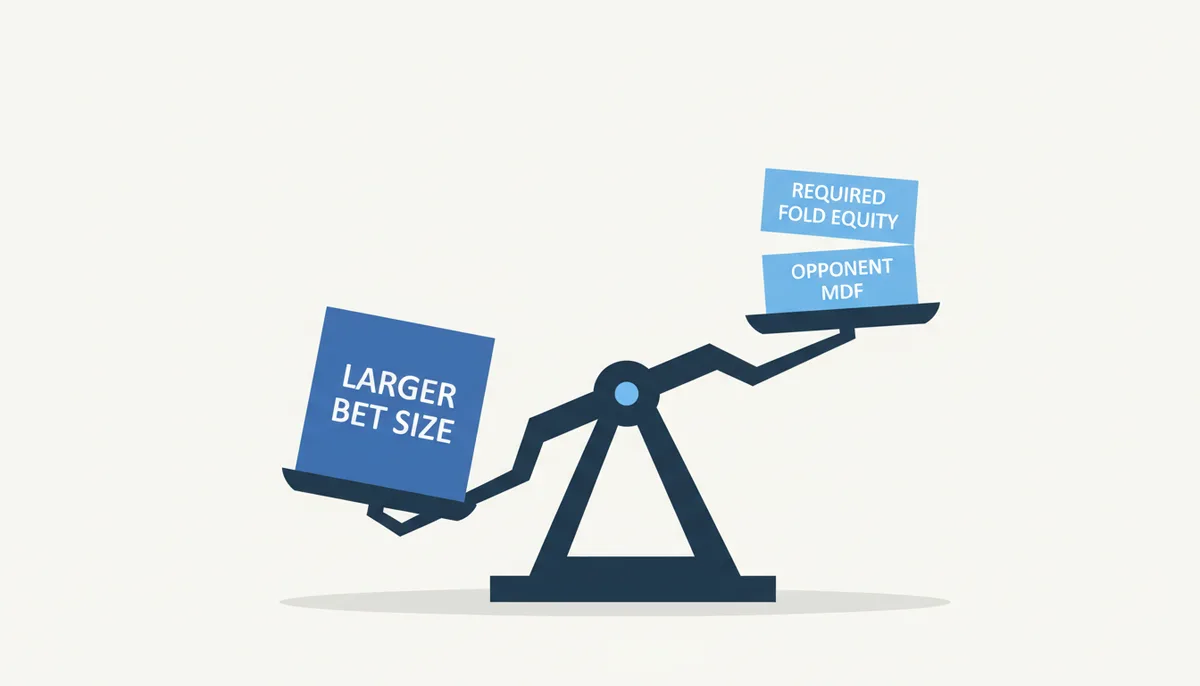
Bet size is the dial you control. You cannot force your opponent to fold, but you can choose a price that makes folding more attractive for them and more profitable for you when they do.
The direct trade-off is this: larger bets increase the fold equity you need, but they may also increase the fold equity you get. Smaller bets risk less and require fewer folds, but they leave more cheap calls available.
Use the breakeven formula to see the required fold equity across common sizes.
| Bet Size as % of Pot | Example with $100 Pot | Breakeven Formula | Required Fold Equity |
|---|---|---|---|
| 33% | Bet $33 | 33 / (33 + 100) | 24.8% |
| 50% | Bet $50 | 50 / (50 + 100) | 33.3% |
| 66% | Bet $66 | 66 / (66 + 100) | 39.8% |
| 100% | Bet $100 | 100 / (100 + 100) | 50.0% |
| 125% | Bet $125 | 125 / (125 + 100) | 55.6% |
Suppose you are deciding between a $25 bet and a $75 bet into a $100 pot. The $25 bet needs 20% folds. The $75 bet needs 42.9% folds. If you think your opponent folds 18% to the small bet but 45% to the large bet, the large bet is correct even though its alpha is higher.
Calculate the EV of each:
Small bet: EV = 0.18 × 100 − 0.82 × 25 = 18 − 20.5 = −$2.50.
Large bet: EV = 0.45 × 100 − 0.55 × 75 = 45 − 41.25 = $3.75.
The larger bet wins because it moves the folding frequency more than it moves the requirement.
But if the small bet gets 30% folds and the large bet gets 35% folds, the small bet is better:
Small: 0.30 × 100 − 0.70 × 25 = 30 − 17.5 = $12.50.
Large: 0.35 × 100 − 0.65 × 75 = 35 − 48.75 = −$13.75.
That is the real rule: do not choose the size with the lowest alpha. Choose the size whose expected folding frequency clears its alpha by the widest margin.
In practice, I default to smaller polarized bets when I have equity to lose less, and larger bets when I need to fold off marginal one-pair hands. A 33% pot bluff with a draw is often better than a pot-sized bluff with air, because the draw softens the called branch. A river overbet with air can be excellent against a cap range that cannot call three streets, but it is terrible against a player who calls down with second pair. The larger sizing is not worth the added risk when it buys only a few extra folds while making the called branch much more expensive. Choose the size that maximizes EV, not the one that merely feels intimidating.
What Makes a High Fold Equity Situation?
Some boards do the work for you. A high fold equity spot usually has at least one of these features: your range looks stronger, the board does not help your opponent’s calling range, you have position, or you hold blockers.
Range advantage means your perceived range contains more strong hands than your opponent’s. A preflop raiser often has more top pair, overpairs, and sets on a K-7-2 board than the big blind. If you bet that board, your range can credibly represent strength. The opponent’s calling range may be narrow: only kings, stronger pairs, or draws. That increases folds.
Board texture matters because it determines what hands can continue. Dry boards, such as K-7-2 rainbow, often produce many missed overcards and weak pairs. They can be good for pure bluffs when your range has the high cards. Wet boards, such as 9♠87♦, give opponents many draws and two-pair combinations. Pure air bluffs fare worse there, but semi-bluffs can thrive because you have equity when called.
Position is not just comfort. Acting last lets you see whether your opponent checks before committing. It also lets you control bet size and take a free card on later streets. Out of position, you must bet into uncertainty, and your bluff has to work more often because you cannot easily realize equity later. Button and cutoff bluffs generally carry more fold equity than blinds-to-late-position bluffs, all else equal.
Blockers remove combinations from your opponent’s range. They do not magically make someone fold. They change the math of what hands your opponent can hold.
Example: the board is K♠7♠2♦, and you hold A♠. The nut flush requires the ace of spades. You have it. Your opponent cannot have the nut flush. That makes a call with a lower flush or a bluff-catcher less attractive, because the strongest possible flush is gone from their range. On a paired board, holding the king can block trips or two pair. On an ace-high river, holding the ace can block a many ace-x calling hands, depending on the line.
Blockers are most powerful when they remove the exact hands your opponent needs to call. A blocker to the nuts is useful. A blocker to a hand they would fold anyway is noise.
The checklist I use before bluffing is narrow:
- Does my range represent the strength this bet requires?
- Does the board give my opponent enough obvious calling hands?
- Am I in position, or am I betting into a check-raise?
- Do my blockers remove key continuing combos?
- Is the opponent capable of folding the specific hand I am targeting?
If the answer to most of those is no, the formula does not save you. Fold equity is not a property of your cards alone. It is a property of the whole situation.
Common Mistakes When Applying Fold Equity In-Game
Most lost money comes from applying the formula to the wrong hand. The math can be correct and the play still bad because the input was fantasy.
Fancy Play Syndrome is the first trap. A player bluffs because the board looks scary, because they “represent” a hand, or because they feel due for a win. They calculate alpha but never estimate folding frequency. A 50% pot bet needs 33% folds. If the opponent is a calling station who folds 10%, the bluff is not close.
The second trap is bluffing your equity. This happens when a hand has real showdown value but you treat it as air. Suppose you have top pair with a weak kicker on a board where worse pairs fold and better hands call. Betting may accomplish nothing except folding out worse. Checking can let you reach showdown, induce a bluff, or call a smaller bet on a later street. The hand is not a pure bluff, and forcing it into a bluffing template throws away value.
The third trap is ignoring street dynamics. A player may have a 60% Fold to Flop C-Bet but a 20% Fold to River Bet. Bluffing the flop might be fine. Bluffing three streets into the same player can be disaster. The required fold equity is not one number for the whole hand. It changes by street, by bet size, and by the line you take.
The fourth trap is assuming all folds are equal. If your bluff only works against hands you were already beating, you may be hurting your value hands. If your bluff makes worse fold but better calls, your equity estimate was wrong. A bluff should target a specific portion of the opponent’s range, not “the board” in the abstract.
The fix is boring: write down the bet size, the pot, the required fold percentage, and the actual folding frequency you believe. If you cannot defend the last number with a stat, a tendency, or a visible pattern, do not make the play.
How Tournament Pressure (ICM) Changes Fold Equity
Cash games treat a chip as a chip. $100 is $100 whether you have a short stack or a big stack. Tournaments do not. Chip value changes with stack sizes, blinds, antes, and the payout structure. That is where the Independent Chip Model, or ICM, enters.
ICM converts chip stacks into tournament equity, meaning the share of the prize pool a stack is expected to win. A medium stack near the money bubble often has more to lose than a short stack. Bustling means losing the chance to cash or to move closer to a larger payout. Calling an all-in with a marginal hand can be -EV in chips but still correct, or vice versa, depending on the payout jump.
For bluffing, ICM creates pockets of high fold equity. A big stack can put pressure on medium stacks because those players are paying for survival. A medium stack facing a shove from a big stack may fold hands that would be clear calls in a cash game. The required fold equity may be ordinary, but the actual folding frequency rises because the opponent’s cost of calling is not just chips. It is tournament equity.
The bubble is the clearest example. Players who have not yet cashed often protect their tournament life aggressively. A bluff from a short stack into two medium stacks can fail because multi-way fold equity is low, but a shove from a big stack at the right moment can force many medium stacks to fold hands that are nominally ahead.
You must also invert the lesson. When you are the medium stack, your own calling range tightens. You are not just calculating whether your bluff has fold equity. You are calculating whether your opponent’s bet has enough fold equity against you to justify pushing. ICM does not only create bluffing spots. It creates traps for players who ignore payout pressure.
An ICM calculator can price these spots precisely, but the bluffing principle is simpler: find the player who is most afraid of elimination and bet into the part of their range that cannot afford to call. The trade-off is that your own bluff must be credible. If you shove too often from the big stack, medium stacks adjust and call with wider ranges, destroying the fold equity you were trying to harvest.
Questions That Come Up After the First Few Calculations
Is there a simple rule of thumb for fold equity when I can’t do the math?
Yes. For a half-pot bet, you need more than one-third folds. For a full-pot bet, you need more than one-half folds. Those are pure-bluff baselines. If your hand has equity, the required percentage drops. If you are multi-way, the required combined folding percentage becomes much harder to achieve.
How does fold equity work in multi-way pots?
It gets worse quickly. In a heads-up bluff, one opponent must fold. In a three-player pot, every opponent must fold for the pure bluff to win immediately. If each player folds 50% of the time, the chance both fold is 0.5 × 0.5 = 25%. That is why bluffing into multiple opponents with air is usually a leak. Semi-bluffs can still work because you have equity against calling ranges, but the fold-equity portion shrinks fast.
What’s the difference between ‘fold equity’ and ‘alpha’?
People use them interchangeably, but there is a useful distinction. Alpha is the required fold percentage for a bluff to break even. It is a number produced by bet size and pot size. Fold equity is the broader concept of value you gain from an opponent folding. Your bluff has alpha, and it succeeds when actual fold equity exceeds alpha.
Does my table image affect my fold equity?
Absolutely. A tight image increases fold equity because opponents respect your bets more. A loose-aggressive image decreases fold equity because opponents call down lighter. The same $50 bet into a $100 pot has the same alpha, but it does not have the same expected folding frequency. Adjust your bluff frequency to the image you have built, not the image you wish you had.
Should I be more willing to bluff when I have blockers?
Yes, when the blocker removes hands your opponent needs to call. Holding the ace on an ace-high board can block ace-x calling hands. Holding a king on a king-high board can block top pair. Holding the nut-flush blocker on a flush-completing river can remove the strongest flush combos. Blockers do not create folds by themselves. They change the combo count behind your opponent’s possible calling range.
How do I use the SorteCalc Fold Equity Calculator with this information?
Use it to remove the arithmetic step. Enter the pot size and your bet size, and it gives the required breakeven fold percentage. Then compare that number to your estimate of the opponent’s actual folding frequency. If the calculator says you need 33% folds and your read says the opponent folds 45%, the bluff has room. If your read says 20%, the calculator has told you what you already suspected: do not put the chips in.
Sources
- Two Plus Two Publishing — The foundational mathematical concepts of poker, including Expected Value (EV), pot odds, and equity, which are the building blocks of the fold equity formula.
- PokerTracker — The claims made about using a Heads-Up Display (HUD) and statistical software to estimate an opponent's folding frequencies based on stats like 'Fold to C-bet'.
- MIT Sloan Sports Analytics Conference — The application of advanced mathematical and game theory principles to competitive games like poker, validating the analytical approach to bluffing.