How to Estimate Slot Loss Per Hour From RTP and Bet Size
2026-11-20 · 20 min · 3,846 words
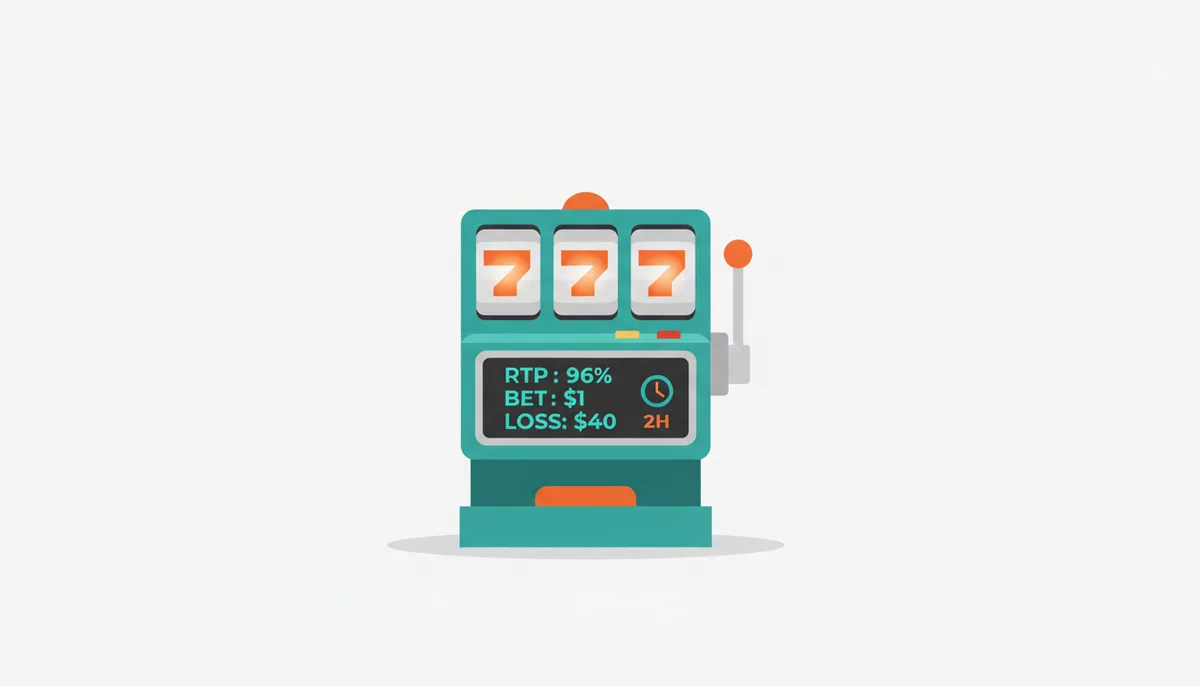
You walk into a casino and sit at a machine. You bet $1 per spin and play for two hours. You leave with $40 less than you started with. Most players call this "bad luck" or "the machine was cold." In reality, you just paid for two hours of entertainment. The problem is that most people don't know what the ticket price is until they've already paid it.
Treating a slot machine like a mysterious black box that occasionally gives money back is a mistake. A slot machine is a predictable mathematical engine. While any single spin is random, the cost of playing over a few hours is surprisingly stable. If you know three specific numbers, you can calculate exactly how much you're likely to lose per hour before you even press the "spin" button.
This shift in perspective—from "gambling for a win" to "paying for an experience"—is what separates professional bankroll management from emotional chasing. When you treat the expected loss as a subscription fee for the game, you stop panic-betting to "get back to even" and start managing your funds based on the actual math of the house edge.
The Three Core Variables: RTP, Bet Size, and Pace of Play
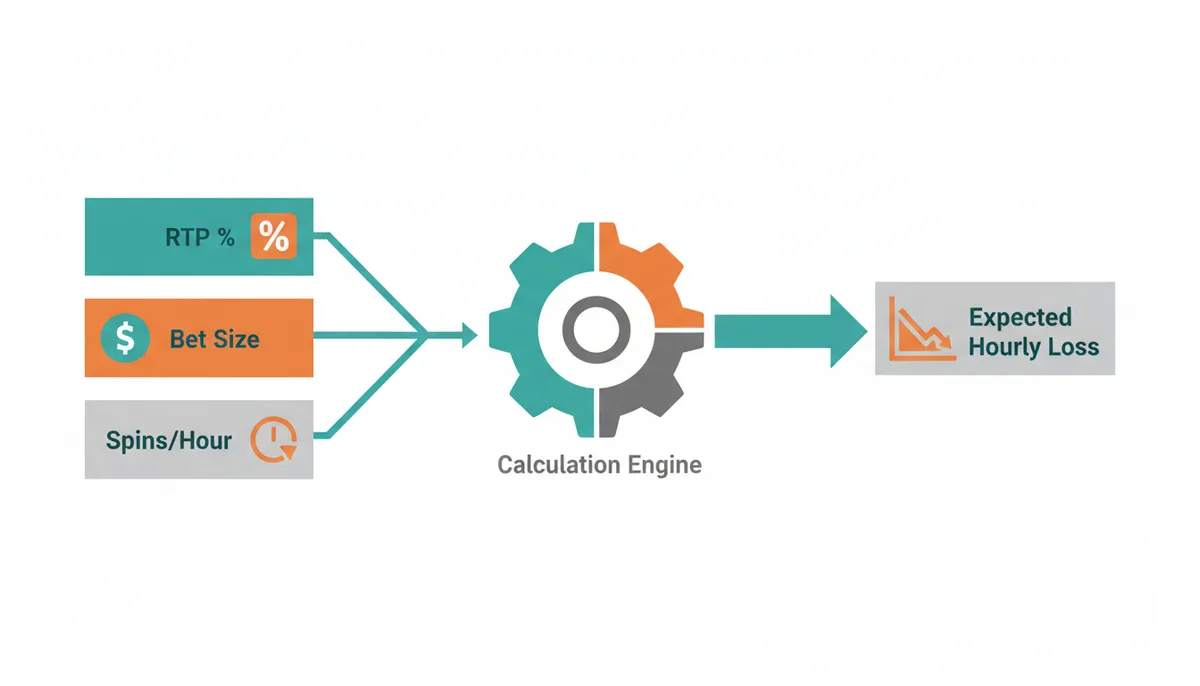
To calculate your hourly cost, you don't need to understand the complex code of a Random Number Generator (RNG). You only need three variables: the game's Return to Player percentage, your bet size, and your speed of play.
Return to Player (RTP) is the theoretical percentage of all wagered money that a machine will pay back to players over millions of spins. If a game has a 96% RTP, it means the machine is designed to keep 4% of every dollar bet. This 4% is the House Edge. It is the "tax" you pay for the privilege of playing. You'll find the RTP in the game's "Help" or "Info" section, usually mandated by regulators like the MGA or the UKGC.
Bet Size is the total amount you wager on a single spin. This isn't just the "coin" value; it's the total cost. If you are playing a game with 20 paylines at $0.10 per line, your bet size is $2.00. The math doesn't care how many lines you have; it only cares about the total amount leaving your balance every time you hit the button.
Pace of Play is where most players fail in their calculations. This is the number of spins you complete per hour. This varies wildly based on the game type and your behavior. A "fast" player on a simple 3-reel slot might hit 800 spins per hour. A player on a complex video slot with long animations, bonus rounds, and "big win" celebrations might only manage 400 spins per hour. If you're chatting with friends or taking breaks, that number drops further.
These three components—the game's math (RTP), your stake (bet size), and your exposure (pace)—determine your theoretical loss. If you change any one of them, the cost of your entertainment changes immediately.
The Formula: How to Calculate Your Theoretical Loss Per Hour
The formula for your expected hourly loss is straightforward. You are essentially calculating the "House Edge" applied to your total volume of betting per hour.
The Formula: Expected Loss = Bet Size × Spins Per Hour × House Edge
To use this, follow these steps in order:
- Find the RTP: Look for the percentage in the game info. Let's assume you find a game with 96% RTP.
- Calculate the House Edge: Subtract the RTP from 100%. (100% - 96% = 4%). In decimal form, this is 0.04.
- Estimate your pace: Decide how many spins you actually do per hour. Let's use a realistic average of 600 spins per hour.
- Determine your bet: Decide your stake per spin. We'll use $1.00 for this example.
- Calculate total hourly handle: Multiply bet size by spins per hour ($1.00 × 600 = $600). This is the total amount of money you are "cycling" through the machine every hour.
- Apply the House Edge: Multiply the handle by the house edge ($600 × 0.04 = $24).
In this scenario, your expected loss is $24 per hour. If you plan to play for four hours, you should budget roughly $96 for the experience. Anything you walk away with above that is a statistical anomaly; anything below it is simply the math working as intended.
The "total hourly handle" is a critical concept. It's why high-limit rooms are so profitable for casinos. A player betting $100 per spin at 600 spins per hour is cycling $60,000 through the machine every hour. Even with a generous 97% RTP (3% edge), that player's expected loss is $1,800 per hour.
Putting It Into Practice: Sample Loss Calculations
The impact of these variables isn't linear—small changes in RTP or bet size can lead to massive swings in your hourly cost. Consider how the cost changes when you move from a "loose" online slot to a "tight" airport slot.
Scenario A: The Budget Player
You play a high-RTP online slot (98%) betting $0.50 per spin, moving at a moderate pace of 600 spins/hour.
$0.50 × 600 × 0.02 = $6.00 per hour loss.
Scenario B: The Average Casino Guest
You play a standard Vegas slot (94%) betting $2.00 per spin, moving at 600 spins/hour.
$2.00 × 600 × 0.06 = $36.00 per hour loss.
Scenario C: The High-Roller
You play a high-volatility progressive slot (90%) betting $5.00 per spin, moving at 600 spins/hour.
$5.00 × 600 × 0.10 = $300.00 per hour loss.
Notice that in Scenario C, the loss isn't just higher because the bet is larger; it's higher because the RTP is lower. A 10% house edge is devastating over time. This is why choosing a game with a 96% RTP over a 90% RTP game saves you $24 per hour for every $600 wagered.
| Bet Size | RTP 98% (2% Edge) | RTP 96% (4% Edge) | RTP 94% (6% Edge) |
|---|---|---|---|
| $0.50 | $6.00 | $12.00 | $18.00 |
| $2.00 | $24.00 | $48.00 | $72.00 |
| $5.00 | $60.00 | $120.00 | $180.00 |
Note: All calculations assume a constant pace of 600 spins per hour.
It is vital to remember that this number is a theoretical average. If you play for one hour, you might end up up $500 or down $200. The "expected loss" is the average result if you played that exact same game for 10,000 hours. For a single session, this number serves as a budget guide, not a guarantee.
The Missing Piece: Why Volatility Determines Your Actual Experience
If two slot machines both have a 96% RTP, you might assume they cost the same and feel the same. This is false. The difference lies in volatility (also known as variance).
Volatility describes the "bumpiness" of your bankroll's journey. A low-volatility game is designed to pay out small amounts frequently. You'll see a lot of "wins" that are actually just small portions of your bet returned to you. Your balance will decline slowly and steadily. These games are for players who want their session to last as long as possible.
A high-volatility game is the opposite. It is designed to pay nothing for long stretches and then occasionally hit a massive payout. These games have a "top-heavy" pay table. You will experience "dead spins" where you lose money for 20 minutes straight, followed by a single hit that might pay 50x or 100x your bet. Your balance will swing wildly.
Here is the danger: high volatility increases your risk of ruin. Even if the expected hourly loss is $24, a high-volatility game can wipe out a $100 bankroll in 15 minutes if you don't hit a bonus. A low-volatility game with the same $24 hourly loss would almost certainly last you several hours with a $100 bankroll.
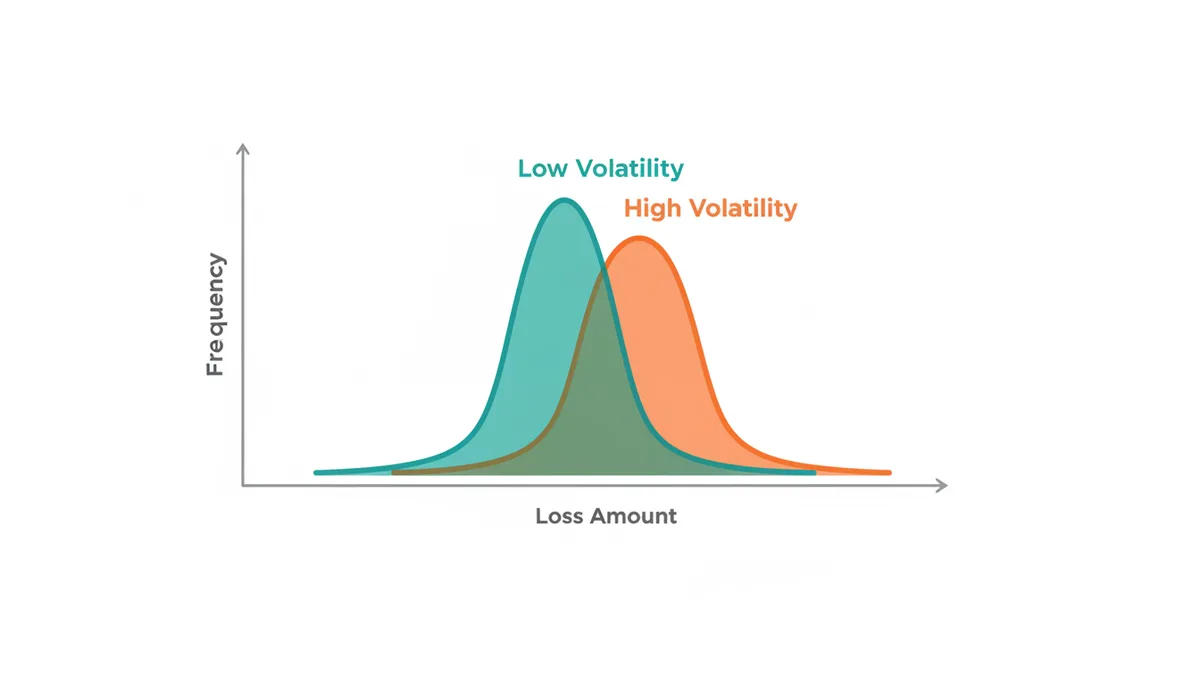
When you choose a game, you are choosing your preferred "ride." If you have a small budget and want to play for four hours, avoid high-volatility slots. You'll likely go bust before the math has a chance to average out. If you are "jackpot hunting" and are comfortable losing your entire budget quickly for a chance at a massive win, high volatility is your only option.
How Features Like Jackpots and Bonus Rounds Fit In
The advertised RTP is often a simplification. When a developer says a game has a 96% RTP, that number is an average that includes all possible outcomes in the pay table, including the Progressive Jackpot and the Bonus Rounds. This is where the "Effective RTP" comes into play during a real session.
In progressive slots, a portion of the RTP is tied to the jackpot. Because the odds of hitting that jackpot are extremely low, the vast majority of players will never experience that part of the payout. For these players, the game effectively operates at a lower RTP than the advertised total, as the rare, massive jackpot wins subsidize the losses of the general player base. This is why progressive slots often feel "tighter" than standard games.
Similarly, bonus rounds (Free Spins, Pick-em games) concentrate a significant portion of the RTP into a single event. For example, if a game's RTP is 96%, but a large share of that is locked in the "Free Spins" feature, the base game (the spinning reels) pays back relatively little. If you have a session where you never trigger the bonus, your actual loss will be significantly higher than the theoretical hourly loss.
Then there is the "Feature Buy". Some modern slots allow you to pay a premium to skip the reels and go straight to the bonus round. While the mathematical RTP of the feature itself remains consistent, this dramatically increases your hourly cost. By removing the "dead spins" and jumping straight to the high-variance part of the game, you accelerate your exposure to the house edge. You are essentially playing a "compressed" version of the game, which can exhaust a bankroll much faster than standard play.
From Math to Money Management: Using This Calculation for Your Bankroll
Once you have your expected hourly loss, you can stop guessing and start budgeting. The most common mistake players make is bringing a bankroll that is exactly equal to their expected loss. If your expected loss is $25/hour and you bring $75 for a three-hour session, you are likely to go bust before the third hour because you haven't accounted for volatility.
The Budgeting Framework: Use your hourly loss as a baseline, then add a "volatility buffer" based on the game's behavior. For low-volatility games, a smaller buffer is usually sufficient to withstand natural dips. For high-volatility games, you need a significantly larger cushion to survive the long droughts between hits without hitting zero.
You should also use these numbers to set a Stop-Loss and a Win Goal. A stop-loss is the point where you walk away to protect your remaining funds. If your budget was $100 and you're down to $20, the math tells you that the "luck" hasn't shifted—you're just in a standard downswing. Accepting this allows you to leave the table without the emotional urge to "chase."
Conversely, a win goal prevents you from giving back your winnings. Because the house edge is constant, the longer you play, the more likely you are to converge toward that theoretical loss. If you've had a "lucky" spike that puts you $200 above your starting bankroll, the math suggests that the most likely outcome for the next few hours is a regression toward the average. That is the time to cash out.
| Player Goal | Suggested Volatility | Conservative Planning Strategy | Bet Sizing Rule of Thumb |
|---|---|---|---|
| Maximize Play Time | Low | Small buffer (e.g., 5x hourly loss) | Very small fraction of bankroll |
| Steady Entertainment | Medium | Moderate buffer (e.g., 10x hourly loss) | Small fraction of bankroll |
| Chase a Big Win | High | Large buffer (e.g., 20x hourly loss) | Moderate fraction of bankroll |
Where to Find Reliable RTP and Volatility Information
You cannot trust a random "Slot Review" blog for accurate RTP numbers. These sites often use outdated data or generic numbers. To get the real figures, you must go to the source.
1. The In-Game Help Menu: In regulated markets (UK, Malta, New Jersey, etc.), developers are required to list the RTP within the game's internal "i" or "Help" menu. This is the only 100% accurate number for that specific version of the game. Always check here first.
2. Regulatory Bodies: If you are unsure about a game's fairness, look for certifications from GLI (Gaming Laboratories International) or eCOGRA. These agencies test the RNG and the RTP to ensure they match the advertised specs.
3. Developer Documentation: Large providers like NetEnt or Pragmatic Play often list the RTP for their games on their official B2B portals. However, be careful: some developers offer "variable RTP" ranges (e.g., 92% to 96%), allowing the casino to choose which version to install. In this case, the in-game menu is the only way to know which version you are playing.
As for volatility, it is rarely published as a hard percentage. You will usually see it listed as "Low," "Medium," or "High." If the game has a massive jackpot but very few small wins, it's high volatility. If it has constant small wins and a small top prize, it's low. When in doubt, check the pay table: if the top prize is 10,000x the bet, the volatility is high. If the top prize is 50x, it's low.
The 'Sunk Cost' Trap: When Math Collides with Psychology
The theoretical hourly loss is a cold, hard number, but the human brain does not operate on mathematics when money is on the line. The most dangerous mistake a player can make is using the "Expected Loss" formula to justify staying at a machine after a bad run. This is the "Sunk Cost Fallacy"—the belief that because you have already lost $100, you are "due" for a win to break even, or that the machine is "overdue" for a payout.
From a mechanism standpoint, slot machines have no memory. The Random Number Generator (RNG) produces a new result for every single spin, regardless of whether the previous 50 spins were losses. If your expected loss is $25 per hour, and you have already lost $100 in the first hour, your expected loss for the second hour remains exactly $25. The machine does not "owe" you a win to bring the average back to the theoretical RTP. The math only averages out over millions of spins; it does not "self-correct" over a single afternoon.
When you see your balance dropping faster than your calculated hourly loss, you are experiencing "negative variance." The temptation is to increase your bet size to recover the loss quickly. This is a mathematical disaster. If you double your bet size from $1.00 to $2.00, you aren't increasing your chance of winning; you are doubling your hourly cost of play. You are effectively paying the casino twice as much for the same amount of entertainment time, which accelerates your journey toward a zero balance.
To combat this, you must treat your session budget as a "spent" expense the moment you sit down. If you bring $200 for a four-hour session, tell yourself that money is already gone. When you view the budget as an entry fee rather than a balance, the emotional pull of the "Sunk Cost" disappears. You stop playing to "get back to even" and start playing until the time you allocated is up, regardless of the balance.
Worked Example: The 'Weekend Trip' Budget Breakdown
To see how these variables interact in a real-world scenario, let's map out a full weekend of gambling. Assume a player, Sarah, has a total budget of $600 for a two-day trip. She wants to balance "safe" play with a few "big win" attempts. She splits her time between two different types of machines: a low-volatility "classic" slot and a high-volatility "modern" video slot.
Session 1: The Low-Volatility 'Safe' Play
Sarah spends 4 hours on a classic slot with 96% RTP. She bets $2.00 per spin and averages 600 spins per hour.
- Hourly Handle: $2.00 × 600 = $1,200
- House Edge: 4% (0.04)
- Expected Hourly Loss: $1,200 × 0.04 = $48
- Total Expected Loss for 4 hours: $192
Session 2: The High-Volatility 'Jackpot' Chase
Sarah spends 2 hours on a high-volatility video slot with 92% RTP. She increases her bet to $5.00 per spin to hunt for the bonus round, still averaging 600 spins per hour.
- Hourly Handle: $5.00 × 600 = $3,000
- House Edge: 8% (0.08)
- Expected Hourly Loss: $3,000 × 0.08 = $240
- Total Expected Loss for 2 hours: $480
By calculating this in advance, Sarah realizes that Session 2 is 5x more expensive per hour than Session 1. She can now make a conscious decision: is the thrill of the high-volatility game worth $240/hour, or would she rather have 10 hours of play on the classic machine for the same cost?
Edge Cases: Variable RTPs and 'Tipping' the Math
While the standard formula works for most games, there are specific edge cases where the math shifts. The most common is the Variable RTP. Many modern game developers provide casinos with a range of RTP settings (e.g., 92%, 94%, and 96%). The casino decides which one to install. If you are playing a game where the developer lists several different RTPs, you should assume the lowest one is installed unless the casino explicitly states otherwise. This means your expected hourly loss could be significantly higher than you calculated if you assumed the "top" RTP.
Another edge case is the 'Max Bet' Requirement. In some older machines and certain progressive slots, you only qualify for the top jackpot if you bet the maximum amount. If the jackpot is large enough, the "Effective RTP" of the Max Bet might be higher than that of the Min Bet. In this specific instance, betting more money reduces the house edge percentage. However, this comes with a trade-off: you are playing with a larger sum of money, which increases the dollar volatility and can exhaust a bankroll much faster if the hits do not come.
Finally, consider the impact of Comps (Complimentary Play). Casinos often track your "Theoretical Loss" (T-Loss) using a player's card. If the casino knows your expected loss is $50/hour based on your bet size and the game's RTP, they may offer you a free meal or a room upgrade once your T-Loss hits a certain threshold. This doesn't change the math of the game, but it changes the total cost of entertainment. For example, if your expected loss is $50 per hour but the casino gives you $20 in usable comp value (like a food credit), your effective entertainment cost for that hour is reduced to $30. Professional players use this to offset the house edge, though it never turns the game into a winning proposition.
FAQ
Why did I lose $200 in an hour when the calculation said my expected loss was only $40?
The calculation provides a long-term average, not a per-session guarantee. Volatility means your actual results will deviate from the average. You experienced a "downswing." Over 1,000 hours of play, your average loss would settle near $40, but in any single hour, losing $200 (or winning $500) is entirely possible and statistically normal.
Is a slot with a 98% RTP always better than one with 95%?
Mathematically, yes. Over a long enough period, you will keep 3% more of your money. However, "better" depends on your goal. If the 95% game has high volatility and a huge jackpot, and you are playing specifically to win a life-changing amount, the 95% game is "better" for that goal, despite the higher cost of play.
Can a casino change the RTP of a machine while I'm playing?
No. This is one of the most common gambling myths. In regulated jurisdictions, the RTP is hard-coded into the game's software and certified by third parties. Changing the RTP would require a technical update to the game's logic and a new round of compliance testing. The machine doesn't "know" you're winning or losing and cannot adjust its payouts on the fly.
Is RTP the same thing as hit frequency?
No. Hit frequency is how often you see a "win" animation (any win, even one that pays back less than your bet). RTP is the total amount returned. A game can have a very high hit frequency (winning 30% of spins) but a low RTP if those wins are mostly small. Conversely, a high-volatility game might have a low hit frequency (winning 10% of spins) but a high RTP because the few wins it does pay are massive.
How do progressive jackpots affect the calculation?
Progressive jackpots "steal" RTP from the base game. A large chunk of the advertised RTP is tied up in the jackpot pool. For the vast majority of players who don't hit the jackpot, the effective RTP is significantly lower than the number listed in the help menu. You are essentially playing a lower-RTP game that contributes to a prize you will likely never win.
Does my bet size affect the game's RTP?
Generally, no. The RTP is a percentage of whatever you wager. Whether you bet $0.10 or $10, the machine is designed to return the same percentage over time. The only exception is in some older games where you must bet the "Max Bet" to qualify for certain bonus tiers or the progressive jackpot; in those specific cases, the RTP is higher at the max bet.
Sources
- UK Gambling Commission (UKGC) — Official definitions of Return to Player (RTP) and regulatory requirements for game developers to display this information to players.
- American Gaming Association (AGA) — Industry standards, statistics on casino revenue, and research on player behavior and the economics of gaming.
- Gaming Laboratories International (GLI) — Explaining the role of independent testing labs in verifying the fairness and randomness (RNG) of slot games and certifying their RTP percentages before they reach the casino floor.
- Malta Gaming Authority (MGA) — Rules and directives for online gaming operators, including transparency requirements for RTP and game rules, which serve as a model for many jurisdictions.