When ICM Turns a Profitable Chip Play Into a Tournament Mistake
2026-10-18 · 39 min · 7,761 words
You have 2,800 chips. The big blind is 300/600 with a 600 ante. The final table bubble is four spots away. You are in the cutoff with Ace-Seven offsuit. The button folds. The small blind folds. You raise to 1,350. The big blind 3-bets to 4,000 and you call. The flop comes A-9-2 rainbow. You bet 2,400 into the 10,800 pot. He shoves all-in for his remaining 18,400. You snap-call with your pair. He shows K-K and the river bricks a king. You lose. You now have 1,050 chips left, which is just 3 big blinds. You will fold every hand for the next 30 seconds, then bust on a small-blind double-up when the blinds go up.
You lost the hand with the better starting hand. You had positive expected value going into the flop. You were ahead post-flop. The math was on your side. But your real-money outcome was a loss of approximately $800 in prize equity because busting here means falling five spots short of the money. Every dollar you put in that pot cost you more than the chips it won. That is the Independent Chip Model in action, and it is the reason the majority of tournament poker players lose more money than they should despite "playing the percentages correctly."
This article explains how to stop making that mistake. You will learn to recognize ICM pressure spots, calculate your risk premium, push ranges that survive real-money pressure, and use the SorteCalc ICM Calculator to off-table study the exact situations that destroy bankrolls. The principle is simple: chips in a tournament are not linear. Their value changes depending on where you sit, who sits across from you, and what payout jumps lie ahead. Once you internalize that fact, the decisions that felt impossible suddenly have structure.
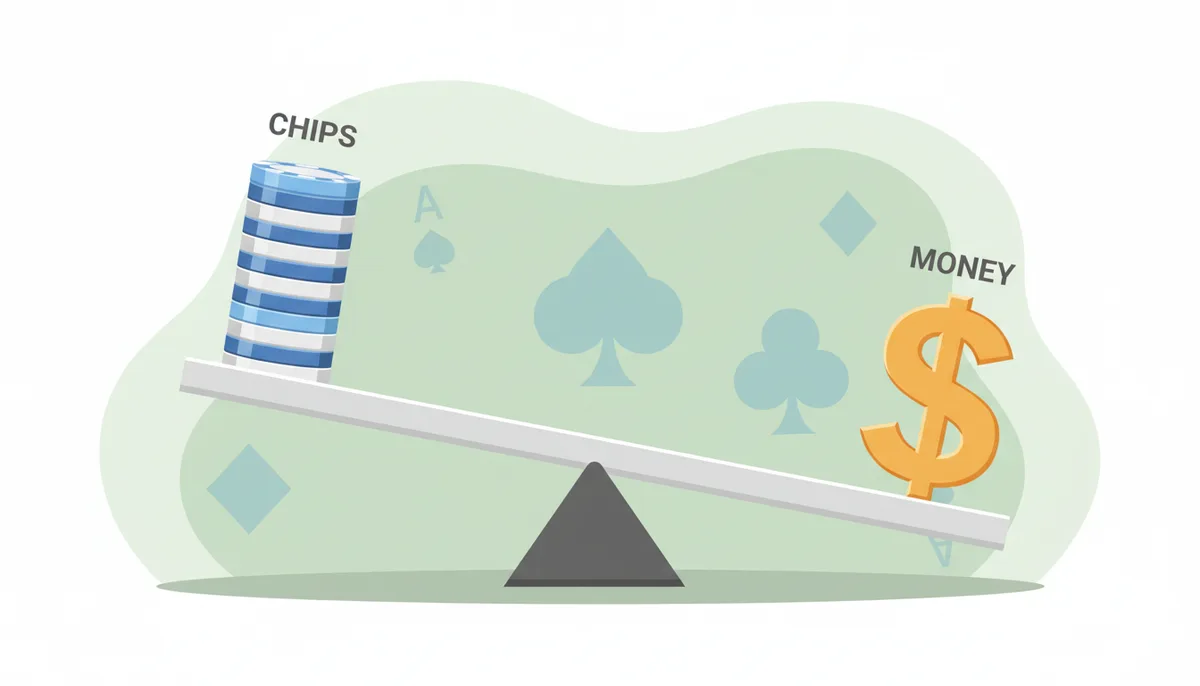
Chips Aren't Dollars: The Fundamental Principle of Tournament Equity
In a cash game, a chip is a chip is a chip. Every chip you put on the table has a fixed monetary equivalent. Fold a hand, you keep the chips. Win a pot, you keep the chips. Your stack size fluctuates, but the relationship between chips and real money never changes. A 1,000-chip stack is worth exactly twice a 500-chip stack. Double your chips, double your cash value. This linearity is why cash game strategy is straightforward: maximize expected value in chips, and you maximize expected value in dollars.
Tournaments do not work that way. The first chip you accumulate is worth more than the last. The last 500 chips in your stack might be worth a fraction of a cent each, while the first 500 chips in your stack could represent hundreds of dollars of survival probability. This non-linearity is the entire reason ICM exists. It is not a theoretical curiosity. It is the mathematical mechanism that converts your stack of chips into a dollar value.
Consider a thought experiment with 10 players remaining in a $1,000 buy-in tournament. The prize pool is $9,000 after the house takes $1,000. The payout structure is 1st: $3,000, 2nd: $2,000, 3rd: $1,500, 4th: $1,000, and 5th through 10th: $500 each. If every player had exactly the same stack, their equity would be the same: $900 each, which is 90% of their buy-in. Now imagine the chip distribution shifts so that one player holds 40% of all chips in play. That player does not hold 40% of the prize pool. Their equity is closer to 45% to 50% of the prize pool, depending on the exact distribution, because the 1st place payout is capped at $3,000 and the deeper stacks gain diminishing returns as their probability of finishing first approaches 100%.
The reason you cannot simply count chips is that the payout structure introduces a cliff. The difference between finishing 10th and finishing 5th is zero dollars in payout but represents a massive swing in equity. The difference between finishing 1st and 2nd might be $1,000 in real money but only 5% of the chips in play at the table. Your stack size determines your probability of finishing in each payout position. ICM takes those probabilities and multiplies them by the payouts to give you a real-money value for your stack.
When you are far from the money bubble, chip value approximates dollar value closely enough that you can mostly ignore ICM. But as the field shrinks and payout jumps become meaningful, the divergence accelerates. At a final table with six players remaining and the top three payouts dramatically larger than the rest, a single call can be the difference between walking away with $5,000 and walking away with $1,200. No amount of chip accumulation during the hand can compensate for that difference. That is why the mistake of winning a pot but losing money exists: you optimized for the wrong metric.
Introducing the Independent Chip Model (ICM): Valuing Your Tournament Life
ICM stands for the Independent Chip Model. It is the standard method for calculating the real-money value of tournament chip stacks. The model was originally developed by David Sklansky and Mason Malmuth, who adapted it from the Malmuth-Harville model used in horse racing to predict the probabilities of different finishing orders. The core assumption is straightforward: each player's probability of finishing in any given position is proportional to their stack size relative to the total chips in play, independent of any other player's skill or playing style.
ICM does not predict how the tournament will actually play out. It calculates what the dollar value of each player's current stack would be if the remaining players were all equal in skill and simply ran the blinds down until one player held all the chips. It is a valuation tool, not a prediction tool. It answers the question: given these stack sizes and this payout structure, what is your stack worth in real money right now?
The calculation works in layers. First, ICM computes the probability that each player finishes first, second, third, and so on. For a simplified three-player example: Player A has 5,000 chips, Player B has 3,000 chips, and Player C has 2,000 chips. The total chips in play are 10,000. Player A's probability of finishing first is 50%. Player B's is 30%. Player C's is 20%. Those are straightforward proportions. But Player A's probability of finishing second is more complex: it is the probability that Player A does not finish first, multiplied by the weighted average of the probabilities that Players B and C finish first given that Player A is not first. The math gets recursive quickly, which is why you use a calculator. But the principle is simple: ICM assigns a probability to every possible finishing position for every player, then multiplies those probabilities by the corresponding payouts and sums the results.
The output is a dollar value for each player's stack. If the tournament is a $500 buy-in with a $45,000 prize pool distributed across ten players, and Player A's stack computes to $6,200 in $EV, that means Player A's current chip stack is worth $6,200 in real-money terms. If Player A's buy-in was $500, their current equity represents a 12.4x return on investment at that moment. That number changes every hand. When Player A wins a pot and grows to 6,000 chips, their $EV increases—but not in direct proportion to the chip gain. The extra 1,000 chips are worth less in dollar terms than the first 1,000 chips they accumulated.
ICM is not the only model that exists. Future Game Simulation (FGS) accounts for player skill differences and position. GTO solvers compute Nash Equilibrium ranges that incorporate stack dynamics and payout structures in more granular ways. But ICM remains the industry standard because it is computationally tractable, transparent, and accurate enough to make decisions that are significantly better than chip-counting alone. You do not need perfect precision. You need the correct directional signal. ICM provides that signal in the spots where it matters most.
cEV vs. $EV: The Two Competing Logics of Tournament Poker
Every poker decision in a tournament can be evaluated through two competing lenses. The first is Chip Expected Value, or cEV. The second is Dollar Expected Value, or $EV. cEV measures the expected change in your chip stack. $EV measures the expected change in your real-money equity. In a cash game, the two are identical. In a tournament, they frequently diverge, and the divergence is what separates profitable tournament players from those who bleed chips in high-pressure spots.
cEV is calculated the same way it is in a cash game. You estimate your hand's equity against your opponent's range, multiply that equity by the total pot size after the call, subtract your cost to call, and the result is your expected chip gain or loss. If the result is positive, the call is profitable in chips. Pot odds are calculated by dividing the pot size before your call by your call amount. If the pot offers you 3-to-1 odds, you need at least 25% equity to break even. If your hand has 36% equity, you call. You expect to win 36 cents for every dollar you invest, which is a positive return.
$EV is calculated through ICM. You run the same hand scenario through an ICM calculator, which computes your tournament equity before the decision, after a fold, and after a call (and subsequent win or loss). The difference between your equity after the call and your equity before the call is your $EV. If folding keeps your equity at $3,400, and calling results in an equity of $3,350 even though you win the pot 36% of the time, your $EV for calling is negative. You lose $50 in real-money equity by making a +cEV call.
Here is a concrete example. You are 6-handed in a $100 buy-in tournament. The payout structure is 1st: $500, 2nd: $280, 3rd: $160, 4th: $80, 5th: $40, 6th: $20. There are six players left. Your stack is 12,000 chips. The big blind has 8,000 chips. The small blind has 5,000 chips. The other three players have between 3,500 and 4,000 chips. You are in the hijack with 9-9 and raise to 1,500. The big blind calls. The flop comes 9-4-2 rainbow. You bet 5,000. He shoves over the top of your bet, putting his remaining 5,000 chips in. You have to call 5,000 to win a pot of 11,000 chips. The pot odds are 11,000 divided by 5,000, which is 2.2-to-1. Against a range of overpairs and strong jacks, 9-9 holds roughly 54% equity, which means your cEV is positive by 3,640 chips.
But let us run this through ICM. Your current equity in the tournament is approximately $410. Calling and winning moves you to a stack that values at approximately $620. Calling and losing drops you to a stack worth $0. Folding keeps you at $410. The weighted $EV of calling is 0.54 × $620 + 0.46 × $0 = $334.80. Folding gives you $410. Calling loses you $75.20 in dollar equity. A +cEV call is a -$EV decision. The call wins chips but costs real money.
| Metric | cEV Calculation | $EV Calculation (ICM) |
|---|---|---|
| Pot Size Before Call | 11,000 chips | $EV before decision: $410.00 |
| Your Equity | 54% hand equity | 54% equity in winning outcome |
| Cost to Call | 5,000 chips | Risking your stack down to $0 |
| Odds Received | 2.2-to-1 (11,000 / 5,000) | — |
| cEV of Call | +3,640 chips | — |
| $EV of Folding | — | $410.00 |
| $EV of Calling | — | $334.80 |
| Decision | Call: +cEV | Fold: higher $EV |
The table above shows the divergence in a single decision. The cEV column tells you the call wins chips on average. The $EV column tells you the call costs you real-money equity. The two logics conflict because the downside loss (elimination to a $0 stack) outweighs the upside gain (growing to a stack worth $620), even though the upside is more probable. The payout structure creates an asymmetry that chip mathematics alone cannot see.
Calculating Your 'Risk Premium': The Price of Survival
Risk premium is the extra equity your hand must hold, above and beyond the pot odds the pot is offering, to justify a risky call in a tournament. It is the cost of survival. When the pot offers you 2-to-1 odds, you need 33% equity to make a +cEV call. With a risk premium of 15%, you actually need 48% equity. The 15% is the price you pay for the possibility of being eliminated from the tournament. It is the gap between what the pot pays you and what your tournament life is worth.
Risk premium is not a fixed number. It changes based on two variables: the payout structure and the stack distribution at the table. Bigger payout jumps create higher risk premiums. A jump from 5th place ($40) to 4th place ($80) doubles your payout. A jump from 2nd place ($280) to 1st place ($500) increases your payout by 78%. Each jump increases the cost of elimination for players who are close to the money. If you are one spot away from doubling your payout by surviving, the risk premium for any call that risks elimination becomes extremely steep.
Stack distribution also matters. When there is a short stack at the table, the risk premium for everyone increases. A player with 6 big blinds is likely to get shoved into by the short stack or shove in themselves. When that player folds, they preserve a stack that retains significant value. When they call and lose, they bust immediately. The presence of that short stack means the medium stack's risk premium is higher than it would be if all players had equal stacks. The chip leader's risk premium is lower because they can absorb a loss without eliminating themselves.
To quantify risk premium for your specific situation, you use the SorteCalc ICM Calculator. Enter the stack sizes, the payout structure, and the hand equity. The calculator returns the $EV of folding, the $EV of calling and winning, the $EV of calling and losing, and the weighted $EV of calling. The difference between the $EV of calling and the $EV of folding is your net risk premium. If folding gives you $400 in equity and calling gives you $390, your risk premium for this spot is $10 in dollar terms. That $10 is the amount your hand needs to be worth beyond the pot odds to make the call profitable. In chip terms, it translates to roughly 10% to 25% additional equity depending on the severity of the payout jump and the stack sizes involved.
Here is how you apply this at the table. You do not calculate risk premium in real time. You build intuition through off-table study. Run the same spot 20 times through the SorteCalc ICM Calculator with different stack sizes and payout structures. Notice how the risk premium changes. A medium stack facing a shove from the big blind with a payout jump three spots away will consistently show a risk premium of 15% to 25%. When you internalize that number, you stop thinking in terms of "the pot is offering good odds" and start thinking in terms of "I need at least 50% equity here, not 35%." That shift in thinking is the difference between breaking even in tournaments and building a bankroll.
The key insight is that risk premium is always asymmetric. The cost of losing is permanent—busted. The benefit of winning is temporary—chips that will be risked again in future hands. ICM captures this asymmetry. cEV does not. Once you understand that every call you make carries a hidden tax on your equity, you begin folding hands that you previously called because the pot offered decent odds. You are not folding because you are afraid. You are folding because the math says survival has a higher expected value than the chips on the table.
The Anatomy of an ICM Spot: A Real-Time Recognition Guide
ICM pressure does not appear everywhere. It concentrates in specific structural situations. Recognizing those situations in real time is more important than memorizing charts or solver outputs. If you can identify a high-pressure ICM spot at the table, you immediately know to widen the gap between your cEV threshold and your actual hand strength before making a call. Here is how you spot them.
The first ingredient is proximity to a payout jump. The money bubble is the most obvious. When you are five or six spots away from the money with ten players remaining, every elimination pushes you closer to a doubling or tripling of your payout. The final table bubble is even more extreme. In a ten-handed tournament that pays the top eight, finishing ninth and tenth both pay $40. Finishing eighth pays $80. The jump from tenth to eighth is 300% in payout value, and the entire bubble pressure concentrates on the players who are one or two spots away from the top eight. But payout jumps are not limited to the bubble. At a final table, the jump from 4th to 3rd, 3rd to 2nd, and 2nd to 1st each carry their own pressure gradients. A player in 4th place with a medium stack faces higher risk premiums than a player in 1st place with the same stack size.
The second ingredient is large stack size disparities. When one player has 40% of the chips in play and another has 3%, the medium stacks are trapped. They cannot call a shove from the big stack without risking elimination, but they also cannot fold to every shove because they are being blinded out. The chip leader exploits this by shoving wider than cEV would suggest, knowing the medium stacks are forced to fold hands with positive cEV. The short stack exploits it by shoving very wide, knowing the medium stacks will fold and the big stack will only call with premium hands. This creates a pocket of extreme pressure in the middle of the table where $EV decisions dominate.
The third ingredient is the presence of one or more very short stacks. A player with fewer than 10 big blinds is an ICM catalyst. Their impending elimination changes the risk premium for every player at the table. When a short stack is about to go all-in, the medium stacks know that if they survive this hand, the short stack will likely bust and the blinds will effectively decrease for the remaining players. This makes survival more valuable, which increases the risk premium for any call that risks elimination. The short stack themselves should not calculate their risk premium carefully because their options are limited: push or fold. But the players facing them must adjust.
VISUAL: FIGURE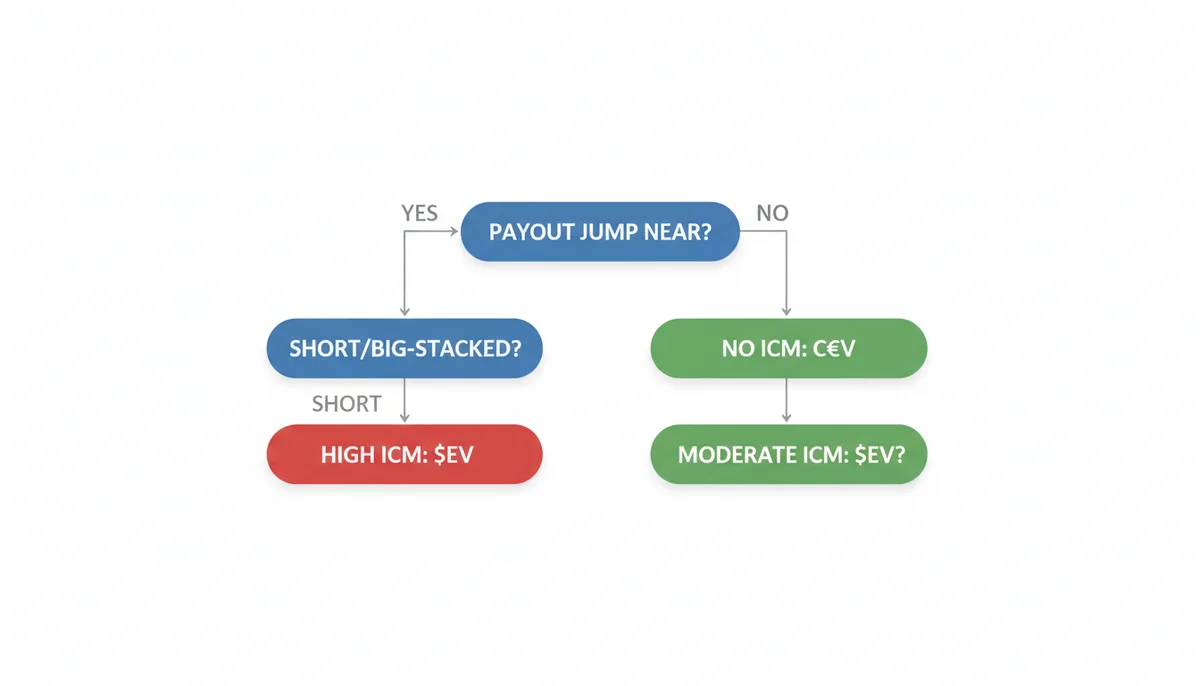
Early-stage tournaments have none of these ingredients. All players have roughly equal stacks. The payout structure is irrelevant because you are nowhere near elimination from the money. cEV is a reliable guide because the risk premium is close to zero. As the tournament progresses and stacks diverge and the money approaches, the risk premium rises. At the final table, the risk premium can be so large that a player with 70% equity against an opponent's range must still fold because the downside loss of elimination outweighs the upside gain of winning the pot. The flowchart above is not a decision tree you follow during a hand. It is a mental framework you use after the fact to analyze your decisions and understand why a particular spot was high-pressure. Over time, the pattern recognition becomes automatic.
Weaponizing ICM: How Big Stacks Can Bully the Table
Most players think about ICM defensively: how to avoid making mistakes when under pressure. But ICM is also an offensive weapon. If you are the chip leader, your stack size creates leverage. You can apply pressure to medium stacks in a way that forces them to fold hands with positive cEV. This is not speculation. This is a mathematical certainty created by the payout structure.
Consider a three-handed final table situation. Player A (you) has 25,000 chips. Player B has 10,000 chips. Player C has 5,000 chips. The payouts are 1st: $5,000, 2nd: $3,000, 3rd: $1,500. Player B is in the big blind with a stack worth approximately $2,100 in $EV. Player C is worth $1,300. You are worth $3,600. Player B knows that calling an all-in from you with anything less than a premium hand risks a stack that drops from $2,100 to roughly $600. That is a loss of $1,500 in equity. Winning the pot only increases their stack value from $2,100 to roughly $2,800, a gain of $700. Even if Player B wins the hand 60% of the time, the $EV of calling is negative. They must fold hands like Ace-Ten, King-Queen, or even pocket 6s through 8s, which are hands with 40% to 50% equity against your shoving range. The pot odds might be offering them 2-to-1, but the ICM pressure makes folding the correct decision.
This is where chip leaders win tournaments. You widen your opening and shoving ranges against players who are handcuffed by ICM. Your shoving range against a medium stack in this spot might include 25 to 30 different hand combinations, whereas against an equal stack it might be only 12. You are not shoving these hands because they have positive cEV. You are shoving them because you expect the medium stack to fold more than the pot odds require. The profit comes from the folds, not from the showdown.
To weaponize this, you need to identify which opponents are most susceptible to ICM pressure. The primary indicator is stack size relative to the big blind and relative to the payout structure. A medium stack with 15 big blinds facing a shove from a player with 40 big blinds will fold much wider than a medium stack with 25 big blinds. The shorter the medium stack, the higher the risk premium, and the wider you can shove. You should also monitor which players are tight. Tight players over-fold to pressure because they fear elimination. Loose players call too wide regardless of ICM. Target the tight medium stacks with your shoves. Avoid shoving into the loose medium stacks because they will call with worse hands and you lose the fold equity that makes the shove profitable in $EV terms.
The counter-strategy for medium stacks is not to fold more. It is to recognize when the big stack is over-shoving and call wider. If you can identify that the big stack is shoving 30% of their hands instead of the optimal 18%, their shoves have negative cEV and negative $EV. Calling them off with a marginal hand that has 45% equity becomes +$EV because you are extracting value from a player who is making a negative-expectation shove. This is a skill gap. Tight players apply ICM pressure correctly. Overly tight players apply it correctly but fail to recognize when it is being exploited back at them. The players who win at the final table are the ones who can do both.
Short Stack Survival: Navigating the Gauntlet
A short stack is in the most difficult position in a tournament when ICM pressure is active. Your options are binary: push all-in or fold. Waiting for premium hands is a losing strategy because the blinds and antes eat your stack, and your fold equity decreases as your stack shrinks. A player with 8 big blinds still has some fold equity because their shove looks strong. A player with 4 big blinds has almost none; their shove looks desperate, and medium stacks call wider knowing they are getting excellent odds.
Push/fold charts provide the baseline for short-stack decisions. These charts, generated by ICM solvers, tell you which hands are profitable to shove from each position given the stack sizes, positions, and payout structure. But the charts assume optimal play from all other players. In reality, medium stacks over-fold in high-pressure spots, which means your shoving range can be wider than the chart suggests. If the medium stack in the big blind folds 70% of the time instead of the 55% the chart assumes, you can add weaker hands to your shoving range and still maintain positive $EV. Conversely, if the big stack calls wider than the chart assumes, you must tighten your range to avoid negative $EV calls.
The critical adjustment for short stacks is position-dependent. From the button and small blind, you should shove wider because you have positional advantage post-flop if you are called, and you can steal the blinds and antes with zero risk of post-flop play. From early position, you must shove tighter because there are more players behind you who can call, and the more callers you face, the lower your equity becomes and the higher the risk of being eliminated.
Here is a specific rule: when you have 8 to 12 big blinds and there is a payout jump within the next two spots, you should be shoving almost every hand from the button and small blind. Not because the hands have positive cEV in a vacuum, but because the expected value of stealing the blinds and antes combined with the fold equity from medium stacks exceeds the value of folding. Folding 8 big blinds with Ace-Six offsuit from the button is a losing decision when the medium stack in the big blind is likely to fold and the chip leader is unlikely to call with anything but a premium hand. You are not trying to win the tournament with that shove. You are trying to survive with a stack that retains fold equity and positional value.
When your stack drops below 5 big blinds, the math changes again. You are now in desperate territory. Your shove is almost always a fold from medium stacks. Your only realistic path to survival is to take a coin flip with any two cards and hope to win. This is not a strategic choice. It is a survival necessity. The risk premium is irrelevant because you are going to be eliminated by the blinds regardless of what you do. The only decision is which coin flip offers you the best chance to win the 50/50 and preserve enough stack to capitalize on fold equity later.
When ICM Gets It Wrong: The Limits and Criticisms of the Model
ICM is a powerful tool, but it is not a perfect representation of tournament reality. Understanding its limitations is as important as understanding its strengths. The model makes three simplifying assumptions that, while useful for calculation, introduce blind spots that experienced players must account for.
The first assumption is equal skill. ICM assumes that every player has an equal chance of winning any given hand or hand segment. This is false. If you are a significantly better player than your opponents, your probability of winning chips in future hands is higher than your chip proportion would suggest. ICM undervalues your stack in that scenario because it does not account for your skill edge. You can sometimes make slightly -ICM calls when you are ahead in skill because your future game equity (FGE) compensates for the short-term loss in current equity. The amount you can deviate from ICM depends on the size of your skill advantage and the number of hands remaining in the tournament. If you are 15% better than the field, you might be willing to take a 5% -ICM spot because your expected future chip accumulation outweighs the current equity loss.
The second assumption is that the tournament ends after the current hand. ICM calculates the value of your current stack as if all remaining hands are played out randomly. It does not account for the fact that chip leaders accumulate chips faster in the future, that position matters, and that stack sizes evolve. This is the Future Game Equity problem. A player with a short stack today might have a much higher probability of finishing in the money tomorrow if the blinds stay at their current level and the short stack wins a few coin flips. ICM cannot model that trajectory. It only values the current snapshot. GTO solvers and FGS models address this by simulating thousands of future hand histories, but they are computationally intensive and impractical for real-time decision-making. ICM remains the best available baseline because it is fast, transparent, and accurate enough for directional decisions.
The third assumption is that payouts are the only value. In satellite tournaments, where the prize for finishing in a paid position is the same regardless of stack size, ICM pressure is extreme but also somewhat simplified: the only goal is survival. In regular MTTs, survival is important but chip accumulation still matters for future hands. ICM does not distinguish between these two scenarios explicitly, though the payout structure inputs capture the difference. In a satellite with a $100 buy-in and 100 entrants paying $10 each, with the top 10 finishing players advancing to a $1,000 final table, every player's equity is identical once they are in the money. The ICM calculation reflects this: a player with 1,000 chips and a player with 50,000 chips have the exact same $EV if both are in the top 10. The difference is that the big stack can apply pressure to force the short stack into mistakes. ICM does not capture that dynamic explicitly, but players who understand the satellite structure use it to their advantage.
The practical takeaway is this: use ICM as a baseline, not a gospel. When ICM says fold, but you have a significant skill edge, consider calling. When ICM says shove, but your opponents are tighter than average, consider folding. The model gives you the starting point. Your read of the opponents and your awareness of future game equity adjust from there. The worst mistake is not deviating from ICM. The worst mistake is deviating from ICM without knowing why.
ICM in Practice: A Deep Dive into 3 Critical Hand Histories
Understanding ICM in theory is different from recognizing it in real situations. The following three hand histories walk through distinct scenarios that every tournament player encounters: a final table bubble spot, a 3-handed payout jump, and a satellite bubble. Each includes the stack sizes, the decision, the ICM calculation, and the strategic lesson.
Hand 1: Final Table Bubble
Eight players remain. The payout structure pays the top six. 1st: $4,000, 2nd: $2,400, 3rd: $1,600, 4th: $1,000, 5th: $600, 6th: $400, 7th: $200, 8th: $100. You are in 5th place with 14,000 chips. Player A is in 1st place with 35,000 chips. Player B is in 3rd place with 9,000 chips. Player C is in 8th place with 4,500 chips. The blinds are 400/800 with an 800 ante. Player B raises to 2,000 from the cutoff. You are in the big blind with 9-9 and call. Player A folds. The flop comes 9-6-3 with two diamonds. You bet 2,800. Player B shoves all-in for their remaining 7,000. You call. You are ahead with a set. The turn and river are safe. You win the pot and eliminate Player B.
Now consider the alternative: you fold on the flop. Your stack remains at 14,000. Player B's shove goes uncontested, and they continue playing with 9,000 chips. Your $EV after folding is approximately $780. Your $EV after calling and winning is approximately $890. Your $EV after calling and losing is approximately $420. Your hand equity is 80% against Player B's range of overpairs and strong draws. The weighted $EV of calling is 0.80 × $890 + 0.20 × $420 = $712 + $84 = $796. Folding gives you $780. Calling gives you $796. The call is +$EV by $16. This is a very thin margin. A slight adjustment in your assessment of Player B's range or the payout structure flips the decision. The lesson: near the bubble, calls are razor-thin. You need high confidence in your read and high equity to justify the call. If your equity drops to 70%, the $EV of calling becomes 0.70 × $890 + 0.30 × $420 = $623 + $126 = $749. Folding at $780 is now correct. The margin for error is almost zero.
Hand 2: 3-Handed Payout Jump
Three players remain. 1st: $5,000, 2nd: $3,000, 3rd: $1,500. You are in 3rd place with 10,000 chips. Player A is in 1st place with 30,000 chips. Player B is in 2nd place with 15,000 chips. Blinds are 600/1,200 with a 1,200 ante. Player B raises to 3,000 from the hijack. You are on the button with K-Q and call. Player A folds. The flop comes K-7-4 rainbow. You bet 2,500. Player B shoves for their remaining 12,000. You call. You are ahead with top pair. The turn and river are safe. You win and move to 2nd place.
Folding gives you $1,500 in equity. Calling and winning moves you to a stack worth approximately $2,600. Calling and losing drops you to 3,500 chips worth approximately $950. Your equity against Player B's shoving range is approximately 55%. The $EV of calling is 0.55 × $2,600 + 0.45 × $950 = $1,430 + $427.50 = $1,857.50. Folding gives you $1,500. The call is +$EV by $357.50. This is a much healthier margin than the bubble spot in Hand 1. The reason is that there are no payout jumps below 3rd place. The risk of elimination does not carry a massive downside because 3rd place is already the minimum payout. The jump from 3rd to 2nd is 100%, but you do not need to eliminate yourself to reach 2nd. You just need to survive longer than Player A. This changes the calculus significantly.
Hand 3: Satellite Bubble
A $200 satellite tournament with 200 entrants. The top 20 advance to a $1,000 final table. All 20 winners receive the exact same prize: $1,000. There are 21 players remaining. You are one spot away from the money with 8,000 chips. Blinds are 300/600 with a 600 ante. Player A has 25,000 chips and raises to 1,800 from early position. You are in the big blind with 7-6 suited and call. Player A is playing to steal the blinds and antes because he knows that surviving with any stack puts him in the money. You miss the flop completely. You check-fold to a continuation bet of 1,200. The cost of calling would have been 600 more chips. The cost of folding is 600 chips and preserving your 8,000-chip stack, which guarantees you a $1,000 prize. The ICM calculation is trivial in this scenario: your equity is exactly $1,000 whether you have 8,000 chips or 100,000 chips, as long as you finish in the top 20. The risk premium for any call that risks elimination is infinite. You fold everything.
VISUAL: FIGURE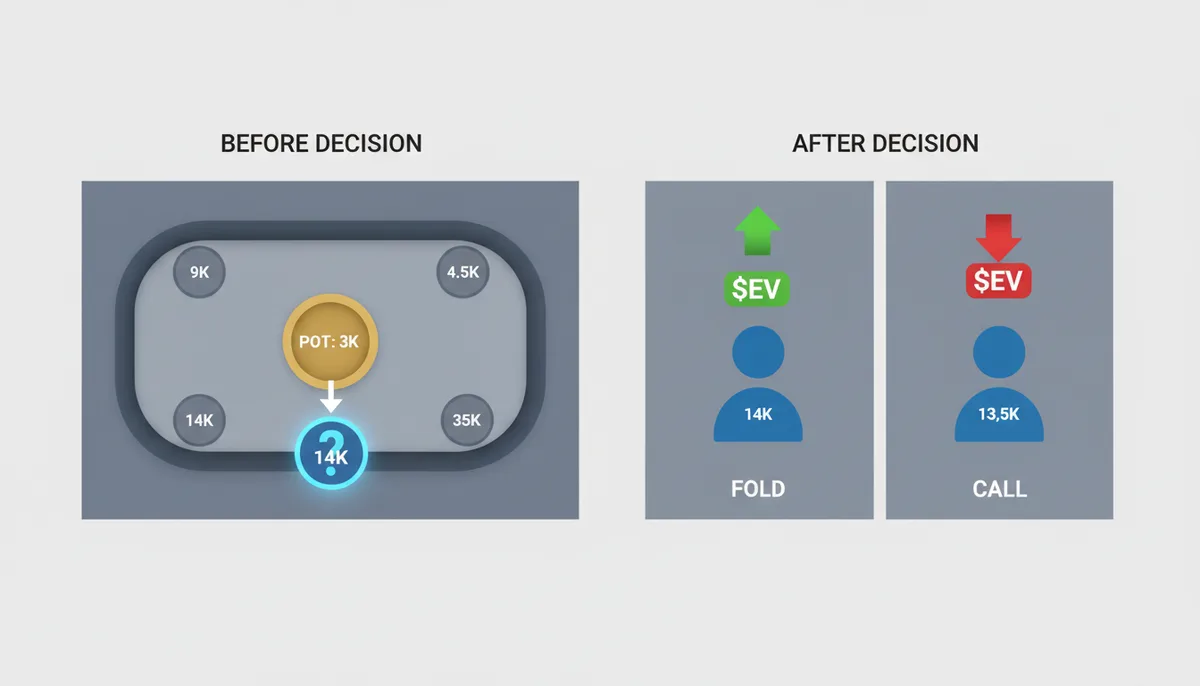
Choosing Your Tools: From Mental Models to Professional Solvers
ICM understanding progresses through three levels. Each level requires more sophisticated tools and more off-table study. You do not need to master all three to be a profitable tournament player, but each level opens new strategic territory.
Level 1 is developing intuition through the SorteCalc ICM Calculator. This is a free, accessible tool that accepts stack sizes and payout structures and returns the dollar equity for each player. You use it to run common scenarios off-table. Run a medium stack facing a shove from the big blind with 20 different stack distributions. Note the $EV of folding versus calling with a marginal hand like Ace-Ten or pocket 7s. The calculator returns numbers you can compare. After running 50 to 100 scenarios, you internalize the patterns: medium stacks need 50%+ equity against a big stack shove near the bubble, short stacks can shove wider than charts suggest against over-folding medium stacks, and satellite bubbles require near-perfect survival play. This level takes hours of study but pays dividends in every tournament you play.
Level 2 is using dedicated push/fold software and ICM calculators like ICMizer or HoldemResources.net. These tools generate specific shoving and calling ranges for any stack size, position, and payout structure. They incorporate ICM into every calculation and output Nash Equilibrium strategies for heads-up and multi-way all-in situations. You use them to analyze specific hands you encountered in tournaments. Did you make the right fold in a 3-handed spot? Run the hand through ICMizer. Did you shove too wide from the button? Run the hand through ICMizer. These tools are expensive and have steep learning curves, but they provide granular range data that casual players never access. The output is a range of hands that you should shove or call with, expressed as specific suited and offsuit combinations. You can compare your in-game decisions against the solver's output and identify leaks.
Level 3 is understanding GTO solver output. Modern GTO solvers incorporate ICM to compute near-perfect strategies for tournament poker. They do not just calculate shoving and calling ranges. They calculate bet sizing, continuation betting frequencies, check-raising frequencies, and bluffing frequencies across all post-flop scenarios. The output is a complete strategy tree that balances cEV and $EV across thousands of possible hand combinations. You do not memorize these ranges. You study the underlying principles: why the solver shoves K-high from the button 40% of the time when the blinds are 800/1,600, why the solver calls a shove with 8-7 suited from the small blind against a 12-big-blind shover, and why the solver folds Ace-Jack offsuit in a specific bubble spot where the risk premium exceeds the pot odds. Level 3 is not about memorizing charts. It is about understanding the logic that generates the charts. The Solvers teach you to think in terms of range interactions and expected value across multiple decision points, not just single-hand cEV calculations.
The practical path is to start at Level 1 and move to Level 2 when you are consistently losing money in the money bubble spots. Level 1 gives you the intuition. Level 2 gives you the precision. Level 3 gives you the edge over players who rely on Level 1 alone. Most tournament players never reach Level 2. That is why the gap between break-even and profitable tournament players is so large. You do not need to be a solver expert to win. You need to understand the baseline ICM pressure and recognize when your opponents are making -EV calls to your advantage.
Beyond the Final Table: ICM in Satellites, PKOs, and More
ICM pressure is not limited to MTT final tables. It appears in satellite tournaments, progressive knockout tournaments, and heads-up match play, each with its own adjustments to the standard model.
In satellite tournaments, ICM pressure is at its most extreme. The prize for finishing in a paid position is identical regardless of stack size. A player with 100 big blinds and a player with 2 big blinds have the same prize equity if both finish in the top 20. This creates a structural incentive for every player to minimize risk. Shoving with any hand becomes a negative-expectation play because the upside is capped at the satellite prize, and the downside is elimination. The correct satellite strategy is ultra-conservative survival: call with very strong hands, fold everything else, and wait for your opponents to make mistakes. The player who survives with the most chips after the bubble pops has an advantage because they can apply pressure in the post-bubble phase where chip accumulation matters again. But before the bubble, survival is everything. This is why satellite tournaments produce some of the most boring and frustrating poker hands you will ever play. You fold Ace-Ace to a shove from an early position player because the risk of elimination outweighs the benefit of doubling up into an identical prize. It feels wrong. It is mathematically correct.
In Progressive Knockout (PKO) tournaments, bounties introduce a competing incentive. Every PKO has a cEV component: the bounty on your opponent's head is worth real money and can be collected at any time. A player with a large bounty is a target, and calling a shove to collect a bounty is profitable in cEV terms even when it is negative in $EV terms. The correct PKO strategy balances cEV bounty collection against $EV survival. If you have a medium stack and an opponent with a large bounty shoves, you call wider than you would in a regular tournament because the bounty adds real-money value to the call. The bounty amount is added to your potential winnings, which shifts the $EV calculation in favor of calling. The more bounty money on the table, the more you should call. This is the one major format where cEV and $EV alignment is partial: the bounty creates a direct monetary incentive for risk-taking that exists outside the ICM payout structure.
In heads-up match play, ICM pressure is eliminated entirely. Each hand is a discrete cash game. Your stack size does not affect your probability of winning the match because there are no payout jumps. Every chip has a fixed value. This is why heads-up poker feels radically different from MTT play: the risk premium is zero, and cEV decisions are identical to $EV decisions. Understanding this difference is important because players who transition from MTT to heads-up often struggle to loosen their ranges. They carry the ICM pressure with them and over-fold in situations where the math clearly demands aggression.
VISUAL: TABLE| Format | Primary Metric | Value of Survival | Aggression vs. Big Stacks | Attitude Towards Marginal Spots |
|---|---|---|---|---|
| Cash Game | cEV = $EV | Low | Standard | Call with +cEV hands |
| Early MTT | cEV dominant | Low | Standard | Call with +cEV hands |
| MTT Bubble | $EV dominant | High | Fold more | Fold marginal hands |
| Final Table | $EV dominant | Very High | Fold significantly | Fold most marginal spots |
| Satellite | $EV (survival only) | Extreme | Fold almost everything | Ultra-conservative |
| PKO | cEV + $EV | High | Call wider for bounties | Call marginal spots for bounty value |
FAQ
Do I really need to do these complex calculations in my head during a hand?
No. The goal is to use ICM calculators and solvers off-the-table to study common situations. This builds a strong intuition that allows you to make quick, accurate decisions during live play. You develop a sense of when a spot carries high ICM pressure without running the numbers in real time. During a hand, you should be thinking about stack sizes, payout jumps, and opponent tendencies, not recalculating equity percentages. The SorteCalc ICM Calculator is designed for off-table study precisely because the calculations are too slow for live play.
Does ICM apply in cash games at all?
No. In cash games, every chip has a fixed monetary value. A $1 chip is worth $1 regardless of your stack size or how many chips are in play. Decisions are always based on maximizing Chip Expected Value (cEV), which is identical to Dollar Expected Value ($EV) because the conversion rate between chips and dollars never changes. There is no payout structure, no elimination risk, and no risk premium. The only exception is if you are playing at stakes where table selection and bankroll management matter, but those are strategic considerations, not ICM considerations.
At what point in a tournament should I start thinking about ICM?
You should start considering ICM as you approach the money bubble. Its importance grows exponentially as the field shrinks and the payout jumps become more significant, peaking at the final table. Early in the tournament, when all players have roughly equal stacks and the money is 50 spots away, cEV is a reliable guide and ICM adjustments are negligible. Once you reach the top 15 or 20 players, ICM pressure becomes meaningful. At the final table, it dominates every decision. If you are playing satellites, you should be thinking about ICM survival from the very first hand.
What's the difference between ICM and a 'payout' calculator?
They are essentially the same thing. An ICM calculator is a specific type of payout calculator that uses the Independent Chip Model to convert chip stacks into real-money equity based on the tournament's payout structure. The terms are used interchangeably in poker strategy discussions. Some payout calculators use simpler models, but ICM is the standard. The SorteCalc ICM Calculator is a payout calculator that implements the ICM model.
Is there a better or more accurate model than ICM?
Yes, more complex models like Future Game Simulation (FGS) exist, which attempt to account for skill differences, position, and evolving stack dynamics. However, they are computationally intensive and not practical for real-time use. ICM remains the industry standard for its excellent balance of accuracy and usability. It is not perfect, but it is the best available tool for making tournament decisions that are significantly better than chip-counting alone.
How does my playing style (tight or loose) affect ICM decisions?
ICM provides a mathematically optimal baseline. If you are a significantly stronger player than your opponents, you might be able to take slightly -ICM spots, betting on your future game equity. Conversely, against very strong opponents, you should stick even more rigidly to ICM principles. Tight players tend to over-fold to ICM pressure because they fear elimination. Loose players call too wide regardless of ICM. The best players adjust their ICM adherence based on their skill edge relative to the field. If you know you are better than the players at your table, you can widen your calling ranges slightly above the ICM baseline. If you know you are worse, you should tighten further.
Sources
- Two Plus Two Publishing — The foundational principles of advanced tournament strategy, including the non-linear value of chips, as popularized in books like David Sklansky's "Tournament Poker for Advanced Players".
- Conjelco — The mathematical underpinnings of poker theory, including concepts like risk premium and game theory optimal play, as detailed in the seminal book "The Mathematics of Poker" by Chen and Ankenman.
- JSTOR — The academic origin of the ICM concept, based on David Harville's 1973 paper "Assigning Probabilities to the Outcomes of Multi-Entry Tournaments" published in the Journal of the American Statistical Association.
- PokerCoaching.com by Jonathan Little — Modern, GTO-based interpretations and applications of ICM, including push/fold charts and solver-based analysis for final table and bubble play.
- Upswing Poker — Claims regarding current professional tournament strategy, including how to weaponize ICM as a big stack and how to navigate high-pressure spots as a short stack.