How to Use a Kelly Criterion Calculator Without Overbetting Your Bankroll
2026-09-04 · 26 min · 5,100 words
Your model says a tennis player wins this match 60% of the time. The bookmaker's odds imply 50%. You've found an edge — the thing every bettor spends months chasing — and now you face the question that actually decides whether you survive long enough to profit from it: how much do you stake?
Bet too little and a genuine edge trickles away to nothing. Bet too much and a perfectly normal losing run ends you, even though you were "right" all along. Every serious bettor hits this wall, and most hit it after they've already lost money guessing at the answer.
The famous mathematical answer is the Kelly Criterion, published in 1956 by John L. Kelly, Jr., a researcher at Bell Labs, in a paper called "A New Interpretation of Information Rate." Kelly proved something remarkable: if you know your exact win probability and the exact odds, there's a single stake size — expressed as a fraction of your current bankroll — that grows your money faster than any other strategy over the long run. Bet more than Kelly and your growth actually gets worse, not better. Bet exactly Kelly and you compound at the maximum possible rate, with zero chance of ever being mathematically ruined, because you always stake a fraction and never the whole roll.
Claude Shannon, Kelly's colleague at Bell Labs and the father of information theory, took the idea seriously enough to use it in his own investing. Ed Thorp read Kelly's paper, applied it to blackjack bet sizing in Beat the Dealer, and later built his hedge fund career on the same principle. William Poundstone's book Fortune's Formula tells the whole story. When people with those track records take a formula seriously, it's worth understanding.
But here's the part that gets glossed over. The formula has two inputs, and one of them — your true win probability — is a number nobody on earth actually knows. And even if you did know it, the ride that full Kelly betting takes you on is violent enough that almost nobody can stick with it. This guide is about using the formula the way professionals do: as a ceiling you deliberately stay under, not a target you hit. By the end you'll know how to run the numbers, why "optimal" is dangerous, and how to pick a stake fraction that fits your bankroll, your edge, and your nerves.
How Does the Kelly Formula Calculate the Optimal Stake?
The formula is shorter than its reputation:
f* = (bp − q) / b
Four symbols, and each one earns its place:
- f* — the fraction of your current bankroll to stake. An output of 0.05 means 5% of your roll.
- b — the net odds: what you win per unit staked, not counting your stake back. This is simply the decimal odds minus 1. Decimal odds of 2.50 means b = 1.50. Decimal 1.80 means b = 0.80.
- p — your assessed probability of winning, as a decimal. If you think the bet wins 45% of the time, p = 0.45.
- q — the probability of losing, which is just 1 − p. If p = 0.45, q = 0.55.
One mental shortcut before the examples: the numerator, (bp − q), is your expected profit per unit staked — your edge. So the whole formula reduces to f* = edge ÷ net odds. Your stake scales with how much you expect to make, discounted by how long the odds are.
A worked example with a biased coin
Say someone offers you even money (decimal odds 2.0, so b = 1) on a coin you know lands heads 55% of the time. Your bankroll is $1,000.
f* = (1 × 0.55 − 0.45) / 1 = 0.10. Full Kelly says stake 10% of your bankroll — $100 — on every flip. After each result, you recalculate against the new bankroll: win the first flip and the next stake is 10% of $1,100, which is $110. Lose and it's 10% of $900, which is $90. The formula constantly resizes to your current position.
A worked example with real sportsbook numbers
Now something closer to actual Kelly criterion sports betting. A football team is priced at decimal odds 2.40 (that's American +140, or fractional 7/5 — three ways of writing the same price). The implied probability is 1 ÷ 2.40 = 41.7%. Your analysis says the true chance is 45%. So p = 0.45, q = 0.55, b = 1.40.
f* = (1.40 × 0.45 − 0.55) / 1.40 = (0.63 − 0.55) / 1.40 = 0.08 / 1.40 ≈ 0.057. Full Kelly recommends 5.7% of your bankroll. Your expected value on the bet is 8% per unit staked (0.45 × 2.40 − 1 = 0.08), and 8% ÷ 1.40 gives the same 5.7% — the edge-over-odds shortcut in action.
What the formula is really telling you
Watch how the output moves. Big edge, short odds → big stake. Thin edge, long odds → tiny stake. No edge → zero or negative, which is Kelly's way of saying don't bet.
The extreme case is worth seeing once. Take a heavy favorite at decimal 1.20 (b = 0.20) that you rate at a 90% chance. f* = (0.20 × 0.90 − 0.10) / 0.20 = 0.08 / 0.20 = 0.40. The formula calmly suggests staking 40% of your bankroll on a single bet. The math is internally consistent — it's maximizing the long-run growth rate of your bankroll, which is the same thing as maximizing the expected logarithm of your wealth after each wager — but that number should make your stomach tighten. If it does, you've understood the next section before reading it.
Why Does 'Full Kelly' Betting Often Lead to Ruin?
The formula does exactly what you tell it to. That's the problem.
Your edge is an estimate, not a fact
Kelly's proof assumes p is the true probability. Your p is a guess — hopefully an informed one, built on data and modeling, but a guess. And the formula has a nasty asymmetry: overestimating your edge hurts far more than underestimating it helps.
Here's the mathematics that should scare you. In the standard model of Kelly betting, if you consistently stake a multiple c of the true full Kelly fraction, your long-run growth rate becomes (2c − c²) times the maximum. Run the numbers:
- Bet exactly 1× Kelly → 100% of maximum growth.
- Bet 0.5× Kelly → 75% of maximum growth.
- Bet 2× Kelly → 2(2) − 4 = 0. Zero growth. You churn forever and get nowhere.
- Bet 3× Kelly → 6 − 9 = −3. Negative growth. You go broke while holding a real edge.
Now put that in practical terms. You estimate p = 0.55 at even odds, so full Kelly says 10% of bankroll. If the true probability is 0.52, the true optimal stake is 4% — you're betting 2.5 times optimal, which puts you in negative-growth territory despite your edge being real. If the true probability is 0.50, you have no edge at all and you're volunteering 10% of your roll per bet on a coin flip.
Estimation errors of three to five percentage points are not catastrophic bad luck. They're the everyday condition of sports betting, poker, and markets. Full Kelly treats your estimate as gospel and sizes accordingly — which is why, applied naively, it's less a growth strategy than an overbetting machine.
The drawdowns are worse than you imagine
Suppose your probability estimates are perfect. No error at all. Full Kelly is still brutal to live through, and the reason is a quirk of percentage-based staking: losses cost more than equivalent wins recover. Stake 10% of your roll, win once, lose once, in either order: $1,000 → $1,100 → $990. One win and one loss left you 1% poorer. Your edge has to continuously pay this "volatility tax," and at full Kelly the tax is heavy.
The drawdown mathematics is stark. In standard theoretical models and simulations, full Kelly leads to large drawdowns with substantial probability over time; these are not rare anecdotes but intrinsic properties of the strategy. These results and the wider analysis of Kelly-style sizing are discussed in the academic literature on the criterion and its practical application, and they are a primary reason many practitioners avoid staking the raw formula. UCLA's statistics work surveys the mathematical properties of fractional Kelly and related variance effects. Ed Thorp — the man who proved Kelly works in casinos and markets — has written widely about these drawdown profiles, and notably, he didn't stake at full Kelly himself. Stanford Graduate School of Business material documents the practical risk management debates that followed Kelly's original paper.
Drop to half Kelly and the same model yields much smaller probabilities of severe collapse; the odds of extreme drawdowns decrease quickly as you reduce the fraction. Same edge, same bets, radically different life.
Your tolerance for loss isn't logarithmic — it's worse
A common defense of full Kelly is that it already accounts for risk aversion, because maximizing expected log wealth is a form of declining marginal utility: the formula itself "feels" that losing 50% hurts more than gaining 50% helps. True as far as it goes. But log utility is still a remarkably risk-tolerant assumption, and your real utility function is almost certainly more conservative.
Your bankroll isn't an abstract number in a differential equation. It might be next month's rent, or the operating capital of your betting business, or two years of disciplined saving. Lose half of it and you don't just lose money — you lose the ability to keep playing, the confidence to follow your own process, and possibly your willingness to ever bet seriously again. The formula prices none of that. This is why even bettors who trust their models completely — horse racing syndicates of the Bill Benter type, who reportedly staked at a fraction of Kelly precisely because their probabilities were model estimates — treat full Kelly as a theoretical reference point rather than an instruction.
How Can You Adapt Kelly for the Real World with 'Fractional Kelly'?
Professionals who actually use this formula almost never bet what it says. They bet a fixed slice of what it says. That's fractional Kelly betting, and it's the single most important concept in this article.
The mechanics are trivial: compute the full Kelly fraction f*, then multiply by a number c between 0 and 1 that you choose in advance.
What you get in return for that haircut is the best trade in bankroll management. Recall the growth multiplier (2c − c²): at c = 0.5 you keep 75% of the maximum growth rate, but the volatility of your bankroll — the size of the swings — scales linearly with c, so you take only 50% of the volatility. You give up a quarter of the growth to eliminate half the pain. At quarter Kelly you keep about 44% of the growth for 25% of the volatility. No other adjustment in gambling offers terms this good.
There's a second benefit that's less famous and arguably more valuable: fractional Kelly is insurance against your own estimation error. Say the true optimal stake is 4%, but you've overestimated your edge and calculated a full Kelly of 8%. Bet the full 8% and you're at 2× Kelly — zero growth, per the math above. Bet half of your estimate and you land at 4% — the true optimum, by accident. Your fraction absorbs your mistakes. The bigger your uncertainty about p, the smaller c should be, which is the entire logic of the next section.
The working process, start to finish:
- Estimate your inputs. Arrive at p through modeling, data, or structured analysis — never vibes — and note the offered odds. Convert odds to decimal to get b = decimal odds − 1.
- Calculate full Kelly. f* = (bp − q) / b, or use a calculator rather than doing arithmetic under pressure.
- Choose your fraction c before you see the output. Deciding on your fraction after seeing a tempting stake is how discipline dies.
- Multiply. Final stake fraction = c × f*. Half Kelly on an 8% full Kelly output = 4% of bankroll.
- Stake that percentage of your current bankroll — not your bankroll from last Tuesday, and round the stake down rather than up when it lands between convenient numbers.
Two rules that keep the system intact. First, the fraction is a policy, not a mood — you don't raise it because you're winning or because a bet "feels special." Second, if a bet's full Kelly output is zero or negative, the fraction you apply to it is irrelevant; you don't bet at all.
Which Kelly Fraction Is Right for Your Risk Tolerance?
Choosing a fraction is choosing where you sit on a single trade-off: growth against pain. There's no universally correct answer, but there are defensible ranges for definable situations.
| Kelly Fraction | Approx. % of Max Growth | Approx. % of Max Volatility | Who Should Use This |
|---|---|---|---|
| 1.0 (Full Kelly) | 100% | 100% | Nobody, realistically — only a perfectly mechanical edge with zero estimation error, which doesn't exist outside a textbook |
| 0.5 (Half Kelly) | 75% | 50% | Confident professionals with large, backtested samples proving their edge is real and stable over time |
| 0.25 (Quarter Kelly) | 44% | 25% | The standard best practice for serious bettors with tested models and a recorded track record |
| 0.1 (Tenth Kelly) | 19% | 10% | Beginners, subjective handicappers, thin edges, and anyone still calibrating their probability estimates |
Here's how I'd map situations to fractions, and I'd rather be too conservative here than too clever:
Near-mechanical edges — arbitrage, bonus engineering, mature statistical models with years of out-of-sample results: 0.4 to 0.5 can be justified, because the probability estimate is close to a fact. Even then, execution risk argues for staying under half. Arbitrage legs fail, accounts get limited, lines move while you're placing the second bet. Warren Buffett is often described as operating like a Kelly bettor — his famous advice to imagine a punch card with only twenty slots for a lifetime of investments is Kelly's spirit of betting big when the edge is huge — but notice that even the most confident capital allocators on earth concentrate far less than the raw formula would suggest.
Model-driven sports betting with a genuine track record: quarter Kelly is the professional default for good reason. It keeps nearly half the theoretical growth while making the drawdowns survivable, and it forgives the moderate estimation errors that every honest modeler knows they have.
Subjective analysis, new models, small samples, or learning stages: 0.1 to 0.125. Yes, the growth rate looks unexciting on paper. The point of this stage isn't growth — it's buying hundreds of settled bets of calibration data without going broke in the process. Treat it as tuition that the edge eventually reimburses.
Three personal factors should push your fraction around within these bands. First, what the bankroll is for: if it pays living expenses, you have no business anywhere near half Kelly; if it's ring-fenced learning money, small fractions extend your education. Second, your calibration evidence: have you recorded every prediction and checked whether your 60% calls actually win 60% of the time? Most people who run this audit for the first time discover they're systematically overconfident, and overconfidence demands a smaller fraction. Third, your honest drawdown tolerance — not the number you write in a planning document, but how you'd actually behave watching your roll drop 30%. At full Kelly that's a routine Tuesday. If a 30% drawdown would make you abandon your process mid-stream, your fraction is too big, because an abandoned process has a growth rate of exactly zero.
How Do You Use a Kelly Criterion Calculator Step-by-Step?
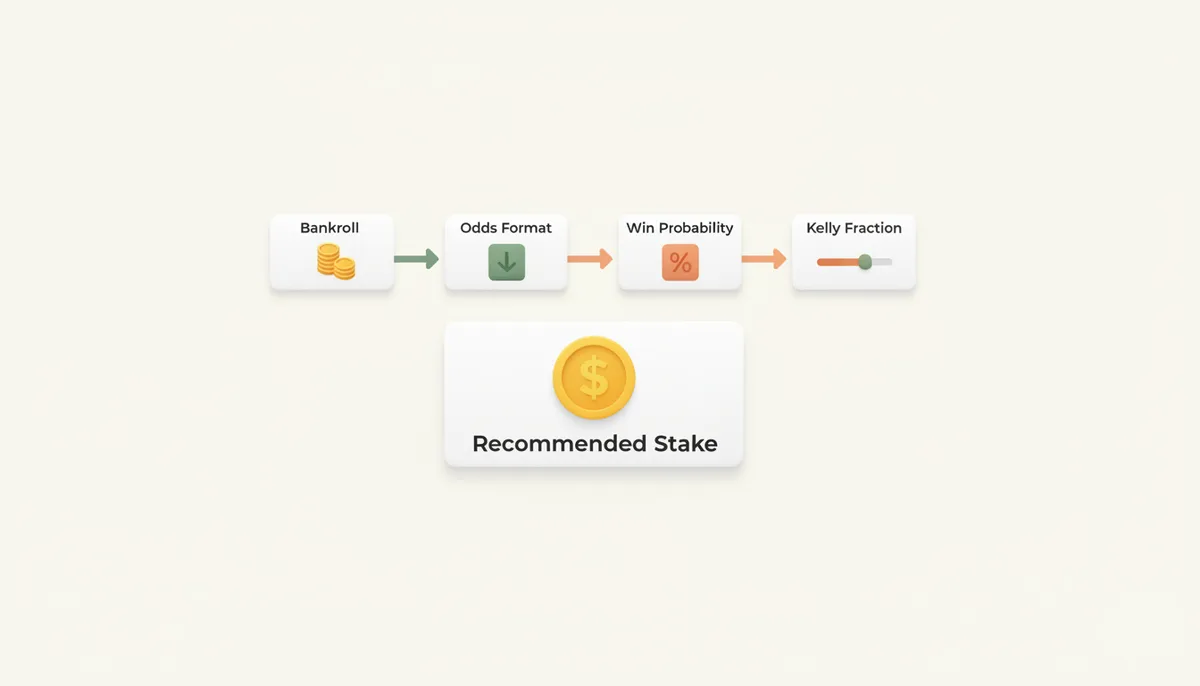
Enough theory — here's the actual workflow. The SorteCalc Kelly Criterion Calculator has a small set of inputs, and each one deserves a deliberate decision rather than a reflex.
Bankroll. Enter your current, actual bankroll — the money you can genuinely afford to have at risk, not the number including last night's unsettled bets or next week's deposit. Kelly sizes everything off this figure, so a stale bankroll means a mis-sized stake.
Odds and odds format. Select the format your sportsbook uses — decimal, American, or fractional — and enter the price as offered. Decimal 2.40, American +140, and fractional 7/5 are the same bet; the calculator handles the conversion. One habit worth building: before entering your own probability, look at what the odds imply. Decimal 2.40 implies 41.7%. The gap between that number and your p is your edge, so stare at it and ask where it comes from.
Win probability. This is the input that determines everything, and the one people lie to themselves about. Enter your honest, conservative estimate — the number your data supports, not the best case and not the number that makes the stake look exciting. If your estimate came from "I fancy this team," that's a signal to set the Kelly fraction very low, not a signal to skip the calculator.
Kelly fraction. This is the risk-management dial, and it's the field that separates this tool from a toy. Set it to your policy fraction — 0.25, 0.1, whatever you've committed to — and leave it there.
Watch what the fraction does to the output. Bankroll $2,000, decimal odds 2.40, win probability 45%:
- Fraction 1.0 → recommended stake ≈ $114 (full Kelly, 5.7%)
- Fraction 0.5 → ≈ $57
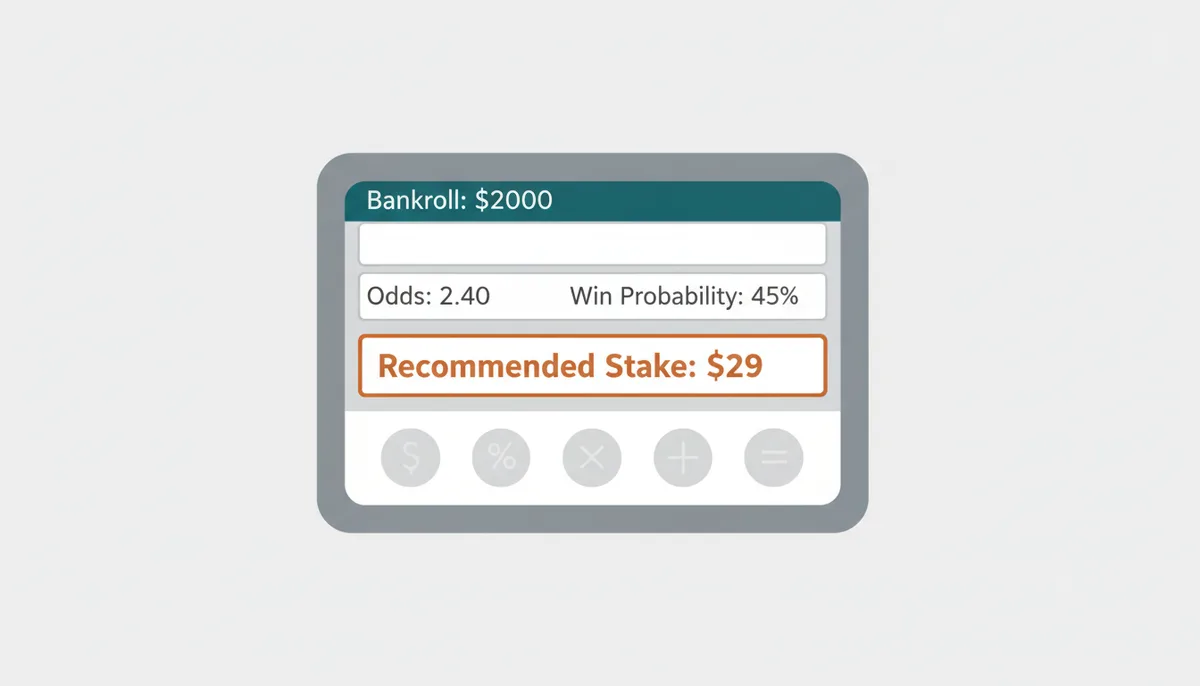
- Fraction 0.25 → ≈ $29
- Fraction 0.1 → ≈ $11
Same bet, same edge, same bankroll — and a tenfold range in recommended stake depending entirely on how much volatility you've decided to accept. That slider is the whole argument of this article rendered as a number. And if the tool ever returns zero or a negative stake, it has just saved you money: the bet is −EV at your stated probability, and the correct stake is nothing. Because the calculator is free and runs instantly in the browser, there's no excuse for sizing a meaningful bet by feel ever again — the thirty seconds it takes to run the numbers is the cheapest insurance in gambling.
What Happens When You Have Multiple Bets at Once?
The Kelly formula assumes your bets resolve one at a time, with the bankroll updated in between. Real betting doesn't look like that. Real betting looks like Saturday: six football matches, three tennis matches, and a card of horse races, all open simultaneously.
The danger is invisible when you size each bet on its own. Run five games through a calculator independently and every recommendation looks reasonable in isolation — 4% here, 6% there. Add them up and you've committed 25% of your bankroll to outcomes that all resolve on the same afternoon. The formula never endorsed that total. It sized each bet as if it were your only open risk. At full Kelly the failure is louder: five independent recommendations of 12% apiece commit 60% of your roll at once, and a busy slate can easily produce individual stakes that sum to more than 100% of the bankroll — a mathematical impossibility the single-bet formula has no way to warn you about.
The exact solution exists — a multivariate version of Kelly that optimizes across all open bets at once — but it requires estimating how every bet interacts with every other bet. For a ten-game slate that's a covariance problem nobody solves on a Saturday morning. Working bettors use three heuristics instead, and together they deliver most of the safety with none of the linear algebra.
Size against available bankroll, not the headline number. When bet #1 is already open, the money staked on it can still be lost — so Kelly's fractions, which assume losses come out of the roll, argue for sizing the next bet against what's actually uncommitted. A $2,000 bankroll with $150 already staked means bet #2 gets sized against $1,850, not $2,000. The adjustment is trivial for the second bet and significant by the fifth — which is exactly when you need it. This one habit stops the silent creep where every new bet gets priced as if it were first in line.
Cap total open exposure. Pick a hard ceiling for how much of your bankroll can be staked across all open bets at the same time — for quarter-Kelly bettors, 15% to 20% is a workable range — and enforce it before placing anything that would break it. When a slate's recommendations sum to more than the cap, don't just drop the last bets or shave the ones you like least. Scale every stake down proportionally, so the relative sizing — which reflects where your biggest edges are — survives intact.
Here's the arithmetic with real numbers. Bankroll $2,000, exposure cap 15% ($300), and four recommendations from the calculator, already at quarter Kelly:
| Bet | Quarter-Kelly Stake | Original Amount | Adjusted for 15% Cap |
|---|---|---|---|
| Bet A | 6% | $120 | $90 |
| Bet B | 5% | $100 | $75 |
| Bet C | 5% | $100 | $75 |
| Bet D | 4% | $80 | $60 |
| Total | 20% | $400 | $300 |
The raw recommendations total $400 — a fifth of your bankroll riding on one day. The cap allows $300, so every stake is multiplied by 300 ÷ 400 = 0.75. Bet A still gets the most because it carries the biggest edge; the whole slate just got quieter.
Cut stakes when bets are correlated. Two bets are correlated when the same event moves both — backing a team to win and also backing the over in the same match, or taking two players from the same side in different markets. If the game turns into a shootout, both win together; if it's a stalemate, both lose together. Sizing them independently treats them as independent risks, and they aren't. The practical fixes, in order of preference: pick the single bet with the biggest edge and drop the other, or treat the pair as one position and split a single capped stake between them. The same logic applies to subtler whole-slate correlations. Back four home favorites on one weekend and the common ingredient is your model's assumption about home advantage — if that assumption is wrong, it's wrong about all four at once, and the formula sized each one as if the others didn't exist.
How Do You Know If Your Probability Estimates Are Wrong?
Every bettor who uses the Kelly Criterion eventually faces the same uncomfortable truth: the number you type into the "win probability" field is not a fact. It is a forecast, and forecasts are wrong more often than we admit. If your true win rate is even three points below what you claim, full Kelly is no longer optimal — it is actively destructive. The only defense is to audit yourself with the same rigor you apply to the sportsbook's odds.
Start a prediction log. Before you place any bet, write down four things: the event, the decimal odds, your estimated win probability, and the market-implied probability from those odds. Do not log the bet after the result; record the probability while your reasoning is still fresh and untainted by hindsight. A spreadsheet is enough. After two hundred settled wagers, you will have something most bettors never produce: a calibration curve.
Group your predictions into buckets. Every bet where you estimated a 55% to 60% chance goes in one bucket; 60% to 65% in another. Then count how many bets in each bucket actually won. If your 55-60% bucket contains forty bets and twenty-two of them won, your actual rate is 55%. That is honest calibration — you were right. But if your 60-65% bucket contains thirty bets and only fourteen won, your true rate there is 47%. You were not just wrong; you were confidently wrong in the exact place where Kelly sizing is most dangerous.
The cost of this error compounds brutally. Imagine the second bucket — your 62% average estimate — was priced at decimal odds of 1.80, implying a 55.6% chance. You believed you had a 6.4 percentage point edge. The true optimal Kelly stake at a real 47% win probability and those odds is not a small fraction; it is precisely zero, because 47% × 1.80 = 0.846, giving negative expected value. Every dollar you staked was −EV, and because you used full Kelly believing the edge was large, you bet roughly 11% of your roll each time. Thirty negative-expected-value bets at that scale do not bruise your bankroll; they halve it, and the edge you thought you had never existed outside your own optimism.
Before you have enough data for buckets, you should still distrust your estimates. Two hundred bets is the minimum to see signal through the noise of normal variance; five hundred is better. If you have only fifty results, a losing run proves almost nothing, but neither does a winning one. Until you cross that threshold, assume you are overestimating your edge by default. Experts consistently overstate the precision of their own forecasts, and the narrower the domain, the worse the overconfidence gets.
When your audit reveals a gap, apply shrinkage. A practical rule is to regress your future probability estimates halfway toward the market-implied number. If you model a 62% chance and the market says 55%, stake as if the true probability were 58.5%. If your historical calibration shows you are typically four points too optimistic across all buckets, subtract four points from every future prediction before it ever reaches the calculator. Combine this with a fractional Kelly of 0.25 or lower, and you have built a machine that survives its own delusions. The goal is not to be right every time; it is to be wrong small enough that you stay solvent until your forecasts actually improve.
Why Does Kelly Slash Your Stake on Longshots?
Most bettors understand that the Kelly Criterion increases your bet size when your edge grows. Fewer grasp that it also crushes your stake when the odds grow, even if the percentage edge stays exactly the same. This behavior is not an accident of the formula; it is the mechanism protecting you from the single fastest route to ruin in gambling: betting too much on high-priced outcomes where variance is a silent killer.
Watch what happens to your stake when you hold the edge constant but stretch the odds. Suppose you have found an 8% expected value edge. In a tight market, that might mean decimal odds of 1.50, which imply a 66.7% chance, but your analysis says the true probability is 72%. The net odds b are 0.50, so f* = (0.50 × 0.72 − 0.28) / 0.50 = (0.36 − 0.28) / 0.50 = 0.16. Full Kelly says stake 16% of your bankroll. That is aggressive but coherent: you expect to win nearly three times out of four, so the path to profit is relatively smooth.
Now move that identical 8% edge to a longshot at decimal odds of 11.00. The implied probability is 9.09%; your true estimate is 9.8%. The edge is mathematically the same — 8% over the market — but b is now 10.00. The formula gives f* = (10.00 × 0.098 − 0.902) / 10.00 = (0.98 − 0.902) / 10.00 = 0.0078. Your recommended stake is 0.78% of your bankroll. Same edge, twenty times smaller stake.
The difference is variance, which the formula sees even when you do not. At 1.50 odds, you lose one stake unit on roughly one bet in four. At 11.00 odds, you lose one stake unit on roughly nine bets out of ten. The rare win pays ten units plus your stake back, but the road to that win is a minefield of total losses. Because Kelly optimizes the logarithm of your wealth, it treats a string of total losses as catastrophic to long-term compounding even if the expected value is positive. A 50% drawdown requires a 100% gain just to break even; the formula refuses to risk a stake large enough that a normal cold streak forces that kind of recovery.
A flat bettor — someone who staked $100 on every "8% edge" regardless of price — would face a brutal sequence on the longshot. Over one hundred such bets at a true 9.8% win rate, the bettor loses ninety times and wins ten, a ride that destroys most bankrolls psychologically before math ever enters the room. The Kelly bettor, meanwhile, staked less than one percent each time, losing tiny increments ninety times and collecting ten large payouts. The total profit is similar in expectation, but the variance is an order of magnitude lower. That is the trade Kelly accepts: it will not let you get rich quickly on any single bet, because getting poor quickly is mathematically fatal.
If you ever run a Kelly criterion calculator and it returns a full Kelly stake below half a percent on a juicy price, treat that as a warning, not a challenge to override. Longshot edges are the most seductive and the most fragile. They are where models break, where liquidity dries up, and where one lost stake followed by a line move wipes out the value on the next three opportunities combined. The formula is telling you that survival matters more than sizing. Listen to it.
Sources
- IEEE Xplore — The original 1956 paper by John L. Kelly, Jr., 'A New Interpretation of Information Rate,' published in the Bell System Technical Journal, which is the ultimate primary source for the formula's derivation.
- Macmillan Publishers — The publication of William Poundstone's 'Fortune's Formula,' a key text that documents the history of the Kelly Criterion and its application by figures like Ed Thorp and Claude Shannon.
- Stanford Graduate School of Business — Academic analysis of financial theory and risk management, including the work of figures like Ed Thorp, who pioneered the practical application of Kelly-style criteria in gambling and investing.
- UCLA Department of Statistics — The mathematical properties of the Kelly Criterion, including the relationship between fractional Kelly strategies, expected logarithmic growth, and the reduction of portfolio variance.
- CFA Institute — The professional standard of position sizing and risk management in financial portfolio management, which shares the same underlying principles as using fractional Kelly for a betting bankroll.