How Table Limits Break the Martingale System
2026-10-23 · 18 min · 3,483 words
You lose five spins in a row on red. You started at $10, you’re now down $310 and the next bet the system demands is $320. The table max is $500, so you think you’re fine. You’re not, because the math doesn’t care how calm you feel. The Martingale system table limit problem isn’t a theory, it’s a countdown. It ends the moment the doubling hits a ceiling you can’t bet past, and that ceiling is built into every casino on purpose.
Why Does the Martingale System Seem Foolproof?
It feels like a cheat code. You pick an even-money bet like red or black in roulette, you lose, you double. Lose again, double again. Eventually you win, you take the profit of one base unit and you reset. The logic is clean: you can’t lose forever, so a win has to come and it will wipe out the whole hole.
That appeal is psychological first and mathematical second. The system is simple enough to explain in one sentence, it gives you a concrete action after a loss instead of inaction, and it promises certainty instead of odds. Novice gamblers love it because it replaces uncertainty with a plan.
The plan runs on the Gambler’s Fallacy. After three blacks you feel red is “due”. The fallacy is the mistaken idea that past independent events change the probability of the next one. A European wheel has 18 red, 18 black and one green zero. The wheel has no memory. The chance of black on spin 100 is the same as spin 1, regardless of the last nine results. Believing otherwise is what makes the doubling feel rational.
How Is the Martingale Progression Supposed to Work?
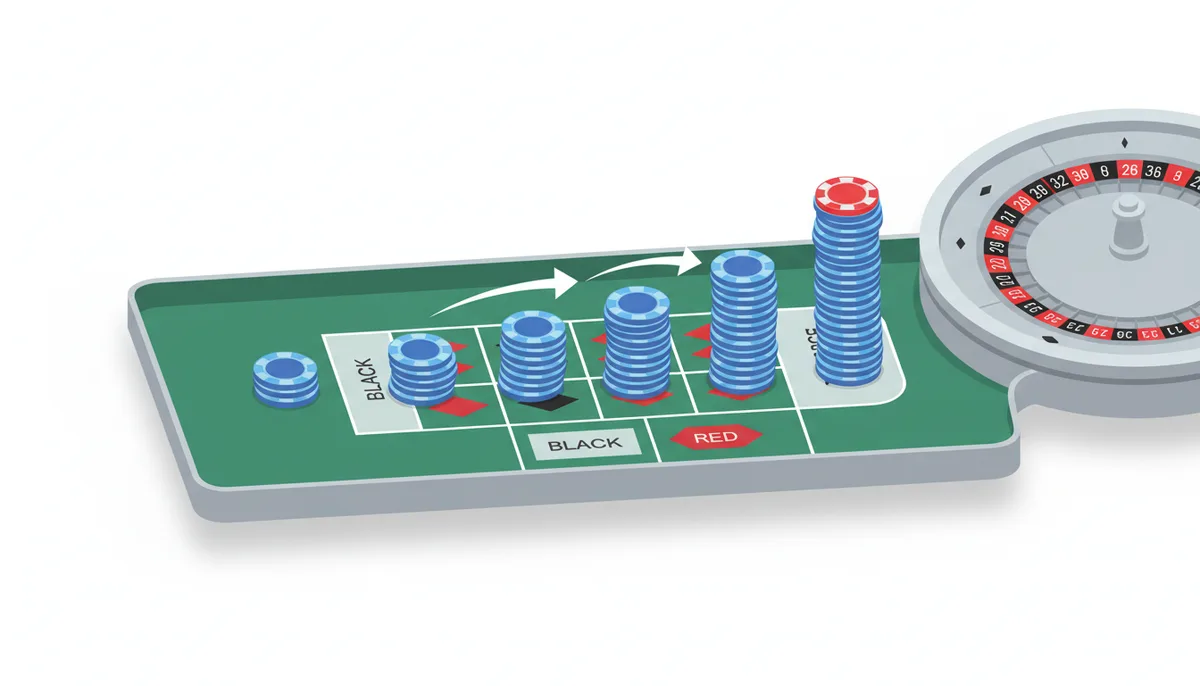
Two rules, nothing else. Start with a base unit. If you lose, double the next bet. If you win, return to the base unit.
Take a $5 base unit on even-money roulette. You bet $5 on red and lose. You’re down $5. Next bet is $10. You lose again. You’re down $15 total. Next bet is $20. You lose again. You’re down $35 total. Next bet is $40. You win $40. You now have $40 profit from that spin, minus the $35 you were down, which leaves a net profit of $5. That’s one base unit.
The system is designed to make every completed cycle a small win. The win recovers all previous losses in the streak plus one unit. The catch is that the system only works if you can keep doubling until a win arrives, and if you can absorb the total amount you’ve staked in the meantime.
How Quickly Do Martingale Bets Actually Escalate?
Exponential growth is quiet at first and then brutal. Starting from $10, the sequence looks tame for three or four steps and then it detonates.
After five consecutive losses you’re betting $160. Your cumulative loss is $310. After eight consecutive losses you’re betting $1,280 and you’ve already lost $2,550. After ten consecutive losses the required bet is $5,120 and your cumulative loss is $10,230. You don’t need a long streak to need money you don’t have.
| Loss Number | Bet Amount | Cumulative Loss |
|---|---|---|
| 1 | $10 | $10 |
| 2 | $20 | $30 |
| 3 | $40 | $70 |
| 4 | $80 | $150 |
| 5 | $160 | $310 |
| 6 | $320 | $630 |
| 7 | $640 | $1,270 |
| 8 | $1,280 | $2,550 |
| 9 | $2,560 | $5,110 |
| 10 | $5,120 | $10,230 |
| 11 | $10,240 | $20,470 |
| 12 | $20,480 | $40,950 |
That table is the pressure. Most players can handle the first three losses. Very few can handle the seventh. The bankroll required isn’t linear, it’s a staircase that gets steeper with every step.
What Are Typical Casino Table Limits?
Every table lists a minimum and a maximum bet per spot. The numbers vary by casino, jurisdiction, time of day and game type. For the math that follows, use an illustrative example: a table with $10 minimum and $500 maximum on even-money bets.
Other illustrative ranges that are commonly used for modeling are $5 minimum to $200 maximum, or $100 minimum to $2,000 maximum. Blackjack tables are often modeled with $25 minimum to $1,000 maximum for comparison. These are examples, not guarantees; actual limits are posted at the table or in the game rules and can change.
The limit applies to a single betting spot. On a $500 max table, a $501 bet on red will not be accepted. That cap is the hard stop for a progression that requires a larger bet to continue.
When Does the Progression Collide With the Table Limit?
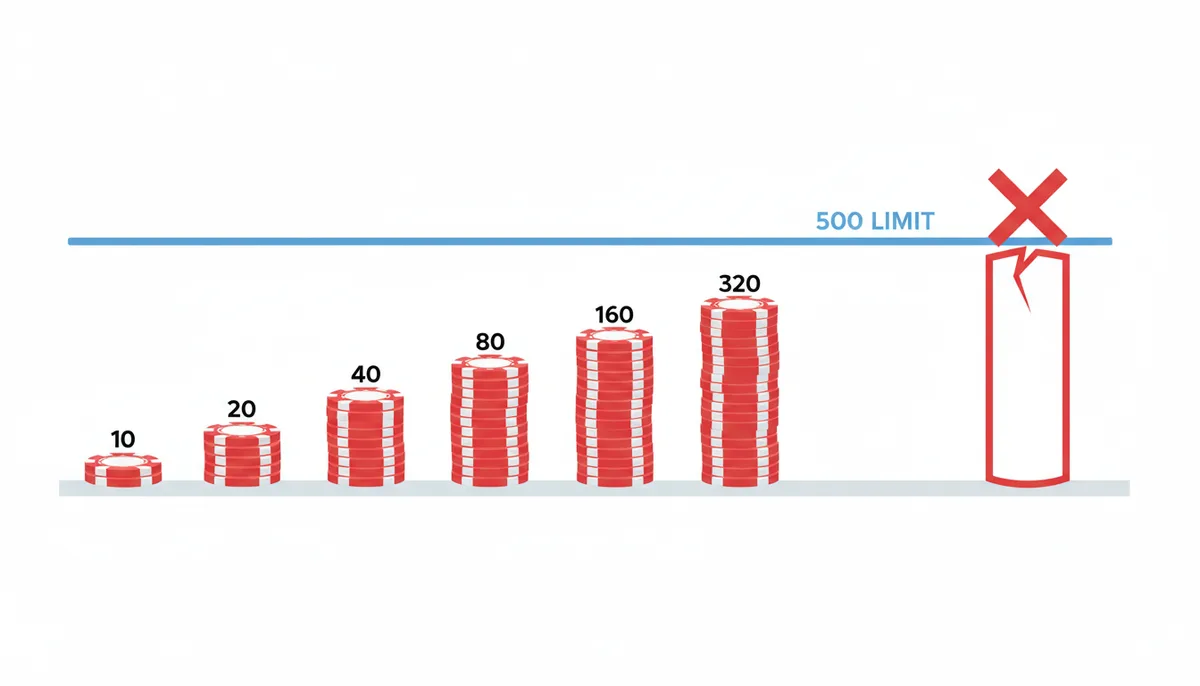
Put the two numbers together and you get a failure point. With a $10 base unit and a $500 maximum, you can survive six losses. Loss six requires a $320 bet and leaves you down $630. The next required bet is $640, which is above the $500 cap.
At that moment you’re blocked. You can’t place the bet that would recover your $630 loss plus one unit. You can either walk away locking in a $630 loss, or you can bet the maximum $500 and still be down $130 even if you win. The system’s promise is broken because the casino’s rule, not your luck, ended the sequence.
Change the base unit and the collision moves. A $5 base hits the $500 cap on the ninth loss. A $25 base hits it on the sixth loss. Smaller units only buy you a few extra steps, not safety.
Can a Massive Bankroll Defeat the Table Limit?
Bankroll helps you survive the streak, it doesn’t remove the ceiling. Once the required bet exceeds the table maximum, your personal wealth is irrelevant. The casino won’t let you bet it.
People often ask about probability. A losing streak of seven or eight in a row on European roulette is uncommon in a short session, but it’s not rare over hundreds of spins. The chance of any specific long streak is low, the chance of seeing a long streak at some point during extended play is high. That’s why simulations show the same pattern over and over.
If you have an unlimited bankroll and you could find a true no-limit table, you’d still be fighting the house edge. Table limits are the casino’s first line of defense, your bankroll is the second. Remove one and the other still kills the system.
What Is the Role of the House Edge?
Even without limits, Martingale loses. The house edge is the reason. European roulette has one zero, American roulette has zero and double zero. On an even-money bet the payout is 1 to 1, but the true odds are 18 in 37 or 18 in 38. That gap is the edge.
Expected Value is the average return per bet if you repeat it forever. Every even-money roulette bet has a negative EV. The Martingale doesn’t change EV, it changes variance. You get many small wins and occasional catastrophic losses. Over time the catastrophic losses outweigh the small wins because each bet carries the same negative expectation.
Think of it as reshaping risk, not removing it. You’re trading a high chance of a tiny profit for a small chance of a ruinous loss. That’s a bad trade for the player.
What Does a Martingale 'Risk of Ruin' Simulation Look Like?
Risk of Ruin simulations make the failure visible by running the same rules many times with stated assumptions. A clean, comparable setup is European roulette even-money, base bet $10, table minimum $10, table maximum $500, starting bankroll $1,000, and a bust condition defined as the required next bet exceeding $500 or exceeding the remaining bankroll. A cycle ends on the first win, at which point the profit is $10, or on a bust.
For European roulette the loss probability on an even-money bet is p = 19/37 ≈ 0.5135. With a $10 base the Martingale bets are 10, 20, 40, 80, 160, 320, 640… The $500 cap is hit after six consecutive losses. Cumulative loss after six losses is $630, and the seventh required bet of $640 cannot be placed.
The theoretical chance of that specific bust is p^6. 0.5135^6 ≈ 0.0183, about 1.8% per independent cycle. That means in 1,000 independent cycles you would expect about 18 busts, and in 10,000 cycles about 183 busts, all from six consecutive losses. Seven or more consecutive losses have lower individual probabilities and are also busts under the $500 cap.
| Consecutive losses | Next required bet | Cumulative loss if bust now | Theoretical probability of this streak |
|---|---|---|---|
| 1 | $20 | $10 | 0.5135 |
| 2 | $40 | $30 | 0.2637 |
| 3 | $80 | $70 | 0.1354 |
| 4 | $160 | $150 | 0.0696 |
| 5 | $320 | $310 | 0.0357 |
| 6 | $640 > $500 cap | $630 | 0.0183 |
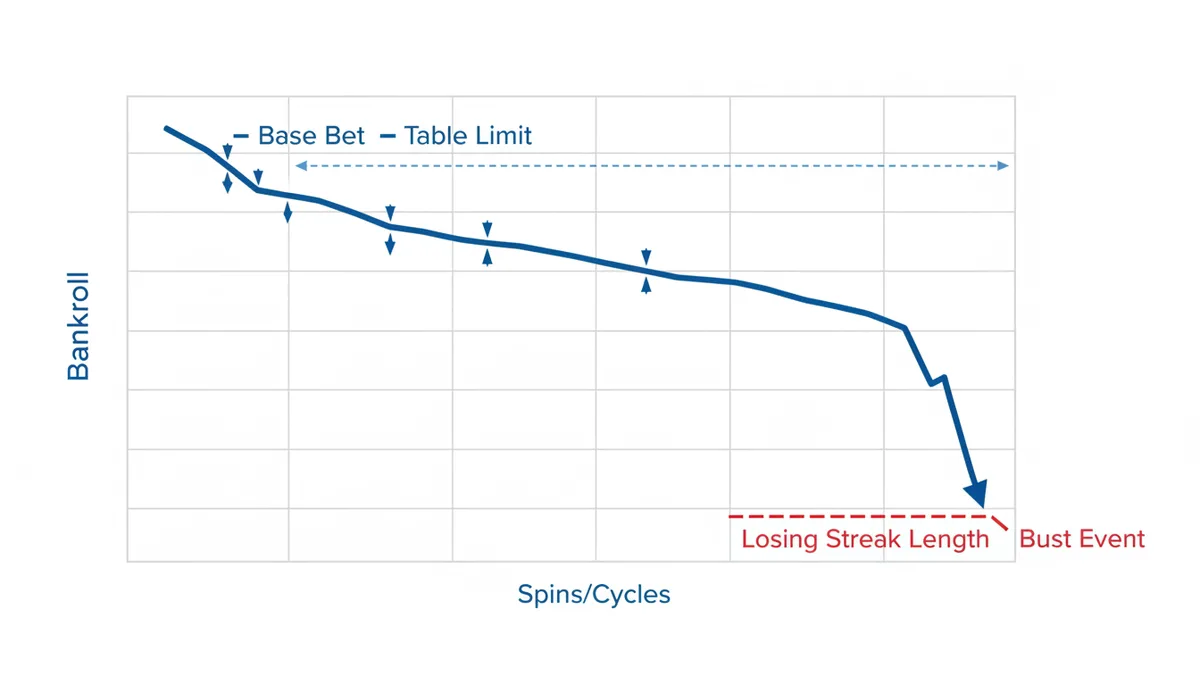
Most cycles finish with a +$10 win, so the bankroll chart climbs in small steps. The rare six-loss bust drops the bankroll by $630 in one cycle, erasing many prior wins. Because every bet carries the house edge, the long-run average bankroll drifts down even though the median after a short run of cycles often stays near the start. The SorteCalc Martingale Calculator lets you input the same base unit, table limit and bankroll to see where the break point lands for your numbers.
Are Milder Progression Systems a Safer Alternative?
People try D’Alembert, Labouchère and Fibonacci because they escalate slower. They’re still negative progression systems. They increase bets after losses, so they share the same core flaw.
| System | Progression Rule | Bet Escalation Speed | Primary Failure Point |
|---|---|---|---|
| Martingale | Double bet after each loss, reset after win | Exponential | Table limit or bankroll after 7 to 10 losses |
| D’Alembert | Increase bet by one unit after loss, decrease bet by one unit after win | Linear | Bankroll erosion over long losing streaks |
| Labouchère | Bet sum of first and last numbers in a sequence, cancel numbers on win, add loss to end | Moderate to fast depending on sequence | Sequence length pushes bet beyond limit |
D’Alembert grows slower, so it takes longer to hit a ceiling, but it still increases exposure when you’re losing. Labouchère can look elegant on paper, but a bad run lengthens the sequence until the next bet is unaffordable. None of them change the house edge. They just stretch the time to failure.
Why Do Casinos Have No Problem With Martingale Players?
Casinos love Martingale players because the math is on their side. The system creates the illusion of control and encourages larger average bets. Table limits were partly created to cap exposure to progressions like this, and they guarantee the casino can’t be forced into a payout it didn’t budget for.
Over a large sample, Martingale players produce many small wins for themselves and one large loss for the house to collect. The casino doesn’t need to cheat or change the wheel. The rules do the work. The player ends up funding the casino’s profit with a predictable pattern of small gains followed by a final, unrecoverable loss.
How Casinos Engineer Limits to Kill Progressions
A $10 to $500 roulette table isn’t random. That 50-to-1 spread is deliberate engineering. The minimum keeps the game moving and covers dealer time. The maximum caps how much a single player can lose the casino in one spin, and more importantly, how much a progression system can force the casino to pay back.
Casinos set the ratio so the max is reachable in about seven to nine doubling steps from the minimum. That is the sweet spot. Seven straight losses on a $10 base needs $640 next. Nine straight losses on a $5 base needs $1,280 next. If the max sits around $500 to $1,000, you hit the wall right where the cumulative loss becomes painful but not table-breaking for the house. They don’t need to ban Martingale, they just make it impossible to complete.
Limits also differ by bet type for a reason. Outside even-money bets often have higher maxes than inside straight-up bets, because the casino knows progression players cluster on red/black, odd/even, high/low. Inside bets are capped lower because a single hit pays 35 to 1. The house wants to control variance on both sides, and the max is the lever they pull.
What you see on the felt is the public number. In practice the limit is per outcome, per spin, per player. You can’t place $250 on red and $250 on black to make $500 work. You can’t spread one progression across three spots. The dealer will refuse the overage, and the floor will back them up. In busy rooms the effective max can drop even lower because the table is managing multiple players at once.
High-limit rooms change the numbers but not the principle. A $100 minimum to $10,000 maximum still gives you about seven doublings before you’re stuck. The ratio stays tight. Casinos will also move limits between day and night, or raise the minimum when a table gets crowded, which shortens your runway without changing the sign on the rail. The Nevada Gaming Control Board and the UK Gambling Commission don’t set table limits, individual operators do, and they set them to protect their own exposure.
A Real Session Walk-Through With Stakes You Can Touch
It’s 9:42 p.m. You buy in for $1,000 at a $10 to $500 roulette table. Base unit is $10. You’re playing red. The wheel spins about once per minute.
Spin 1: $10 on red. Black 17. Down $10. Next bet $20.
Spin 2: $20 on red. Zero. Down $30. Next bet $40.
Spin 3: $40 on red. Black 31. Down $70. Next bet $80.
Spin 4: $80 on red. Red 7. You win $80. You’re now up $10 for the cycle. You reset to $10.
That’s the story you remember. It happens a lot. Now the run you don’t want.
Spin 12: $10 on red. Black. Down $10.
Spin 13: $20 on red. Black. Down $30.
Spin 14: $40 on red. Black. Down $70.
Spin 15: $80 on red. Black. Down $150.
Spin 16: $160 on red. Black. Down $310.
Spin 17: $320 on red. Black. Down $630.
Spin 18: The system demands $640. The max is $500. You can’t place it. You can bet $500 and still be down $130 even if you win, or you can walk. Most people walk. You’re down $630 in eight minutes.
That $630 loss wipes out sixty-three winning cycles of $10 profit. You needed an hour of perfect small wins to build that, and eight minutes to lose it. The session ends at 10:04 p.m. You’re out of chips, you’re tired, and you tell yourself you’ll start smaller next time. Starting smaller only buys you a few more spins before the same wall arrives.
What Breaks First in Practice: Bankroll, Discipline, or the Rules
The math is clean. The table is not. In practice the system fails before the limit because the environment fights you.
Chip denominations make exact doubling messy. You have $5 and $25 chips, not $10, $20, $40. You’ll be short or over, and the dealer will round you down. Rounding down means you don’t fully recover losses when you finally win. You also can’t always get more chips fast enough. A runner takes a minute, and the table doesn’t wait. Miss a spin and your progression is broken.
Time pressure adds error. After four losses in a row your heart rate is up. You’re calculating the next bet while the dealer is paying out. You misplace a chip, you bet on the wrong color, you hesitate and the table moves on. Fatigue sets in after twenty minutes. You start taking the “one more spin” shortcut instead of resetting properly.
Zeros change the math in the moment. European roulette has one zero, American has two. A zero doesn’t just cost you the bet, it resets your progression with a loss that feels random. You get no chance to recover that spin, and it pushes you one step closer to the ceiling. Players often forget to account for this in their head math.
Casinos also have soft rules. If you’re slow, you get a warning. If you’re counting chips for two minutes between spins, the floor may ask you to speed up or leave. You can’t pause a progression. The system assumes perfect execution every time, and perfect execution is not how people behave under stress.
Martingale Against Flat Betting: Same Bankroll, Different Life Expectancy
Take $1,000 and a $10 bet. Flat betting gives you 100 bets before you’re broke, ignoring wins and losses. You’ll ride the variance up and down, but you’ll get hours of play and the house edge will grind slowly.
With Martingale $10 base, your life expectancy is different. You’ll win $10 most cycles. You might play 80 or 100 cycles and be up $800 to $1,000. That feels great. Then one eight-loss streak hits. You need $1,280 for the next bet and you can’t place it. You’re down $1,270. Your entire bankroll is gone in a few minutes.
The cost per hour is also higher. Flat betting at 60 spins per hour is $600 in total action. Martingale increases average bet size because you’re often betting more than base after losses. Your total action per hour climbs even when you’re winning small. More action means more exposure to the house edge, faster.
Risk of ruin is the real comparison. Flat betting with a $1,000 bankroll and $10 bets gives you a low probability of ruin in a single session, and you can walk away at any point. Martingale gives you a high probability of a small gain and a small probability of total ruin. That is a terrible risk reward profile for anyone who values their time and capital.
You don’t need a simulation to see it. The system forces you to bet big when you’re already losing. Flat betting forces you to bet the same when you’re winning or losing. One is a controlled bleed, the other is a controlled bleed with a hidden cliff.
FAQ
What if I find a 'no limit' table?
True no-limit even-money tables are extremely rare and usually carry very high minimums. Casinos can also impose discretionary limits on players they suspect of using progressions. Even without a table cap, you’re still limited by your own bankroll and the negative expected value of the game. Removing the table limit just moves the failure point to your personal ruin.
Can I use the Martingale system for sports betting?
You can try, but it’s worse. Bookmakers monitor betting patterns and can limit or close accounts that show systematic progression play. Your effective table limit can become zero without warning. Sports markets also don’t offer true even odds, the vig ensures a negative EV on every bet.
Is the 'Reverse Martingale' (doubling after a win) a better system?
The Reverse Martingale or Paroli system caps your risk to one unit per sequence because you only increase after wins. It still doesn’t beat the house edge. It relies on catching a winning streak, which is statistically unlikely to be long, and it leaves the bulk of your bankroll untouched during losses. Safer in the sense of smaller downside, not a winning strategy.
Why not just start with the smallest possible bet, like $1?
A $1 base on a $500 table lets you survive nine losses before the tenth bet of $512 is impossible. That’s more steps, but a nine-loss streak happens more often than intuition suggests over extended play. You’re just delaying the collision, not avoiding it, and you’re still exposing yourself to a $511 cumulative loss when it hits.
Does this apply to online casinos too?
Yes. Licensed online casinos publish table limits in the game rules. The software enforces the maximum bet automatically. The exponential growth of Martingale and the house edge are identical online. The only difference is the speed of play.
If Martingale is so bad, why is it so famous?
Because it’s simple and it feels like a hack. The logic of “double until you win” is easy to understand and psychologically satisfying. The mathematical proof of failure is less memorable than the story of a player who won five times in a row. Fame comes from appeal, not from results.
Sources
- Nevada Gaming Control Board — The existence and regulation of casino game rules and table limits as a standard industry practice for risk management.
- UK Gambling Commission — Information on regulations regarding fairness, transparency, and the display of rules, including betting limits, in licensed gambling operations.
- Stanford Encyclopedia of Philosophy — The fundamental concepts of probability theory, which underpin why a losing streak of sufficient length to break the Martingale is a statistical certainty over time.
- Encyclopaedia Britannica — The historical context and definition of the Martingale system as a betting strategy, establishing it as a well-known concept.