Poker Pot Odds: How to Know When a Call Is Profitable
2026-10-03 · 21 min · 4,138 words
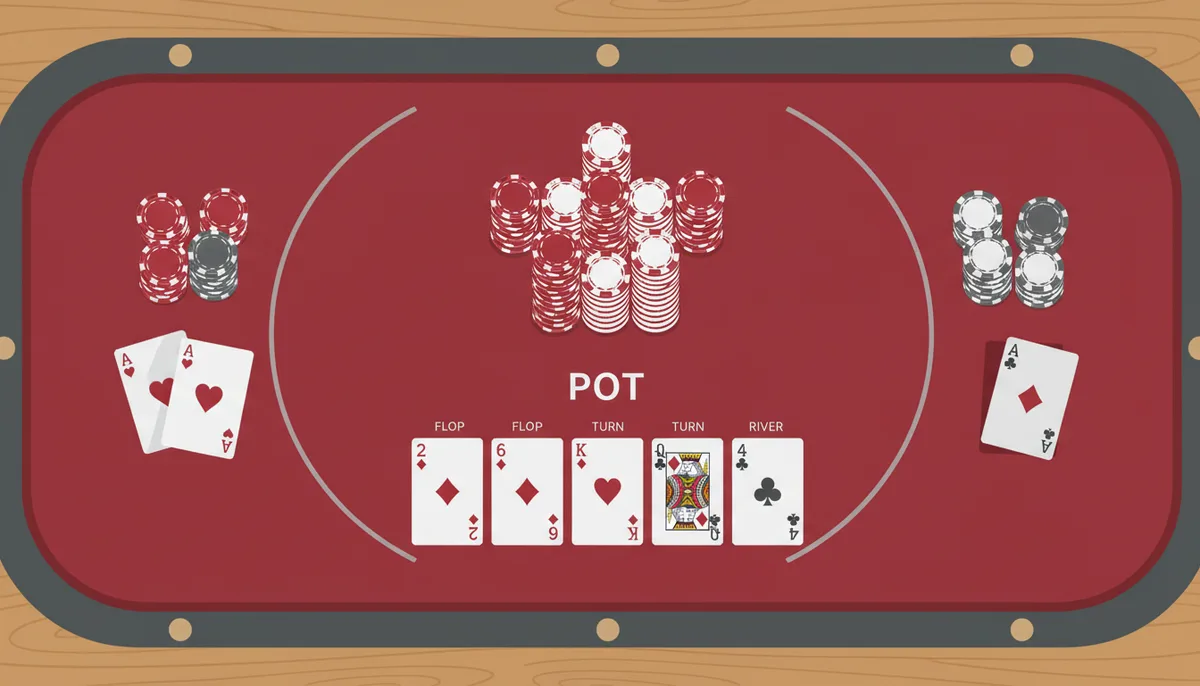
You're on the turn in a Texas Hold'em hand. The board shows two hearts, and you've got the Ace of hearts in your hand for a nut flush draw. Your opponent slides a bet of $50 into a pot that already holds $100. You feel the tension. Your gut tells you that you're "likely" to hit your card, or that your opponent is bluffing. You call, the river is a brick, and you fold. You just lost $50. If this happens once, it's a bad beat. If it happens every session, you're leaking money because you're playing by "feel" rather than by the numbers.
Most players treat poker like a guessing game of psychology. While reading an opponent is vital, psychology is a layer that sits on top of mathematics. If the math doesn't work, the most "convincing" bluff in the world doesn't make a call profitable. Pot odds are the mechanical foundation of every professional decision. They strip away the emotion and replace it with a simple risk-versus-reward framework: is the price I'm paying to see the next card lower than my chance of winning the hand?
You don't need to be a mathematician to master this. You don't even need a calculator at the table. You just need to understand a specific ratio and a few shortcuts. Once you stop guessing and start calculating, you stop wondering why your bankroll is shrinking and start understanding exactly where your profit comes from.
What Are Pot Odds? The Core Concept of Risk vs. Reward
At its simplest, pot odds are the ratio between the size of the pot and the size of the bet you must call. It's a price tag. When an opponent bets, they are offering you a price to "buy" the right to see the next card. Your job is to determine if that price is a bargain or a rip-off.
Think of it like a lottery ticket. Imagine a ticket costs $1, but the prize is $10. If you know for a fact that you have a 20% chance of winning, you should buy that ticket every single time. Why? Because if you bought 100 tickets, you'd spend $100, but you'd win 20 times. Those 20 wins would pay out $200 (20 * $10 prize), leaving you with a $100 profit. Even though you'll lose 80% of the time, the 20% of the time you win pays for all the losses and leaves you with a massive profit. That is exactly how pot odds work in poker.
In poker, we express these odds in two ways. The first is as a ratio, such as 3:1. This means for every $1 you put into the pot, you stand to win $3. The second is as a percentage, such as 25%. This is the "break-even" point. If you have a 25% chance of winning the hand, and the pot odds are 3:1, you are exactly breaking even. If your chance of winning is 30%, you're making a profit. If it's 20%, you're losing money in the long run.
You'll find that pros often switch between these two. Ratios are easier to see instantly on the table; percentages are easier to compare against your hand's actual equity. To make a decision, you must be able to translate one into the other.
How to Calculate Pot Odds in 3 Simple Steps
Calculating pot odds doesn't require a degree in algebra. It's a three-step process of addition and division. The mistake most beginners make is forgetting to include the opponent's current bet in the "total pot" before calculating the ratio.
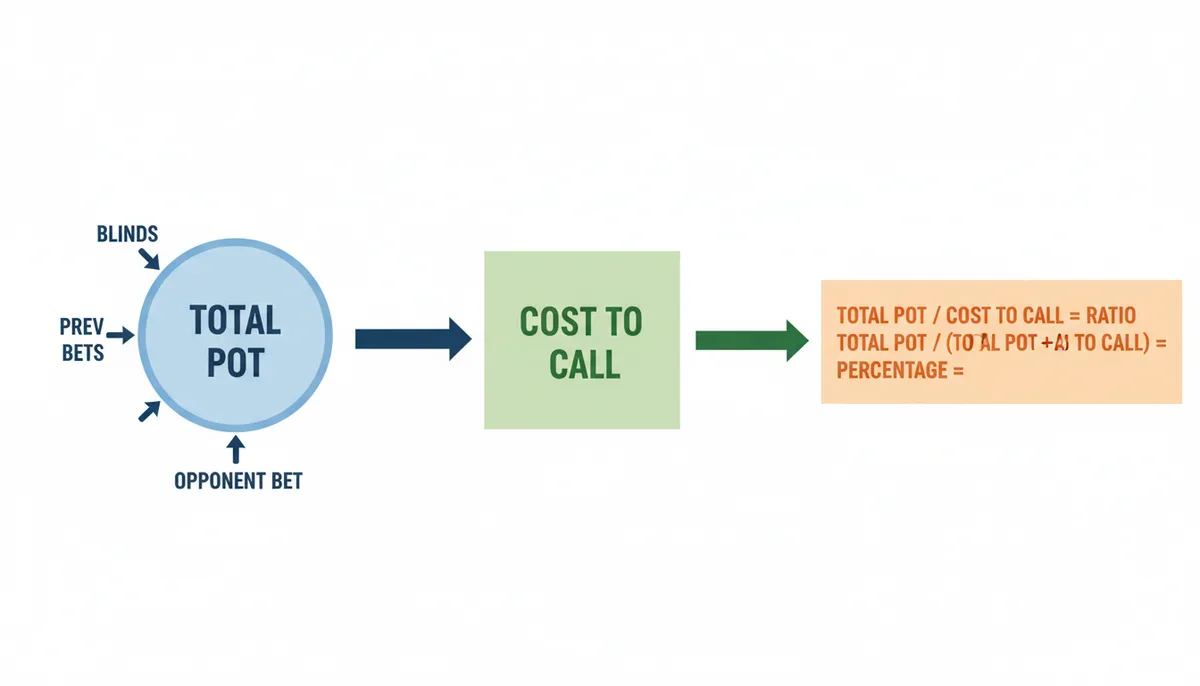
Step 1: Calculate the Total Pot Size
Sum up everything currently in the middle. This includes the blinds, any bets from previous streets (flop, turn), and the bet your opponent just placed. If the pot was $100 and your opponent bets $50, the total pot is now $150.
Step 2: Identify the Cost to Call
This is the specific amount of money you need to put in to stay in the hand. In the example above, the cost to call is $50.
Step 3: Create the Ratio and the Percentage
First, the ratio: Total Pot / Cost to Call. Using our numbers: $150 / $50 = 3. Your pot odds are 3:1.
Now, convert that to a percentage to find your "required equity." The formula is: Cost to Call / (Total Pot + Cost to Call). In our case: $50 / ($150 + $50) = $50 / $200 = 0.25, or 25%.
This 25% is your threshold. If your hand has more than a 25% chance of becoming the best hand, you call. If it has less, you fold. If you call with 20% equity when you need 25%, you aren't "unlucky" when you lose; you're making a mathematically incorrect play that will drain your stack over time.
The Other Side of the Equation: Calculating Your Hand's Equity
Pot odds tell you the price. Equity tells you if you can afford it. In poker, equity is your percentage chance of winning the pot based on the cards remaining in the deck. To find your equity, you first need to count your "outs."
Outs are the cards left in the deck that will improve your hand to a winning position. For example, if you have four hearts in your hand and on the board, there are 13 hearts in a deck. You see four of them, so there are 9 hearts left. Those 9 cards are your "outs."
Counting outs varies by draw:
- Flush Draw: 9 outs (13 total hearts - 4 already seen).
- Open-Ended Straight Draw (OESD): 8 outs (e.g., you have 8-9, board is 6-7-2; any 5 or 10 gives you the straight).
- Gutshot Straight Draw: 4 outs (e.g., you have 8-9, board is 6-10-2; only a 7 gives you the straight).
- Two Overcards: 6 outs (e.g., you have A-K on a 2-7-J board; any Ace or King might give you the best hand, though this is riskier as it doesn't guarantee a win).
Once you have your outs, you need to convert them into a percentage. Doing full division at the table is too slow. Instead, use the Rule of 2 and 4. This is a professional shortcut that is accurate enough for almost every situation.
The Rule of 2 and 4:
- On the Flop: If you want to know your chance of hitting your draw by the river (two cards to come), multiply your outs by 4. (Example: 9 outs * 4 = 36% equity).
- On the Turn: If you are looking for the chance of hitting on the final card (one card to come), multiply your outs by 2. (Example: 9 outs * 2 = 18% equity).
| Draw Type | Number of Outs | Equity on Turn (Outs x 2) | Equity from Flop to River (Outs x 4) |
|---|---|---|---|
| Flush Draw | 9 | 18% | 36% |
| Open-Ended Straight | 8 | 16% | 32% |
| Gutshot Straight | 4 | 8% | 16% |
| Two Overcards | 6 | 12% | 24% |
| Set Mine (Pocket Pair) | 2 | 4% | 8% |
The Golden Rule: Comparing Pot Odds to Equity
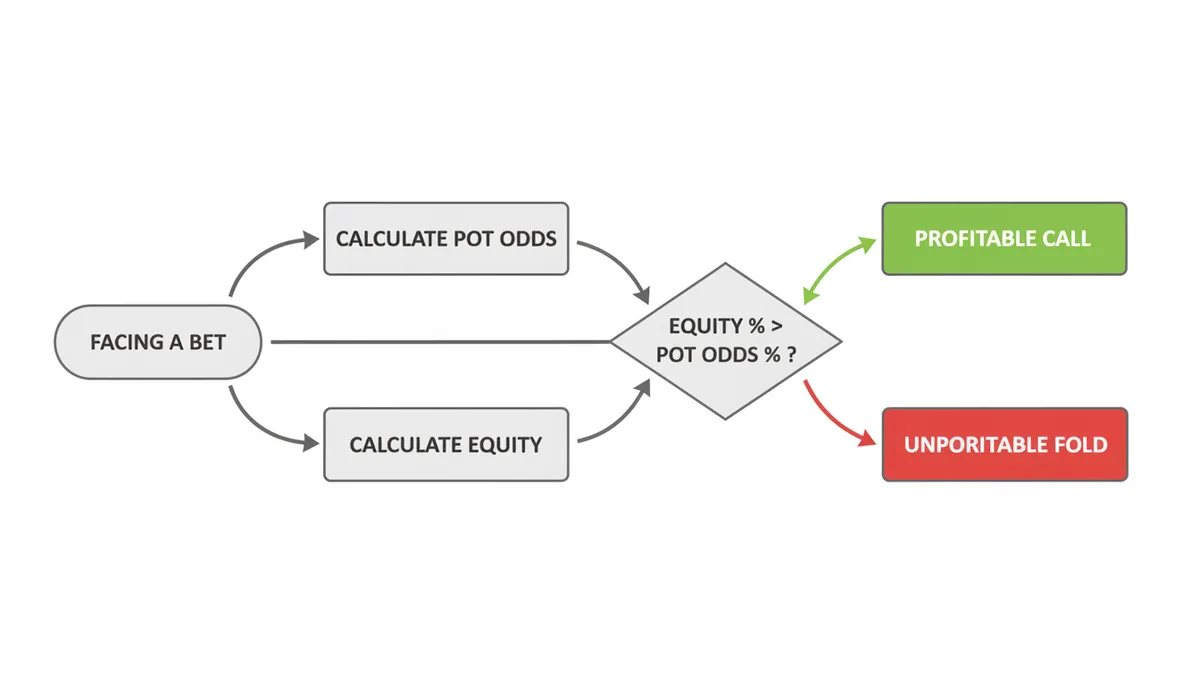
Now we bring the two halves together. The decision to call, fold, or raise is based on a single comparison: Is my Equity % > Pot Odds %?
If the answer is yes, the call is +EV (Positive Expected Value). This means that if you played this exact scenario 1,000 times, you would end up with more money than you started with. If the answer is no, the call is -EV. You are paying more for the "ticket" than the ticket is worth.
A Worked Example:
You are playing a cash game. The pot is $60. Your opponent bets $40. You have a flush draw (9 outs) and it is currently the turn.
- Calculate Pot Odds: Total pot is $60 + $40 = $100. Cost to call is $40.
Ratio: 100:40, which simplifies to 2.5:1.
Percentage: 40 / (100 + 40) = 40 / 140 = 28.5%. - Calculate Equity: You have 9 outs on the turn. Using the Rule of 2: 9 * 2 = 18%.
- Compare: Your equity (18%) is significantly lower than the required pot odds (28.5%).
The Decision: Fold. Despite having a strong draw, you are not getting a good enough price to justify the call. If you call here, you are effectively "donating" the difference in equity to your opponent over the long term.
Crucially, you must detach yourself from the result of a single hand. You could make this "correct" fold and then see your opponent show a total bluff. You might feel like you "should" have called. But poker is a game of aggregated decisions. The goal isn't to win every pot; it's to make decisions that have a positive expectation. If you consistently call when your equity is higher than the pot odds, the math guarantees you will profit, regardless of whether you lose the next three hands.
Common Scenarios: Pot Odds in Action
To build an intuition for these numbers, you need to see how they shift based on bet sizing. A "half-pot" bet and a "full-pot" bet change the mathematics of your draw entirely.
Take the flush draw (9 outs) on the turn. Your equity is roughly 18%.
- If your opponent bets half the pot: The pot odds are 3:1 (25%). You need 25% equity to call. You only have 18%. Fold.
- If your opponent checks and you bet, or if the pot was already massive: If the pot odds were 5:1 (16.6%), you only need 16.6% equity. Now, your 18% equity makes the call Profitable.
This is why bet sizing is a weapon. By betting larger, an opponent "prices you out" of your draw. They are intentionally making the pot odds higher than your equity so that you are forced to fold or make a mathematical mistake by calling.
Another critical application is set mining. This happens pre-flop. You hold a pocket pair (like 2-2) and face a raise. You aren't calling because a pair of twos is the best hand; you're calling because you want to hit a set (three of a kind) on the flop. The odds of hitting a set are roughly 11.8% (or about 7.5:1). If the cost to call the raise is small compared to the effective stacks of the players, you have the "implied odds" to call. If the raise is massive and the stacks are shallow, the direct pot odds are not there, and calling becomes a mistake.
| Draw Type | Equity on Turn | Call 1/2 Pot Bet? (25%) | Call 3/4 Pot Bet? (30%) | Call Full Pot Bet? (33%) |
|---|---|---|---|---|
| Flush Draw (9 outs) | 18% | Incorrect | Incorrect | Incorrect |
| OESD (8 outs) | 16% | Incorrect | Incorrect | Incorrect |
| Gutshot (4 outs) | 8% | Incorrect | Incorrect | Incorrect |
| Open-Ended (Flop to River) | 32% | Correct | Correct | Incorrect |
Going Deeper: Implied Odds & Reverse Implied Odds
Direct pot odds only look at the money currently in the pot. But poker doesn't end on the turn. Implied Odds are the additional bets you expect to win on future streets if you hit your draw.
Implied odds turn "mathematically incorrect" calls into winning plays. Let's go back to the flush draw example: you need 28.5% equity, but you only have 18%. On a purely direct-odds basis, you fold. However, if your opponent is a "calling station" (someone who hates folding) and has a huge stack of chips, you know that if the heart hits on the river, you can bet big and they will likely call. That potential future profit "implies" that the call on the turn is actually profitable.
To evaluate implied odds, consider these three factors:
1. Stack Depth: If both you and your opponent have $1,000 behind, the implied odds are massive. If you only have $20 left, implied odds are irrelevant because there's no more money to win.
2. Opponent Tendencies: Does the player fold to aggression? If they do, your implied odds drop because they'll fold the moment the obvious flush card hits. If they are aggressive or stubborn, your implied odds rise.
3. Hand Visibility: Is your draw "hidden"? A gutshot straight is often more valuable than a flush draw because the board doesn't scream "STRAIGHT" as loudly as it screams "FLUSH." If the opponent doesn't realize you've hit, they are more likely to pay you off.
However, there is a dark side: Reverse Implied Odds. This occurs when you hit your hand, but that very hit makes you second-best. The classic example is a low flush. You hit your heart flush, feeling confident, and bet big—only to find out your opponent has the Ace-high flush. You've hit your card, but because your hand is "strong but not the strongest," you end up losing a massive pot. When you face reverse implied odds, you must tighten your requirements and be wary of calling draws that aren't the "nuts" (the absolute best possible hand).
How Game Type and Format Change Your Calculations
The math of pot odds is universal, but the application changes based on the game you're playing.
No-Limit Hold'em vs. PLO (Pot Limit Omaha)
In Hold'em, you have two cards. In PLO, you have four. This drastically increases the number of outs you'll typically have, but it also increases the "strength" required to win. In PLO, "naked" draws (drawing to a single pair or a weak straight) are almost always -EV because the probability that someone else has a better version of that same hand is much higher. In PLO, you generally only call based on pot odds if you have "wrap" draws or nut-draws. The multi-way nature of PLO pots often means you're getting incredible pot odds (e.g., 5:1 or 6:1), but your equity is split between more players.
Cash Games vs. Tournaments
In a cash game, a chip is exactly equal to its monetary value. If the math says call, you call. In tournaments, the ICM (Independent Chip Model) changes the math. Because your survival is often more valuable than the chips you gain, you cannot treat tournament chips as having linear value. In the bubble phase of a tournament, you might fold a hand that has a "mathematically profitable" call in a cash game because the risk of busting out (and losing your chance at the prize money) outweighs the chip gain. In tournaments, you need a "buffer" of equity above the pot odds to justify a call.
Fixed-Limit Games
In limit games, the bet sizes are constant. This removes the "pricing out" strategy used in No-Limit. Because the bets are predictable, the pot odds are often similar across many hands. This makes the game more about precise equity calculations and less about exploiting bet sizing.
From Theory to Practice: Tools and Drills to Master Pot Odds
You will not become a proficient calculator by reading this article once. You need to move these calculations from your conscious mind (where they are slow) to your subconscious (where they are instant). The goal is for you to look at a $50 bet into a $100 pot and instantly think "25%," without doing the division.
The most important tool in your real-time arsenal remains the Rule of 2 and 4. Use it for every single draw you face. Even if you think you know the answer, run the numbers: "9 outs, turn, 18%."
For off-table study, use a poker equity calculator. The SorteCalc Poker Equity Calculator allows you to input your hand and the board to see your exact percentage of winning against a specific hand or a range of hands. This is where you bridge the gap between the "shortcut" (18%) and the "truth" (e.g., 17.4%).
The "Post-Game Review" Drill:
1. Save a hand history of a session you recently played.
2. Find every instance where you called a bet on the flop or turn.
3. Manually calculate the pot odds you were given at that moment.
4. Use an equity calculator to find your actual winning percentage for that hand.
5. Compare the two. If you called with 15% equity when the pot odds required 25%, mark that as a "leak."
If you do this for 50 hands, you'll identify the exact point where your intuition is failing you. Most players find they are far too loose with "gutshot" draws and overvalue "two overcards." Once you see the data, the habit of folding those -EV spots becomes much easier to maintain.
The Psychology of the 'Sunk Cost' Fallacy in Pot Odds
One of the most frequent mistakes players make is letting the "Sunk Cost Fallacy" override their pot odds calculations. This happens when you've already put a significant amount of money into a pot—perhaps you've bet the flop and the turn—and you face a massive river bet. You feel "invested" in the pot. You tell yourself, "I've already put $200 in here, I can't just fold now."
From a mathematical perspective, the money you have already contributed to the pot is gone. It no longer belongs to you; it belongs to the pot. The only two numbers that matter for your decision are the current cost to call and your current equity. Whether you put $10 or $1,000 into the pot on previous streets has zero impact on whether a call on the river is profitable. If you have 10% equity and the pot odds require 20%, folding is the only correct play, regardless of how much you've already "invested."
This fallacy often leads to "calling stations" who chase draws into the river even when the price is absurd. Consider this scenario: you have a flush draw on the turn. You call a $50 bet. The river is a brick. Your opponent bets another $100. The pot is now $250. You need to call $100 to win $350. Your pot odds are 3.5:1, requiring about 22% equity. But your equity is now 0%—the river has already fallen, and you missed. Many players call here because they feel they "deserved" to hit after paying for the turn call. This is a critical leak. The turn call was a purchase of a chance; once that chance is gone, the "investment" is reset to zero.
To combat this, you must treat every street as a brand-new hand. When you face a bet on the river, ignore the history of the hand. Ask only: "Based on the current pot and my current hand strength, is this call profitable?" If the answer is no, the most professional move you can make is to fold a pot that you've spent the last ten minutes building. The ability to walk away from a large pot when the math fails is what separates a winning player from a gambler.
Advanced Edge Case: Fold Equity and the 'Semi-Bluff'
Pot odds tell you if it's profitable to call, but they don't tell you the whole story when you're the one acting. This is where we introduce Fold Equity: the probability that your opponent will fold if you raise, allowing you to win the pot immediately without needing to hit your draw.
When you combine pot odds (your chance of winning if the cards fall your way) with fold equity (your chance of winning if the opponent folds), you are "semi-bluffing." This is the most powerful tool in a professional's arsenal because it gives you two ways to win. If you simply call based on pot odds, you only win if you hit your outs. If you raise, you can win by hitting your outs OR by forcing the opponent to fold.
Worked Example: The Semi-Bluff Calculation
You have an open-ended straight draw (8 outs, ~16% equity on the turn) in a $100 pot. Your opponent bets $50.
- If you call: You spend $50 for an 18% chance to win. As we established, this is a -EV call based on direct pot odds.
- If you raise to $200: You are now risking an additional $150 to win the $150 currently in the pot. Now, you add fold equity. If there is a 30% chance the opponent folds to your raise, your total equity isn't just 18%; it's 18% (hitting the card) + 30% (opponent folding). Your "effective equity" jumps to 48%.
This transforms a losing call into a highly profitable raise. However, this depends on a critical variable: opponent elasticity. If you are playing against a "calling station" who never folds any pair, your fold equity is 0%. In that case, semi-bluffing is just a way to lose money faster. If you are playing against a tight, cautious player, your fold equity is high, and raising is significantly more profitable than calling.
The trade-off here is risk. By raising, you increase the variance of your game. You are putting more money at risk on a hand that is currently weak. But for a professional, this is a calculated trade. You are accepting the risk of a larger loss in exchange for a higher frequency of winning the pot. When you use the SorteCalc Fold Equity Calculator, you can model these exact scenarios to see how much fold equity you need to make a semi-bluff profitable compared to a standard call.
FAQ
Do I need to calculate pot odds exactly for every hand I play?
No. Trying to do long division while your opponent is staring at you will slow down your game and make you anxious. The goal is to use shortcuts like the Rule of 2 and 4 to get a "close enough" estimate. Exact calculations are for when you're studying your hand histories off-table to build your intuition. At the table, being 2% off is fine; being 20% off is the problem.
How do pot odds work when multiple players are in the pot?
The basic calculation remains the same: you compare the cost of your call to the total size of the pot. In multi-way pots, the pot odds are usually much better (you're risking less to win more). However, the "catch" is that your equity usually drops. With more players, the chance that someone already has you beaten or will hit a better hand increases. You generally need a stronger draw (like the nut flush draw rather than a low flush draw) to justify calling in a multi-way pot.
What's the difference between pot odds and pot equity?
Pot odds are the price. It's the ratio of the reward to the risk (e.g., "The pot is offering me 3:1"). Pot equity is your chance of winning (e.g., "I have a 20% chance to hit my straight"). You compare the two: if your equity (the chance of winning) is higher than the price you're paying, the call is profitable.
Are implied odds more important than direct pot odds?
In deep-stacked games, they often are. Direct pot odds tell you if a call is profitable based only on the money currently on the table. Implied odds factor in the money you'll win on the river if you hit. If you're playing a game with very deep stacks, a call that looks "wrong" based on direct odds can be a goldmine because of the massive amount of money you can extract from your opponent once you hit your winning card.
How do pot odds apply before the flop?
The principle is the same—cost to call vs. total pot—but the variables are fuzzier. Pre-flop, you don't have a "draw" to a specific card; instead, you have "equity" based on your hand's strength against your opponent's range (all the possible hands they might have). For example, pocket Jacks have high equity against a range of "any two cards," but low equity against a range of "only pocket Queens or better."
What are 'reverse implied odds'?
Reverse implied odds are the opposite of implied odds. They represent the money you are likely to lose on future streets even if you "hit" your hand. This happens when your made hand is strong but is likely second-best. If you hit a small flush on a board where a larger flush is possible, you may find yourself betting into a hand that dominates you, turning a "winning" card into a way to lose your entire stack.
Sources
- David Sklansky, "The Theory of Poker" — This book is the canonical source for foundational poker concepts, including the formalization of pot odds, implied odds, and the Fundamental Theorem of Poker. We are citing the concepts he popularized.
- Card Player Magazine — Standardized poker terminology, hand rankings, and rules of games like Texas Hold'em and Omaha, which are necessary context for any pot odds discussion.